
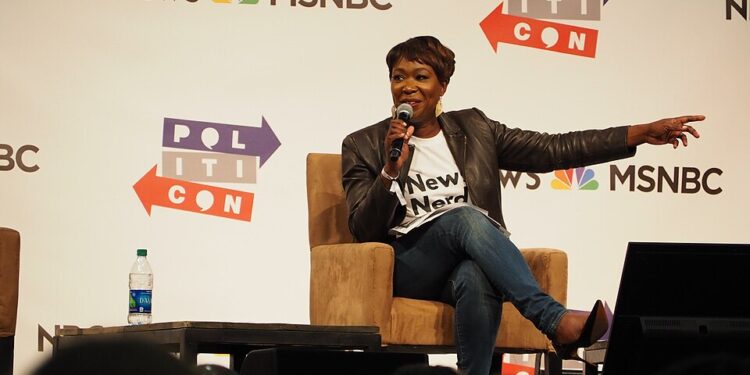
Former cable news host Joy Reid is drawing attention after making sweeping accusations about Black Republicans, claiming that Black conservatives must demean other Black Americans to gain acceptance and influence within the conservative movement.
Reid made the remarks Sunday during an appearance on progressive podcaster Jack Cocchiarella’s show. During the discussion, she argued that the Republican political establishment is eager to promote emerging Black conservative voices — but alleged that there is a price for receiving that support.
“In order to get that boost from the right, you have to humiliate your own people,” Reid said.
She went even further, accusing some Black conservatives of displaying “disdain” for other Black Americans and promoting what she characterized as “self-hate.”
The remarks immediately raise a broader question that has become increasingly important in American politics: Can Black voters and political leaders embrace conservative ideas without having their motives or character questioned?
Joy Reid Targets Black Conservatives
Reid’s argument was not limited to disagreements over Republican policies.
Instead, she portrayed the success of some Black Republicans as being connected to their willingness to criticize other members of the Black community.
That is a significant accusation, particularly as Republicans continue trying to broaden the party’s appeal among Black and minority voters.
Reid also connected her criticism directly to President Donald Trump and his political movement.
“MAGA Trumpism is about humiliation, and that’s not just about Black folks,” Reid said.
Her comments come amid an ongoing national debate over race, political identity and whether either major political party should be able to take the support of any demographic group for granted.
Black Americans have historically supported Democratic presidential candidates by large margins. However, Black conservatives have maintained a visible presence in Republican politics, conservative media, business and grassroots organizations.
Those conservatives often argue that their political beliefs are based on issues such as economic opportunity, religious freedom, public safety, school choice, lower taxes and limited government — rather than racial identity.
Byron Donalds Singled Out
Florida Republican Rep. Byron Donalds became one of Reid’s primary targets.
Reid referenced controversial remarks Donalds previously made while discussing Black families during the Jim Crow era. She portrayed his comments as suggesting that Black Americans had been better off under slavery and segregation.
Donalds has strongly denied ever making that argument.
The original controversy dates to 2024, when Donalds discussed changes in Black family structure and political affiliation.
“You see, during Jim Crow, the Black family was together,” Donalds said.
He continued by arguing that more Black Americans had previously held conservative political views before discussing changes associated with the Lyndon Johnson era.
Critics attacked the comments, arguing that Donalds was presenting an overly favorable picture of one of the darkest periods of American history.
Donalds responded that his remarks were being distorted.
“They’re trying to say that I said Black people were doing better under Jim Crow. I never said that. They are lying,” Donalds said.
That context matters.
Jim Crow laws imposed government-enforced racial segregation and discrimination across parts of the United States for decades. Donalds has not disputed that history. His defense was that he had been discussing Black family structure and political trends rather than endorsing segregation or claiming that Jim Crow itself benefited Black Americans.
The dispute demonstrates how quickly disagreements about race and history can become politically explosive.
Reid Claims Black Republicans Must “Excuse Slavery”
Reid then broadened her criticism beyond Donalds.
She alleged that Black conservatives seeking political influence, elected office or success in conservative media may be expected to “excuse slavery” in order to advance.
“To me, the amount of humiliation that you have to suffer isn’t worth the boost you get from the right,” Reid said.
She then accused some people of being “thirsty for that boost.”
The comments move beyond a traditional disagreement over Republican policies and instead question the motivations of Black Americans who identify as conservative.
For many conservatives, that is precisely the problem.
Americans routinely argue that voters should be judged as individuals rather than being expected to support a particular political party because of their race, sex, religion or background.
Black Republicans represent a relatively small but politically significant part of the GOP coalition, and Republicans have increasingly competed for Black voters by focusing on economic concerns, crime, education, entrepreneurship and social issues.
Democrats counter that their positions on health care, voting rights, economic programs and civil rights better represent the interests of Black Americans.
Those are legitimate political disagreements voters can evaluate for themselves.
Questioning whether someone respects his or her own community simply because that person reaches a different political conclusion takes the debate in a far more personal direction.
The Growing Battle Over Black Voters
The controversy also reflects a larger political battle taking place across America.
For decades, Democrats have enjoyed a substantial advantage among Black voters in presidential and congressional elections.
Republicans, however, have increasingly argued that no political party should consider any group of Americans permanently locked into its coalition.
Conservative leaders have sought to appeal to Black voters by emphasizing inflation, small-business ownership, employment, criminal justice, border security, religious values and parental control over education.
Democrats have responded by emphasizing issues including voting rights, health care, economic assistance, abortion rights and anti-discrimination policies.
The result is a genuine debate over which political philosophy offers better opportunities for American families.
That debate becomes much more contentious when disagreements over policy turn into accusations about a person’s racial loyalty.
Reid Launches Broader Attack on Capitalism
Reid did not restrict her criticism to Trump, Republicans or the conservative movement.
She also attacked capitalism itself.
Reid described conservatism as centered around “cruelty” and argued that capitalism operates according to a “dog eat dog” philosophy.
Her description is sharply different from the way free-market advocates view the American economic system.
Supporters of capitalism argue that private property, entrepreneurship, competition and individual economic freedom have allowed millions of Americans from vastly different backgrounds to create businesses, accumulate wealth and improve their standard of living.
Critics of capitalism argue that markets can produce substantial inequality and that government intervention is necessary to provide greater economic security.
That disagreement has existed throughout modern American political history, but Reid’s remarks show how fundamental the divide between progressives and conservatives remains.
Politics or Personal Attacks?
There is nothing unusual about Joy Reid disagreeing with Republicans.
Political commentators make their careers challenging politicians and ideologies they oppose.
What makes these remarks different is that Reid appeared to question why Black Americans become conservatives in the first place.
Rather than simply arguing that conservative policies are wrong, she suggested Black Republicans may be willing to demean their own community to receive political recognition.
Black conservatives would undoubtedly reject that characterization.
They have the same right as every American to decide which candidates, policies and political philosophy best represent their beliefs.
Voters can strongly disagree with Byron Donalds, Donald Trump or any other Republican without assuming that race determines what someone is supposed to believe.
The Bigger Question for American Voters
The controversy surrounding Reid’s remarks ultimately reaches beyond one television personality or one Republican congressman.
It touches on a fundamental principle of American democracy: individual political choice.
Should Americans be free to support Republicans, Democrats or neither party without having their racial identity questioned?
As Republicans and Democrats compete for Black voters, both parties will have to make their case on issues that directly affect families — including the economy, taxes, education, crime, immigration, health care and the cost of living.
Those are debates worth having.
Whether accusations of “self-hate” and racial disloyalty contribute anything useful to that debate is something voters can decide for themselves.