
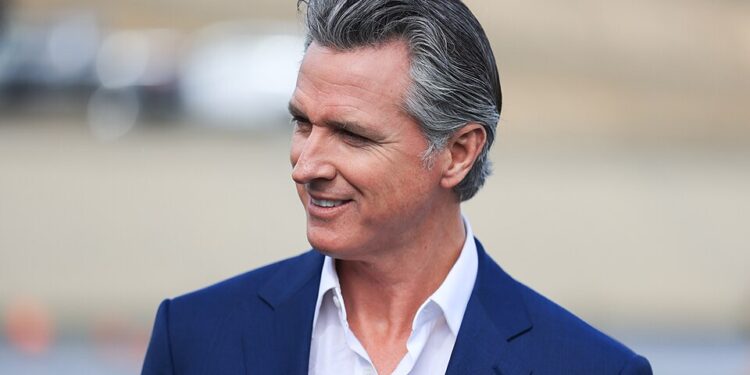
California Gov. Gavin Newsom has spent months fueling speculation about a possible 2028 presidential campaign, but one closely watched prediction market is showing a dramatic decline in confidence about his chances of reaching the White House.
Newsom’s presidential ambitions have not literally been canceled. However, his falling numbers on Polymarket are raising new questions about where the California Democrat stands in an increasingly competitive field of potential 2028 candidates.
According to Polymarket, Newsom’s chance of winning the 2028 presidential election fell to approximately 7% Thursday morning, a level the prediction platform described as an all-time low for the governor.
That represents a significant reversal from October of last year, when Newsom’s chances on the platform were approximately 22%.
The numbers are particularly noteworthy because Newsom has continued making appearances outside California, including visits to politically important states such as Michigan and South Carolina.
Those appearances have added to speculation that the governor is positioning himself for a possible campaign after President Donald Trump’s current term ends.
But the early numbers suggest Newsom would face plenty of competition.
Newsom Falls As Other Democrats Gain Ground
While Newsom has lost ground on the prediction market, other prominent Democrats have moved in the opposite direction.
Rep. Alexandria Ocasio-Cortez of New York recently reached approximately 13% on Polymarket, while Georgia Sen. Jon Ossoff stood near 12%.
Those figures placed both Democrats ahead of Newsom on the platform.
That doesn’t necessarily mean Democratic primary voters have reached the same conclusion.
Prediction markets and traditional political polls measure different things. Prediction markets reflect the positions taken by traders, while public-opinion surveys attempt to measure the preferences of selected groups of voters.
With the 2028 election still years away, both can change substantially.
Nevertheless, Newsom’s decline provides another indication that the Democratic presidential field remains far from settled.
Could California Become Newsom’s Biggest 2028 Challenge?
If Newsom ultimately runs for president, his record governing California would almost certainly become one of the defining issues of his campaign.
California is home to one of the world’s largest economies and remains a dominant force in technology, agriculture and venture-capital investment.
Newsom regularly highlights those strengths when defending his record.
During a Thursday press conference in Marin County, the governor was asked whether his association with California could become a liability in a national election.
Newsom rejected that argument and pointed to California’s economic accomplishments, agricultural production, minimum-wage policies and investment activity.
“We’re proud of that,” Newsom said.
Republicans would likely focus on a very different set of issues.
California has faced persistent concerns involving housing affordability, homelessness, taxes, regulations and the overall cost of living. Those subjects have already become central to the national political debate surrounding Newsom.
If he enters the 2028 presidential race, voters could hear two dramatically different versions of California’s record.
Newsom and his supporters would likely present the state as an economic and technological powerhouse.
His political opponents would likely argue that California’s affordability and homelessness problems demonstrate the weaknesses of its governing approach.
That debate could become especially important in competitive states where independent and swing voters may be less familiar with Newsom’s record.
JD Vance Leads The Prediction Market
The early 2028 conversation isn’t limited to Democrats.
Vice President JD Vance has emerged as one of the most prominent Republican names being discussed as a potential successor to Trump.
On Polymarket, Vance recently stood at approximately 24%, putting him ahead of the other potential candidates listed in the presidential market.
Secretary of State Marco Rubio was around 9%.
Those numbers should not be interpreted as election results or conventional polling. The presidential election remains more than two years away, and the eventual Republican and Democratic fields have not been determined.
Still, the numbers offer a snapshot of where prediction-market traders are currently putting their money.
Democratic 2028 Race Remains Wide Open
Newsom’s declining prediction-market numbers come as Democrats continue debating the future direction of their party.
Former Vice President Kamala Harris has remained prominent in early Democratic primary polling, while Newsom has frequently appeared near the top of potential candidate lists.
At the same time, interest has increased around Ocasio-Cortez, Ossoff and former Transportation Secretary Pete Buttigieg.
The rise of progressive candidates in Democratic primaries has also fueled speculation about whether Ocasio-Cortez could eventually pursue the presidency.
That could create an ideological contest inside the Democratic Party over what kind of candidate should lead the ticket in 2028.
Newsom would enter such a race with significant advantages, including national name recognition, fundraising connections and years of experience governing the nation’s most populous state.
But those strengths would also come with vulnerabilities.
His opponents would have an extensive California record to scrutinize, including policies involving taxes, energy, housing, crime, immigration, environmental regulation and government spending.
Polls Tell A Different Story
There is another reason to avoid writing Newsom off based solely on prediction-market activity: traditional polling has generally painted a more competitive picture.
Recent Democratic presidential primary surveys have continued to place Newsom among the party’s recognizable potential contenders.
Some recent polling has shown Harris leading prospective Democratic fields, with Newsom remaining within the upper tier of possible candidates.
That difference demonstrates why early prediction-market numbers should be viewed as one piece of information rather than a definitive forecast.
No major presidential primary votes have been cast, the candidate field has not been finalized and the political environment could change considerably before Americans begin choosing their 2028 nominees.
Newsom’s National Test Is Just Beginning
For Newsom, the larger political question may ultimately be whether the California brand can succeed nationally.
The governor has made clear that he views California’s economic power as an asset rather than a liability.
His critics see an opportunity to turn the state’s cost of living, homelessness and regulatory policies into arguments against his leadership.
If Newsom launches a presidential campaign, that debate could follow him from the Democratic primaries through a potential general election.
For now, however, there is no official Newsom presidential campaign that has been canceled.
What has fallen sharply is his position on one prediction market.
Going from roughly 22% last year to approximately 7% represents a significant change in sentiment among traders. Whether that decline becomes a lasting political problem is another question entirely.
With the 2026 midterm elections still ahead and the 2028 presidential field taking shape, Newsom has plenty of time to recover — or fall further behind.
Either way, the battle over who will lead the Democratic Party after Trump’s presidency is already beginning to attract national attention.