
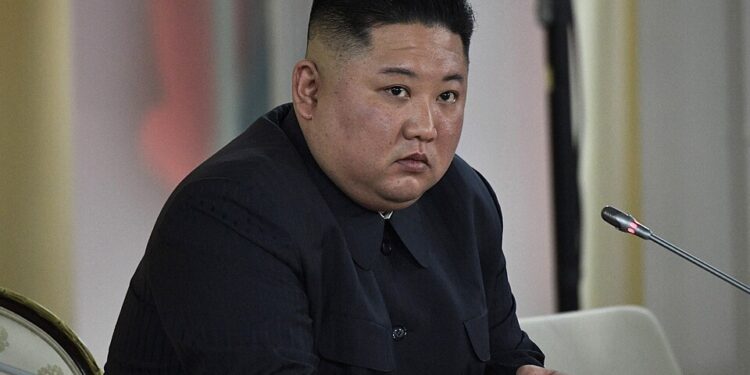
North Korea has issued a threatening message aimed at the United States, positioning military artillery near its border with South Korea as tensions continue to rise. The provocative display comes as President Donald Trump faces renewed challenges from North Korean leader Kim Jong Un.
The communist regime recently moved several powerful artillery weapons into highly visible positions near the heavily guarded border separating North and South Korea.
But it wasn’t simply the presence of the weapons that attracted international attention.
One of the artillery vehicles carried a hostile message calling for the destruction of American forces, raising fresh concerns about North Korea’s intentions toward the United States and its regional allies.
The development comes as Washington continues monitoring Pyongyang’s military activities and its growing arsenal of ballistic missiles.
North Korea Displays Threatening Message Against America
According to Reuters and South Korean news reports, three North Korean self-propelled artillery guns were spotted near the border, with their barrels pointed toward South Korean territory.
The weapons were identified as 122-millimeter howitzers, military artillery systems capable of striking targets up to approximately 15 miles away.
One of the weapons featured a message declaring that American forces should be destroyed, describing the United States as an enemy of the Korean people.
The openly hostile language reflects North Korea’s longstanding opposition to America’s military presence in the region.
What made the display especially unusual was the decision to position the weapons where they could easily be observed from South Korea.
North Korean military forces generally attempt to conceal artillery equipment to prevent opposing forces from identifying its location.
By leaving these weapons exposed, Pyongyang appeared to be sending a deliberate warning.
Military analysts believe the display was intended to demonstrate strength and pressure South Korea rather than immediately signal the beginning of an attack.
However, the appearance of weapons bearing anti-American messages has renewed attention on North Korea’s unpredictable military behavior.
Kim Jong Un Increases Military Pressure
The artillery deployment follows weeks of growing tensions between North Korea and South Korea.
In September, three South Korean soldiers were injured by landmine explosions inside the Demilitarized Zone, the heavily fortified area separating the neighboring countries.
South Korean officials accused North Korea of responsibility for the incident.
Pyongyang denied the allegations and instead accused Seoul of attempting to create a confrontation.
The disagreement eventually reached the United Nations Security Council, where both governments presented competing accounts of the incident.
North Korean officials also warned that violations of their country’s sovereignty could lead to military responses.
Meanwhile, North Korean soldiers have continued constructing fences and strengthening defensive positions along portions of the border.
South Korean forces have responded to some border crossings with warning broadcasts and warning shots.
These increasingly confrontational activities have raised concerns that even a relatively minor incident could lead to a broader military dispute.
North Korea’s Leadership Issues Another Warning
Kim Yo Jong, the influential sister of North Korean leader Kim Jong Un, has also contributed to the escalating tensions.
She recently warned that North Korea could deploy additional tactical weapons and resume propaganda broadcasts along its border with South Korea.
The threatened loudspeaker broadcasts would represent a return to psychological operations that have repeatedly strained relations between the neighboring countries.
North Korea claims its military measures are necessary to defend its territory.
South Korean officials, however, maintain that their forces are responding to North Korean border activities and remain prepared to defend the country.
Military observers have suggested that Pyongyang’s recent actions are intended to demonstrate its willingness to confront neighboring forces while strengthening its bargaining position.
South Korean defense officials have also characterized the exposed artillery as a show of force rather than evidence of an immediate offensive operation.
Despite that assessment, officials continue monitoring the region closely.
Trump Faces Renewed North Korean Challenge
The latest confrontation creates another foreign policy challenge for President Donald Trump, who previously made direct diplomacy with Kim Jong Un a major part of his approach to North Korea.
During his first administration, Trump became the first sitting American president to meet a North Korean leader.
The two held a historic summit in Singapore in 2018, followed by another meeting in Vietnam in 2019.
Although the talks attracted worldwide attention, they ultimately failed to secure an agreement ending North Korea’s nuclear weapons program.
Trump has nevertheless expressed interest in reopening diplomatic discussions with Kim.
North Korea’s latest military activity demonstrates how difficult those negotiations could become.
Pyongyang has continued developing missiles and other weapons systems despite international sanctions and diplomatic pressure.
For the United States, the challenge is to maintain strong security commitments while preventing a confrontation that could threaten millions of people throughout East Asia.
North Korea Launches More Ballistic Missiles
Adding to the growing concerns, North Korea launched approximately 10 short-range ballistic missiles toward the sea off its eastern coast on October 29.
South Korean military officials reported that the missiles traveled roughly 155 miles before reaching the water.
The launches prompted South Korea to increase surveillance and coordinate its response with American and Japanese defense officials.
Seoul condemned the missile tests as violations of United Nations Security Council resolutions.
Japanese authorities also monitored the launches and reported that the missiles did not appear to land within Japan’s exclusive economic zone.
The tests followed other North Korean military demonstrations in recent weeks.
Although there were no reports that the missiles struck American or allied territory, the launches reinforced concerns about the regime’s continued development of military capabilities.
North Korea’s willingness to conduct repeated missile tests remains a major challenge for regional security.
Why North Korea’s Threat Matters To The United States
North Korea’s military activities are particularly important because the country possesses nuclear weapons and has developed ballistic missiles capable of threatening distant targets.
The United States maintains a longstanding military alliance with South Korea, where thousands of American service members are stationed.
American forces also play an important role in supporting Japan and maintaining regional security.
Any major military confrontation involving North Korea could place American personnel and allied populations at risk.
A conflict could also disrupt international commerce, create instability in global financial markets, and strain relations among several major world powers.
These potential consequences make North Korea’s military decisions an important concern for Washington.
For the Trump administration, maintaining American military readiness while pursuing opportunities for diplomacy remains a central challenge.
The president’s previous diplomatic engagement with Kim Jong Un demonstrated that direct negotiations are possible.
However, the North Korean government’s continued weapons development and increasingly hostile statements show that considerable disagreements remain.
What Happens Next?
For now, South Korean military officials are closely watching the North’s troop movements, artillery positions, and missile activities.
There has been no confirmed announcement of an imminent North Korean attack on the United States.
Nevertheless, the artillery display and recent missile launches have added to concerns about the possibility of further military confrontations.
The latest developments also highlight the importance of communication among Washington, Seoul, and Tokyo as they evaluate North Korea’s intentions.
Whether Kim Jong Un is attempting to pressure neighboring countries, strengthen his position ahead of possible negotiations, or discourage South Korean military activity remains uncertain.
What is clear is that North Korea has once again directed hostile rhetoric toward the United States, placing renewed attention on President Trump’s approach to one of America’s most unpredictable adversaries.
As tensions continue along the Korean Peninsula, the decisions made by Washington and its regional allies could play an important role in determining whether the current confrontation escalates or eventually returns to the negotiating table.