
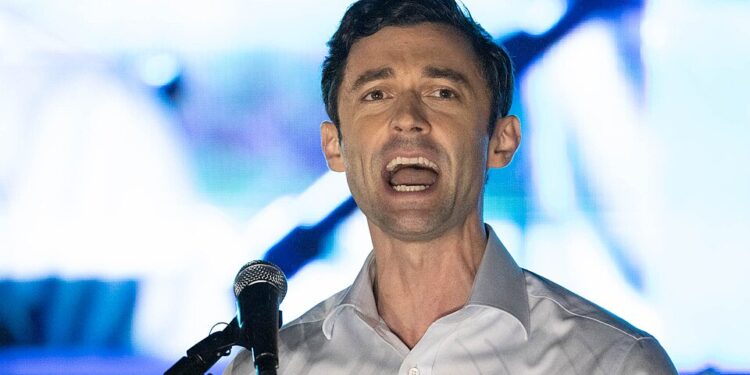
Sen. Jon Ossoff is accusing President Donald Trump of being “compromised” over artificial intelligence, pointing to investments connected to a venture capital firm where the president’s eldest son is a partner.
The Georgia Democrat made the allegation Monday while discussing the growing debate over how Washington should handle the rapid development of artificial intelligence.
Ossoff specifically pointed to 1789 Capital, a venture capital firm where Donald Trump Jr. is a partner. The firm has invested in businesses connected to artificial intelligence and data center infrastructure.
Ossoff said during an interview with Lawrence O’Donnell on MS NOW that substantial investments have been made in both artificial intelligence labs and data center projects.
Ossoff then argued that those business interests create a problem for the president.
Ossoff argued that the first family’s financial interests in the industry create a conflict that, in his view, compromises the president.
The accusation is Ossoff’s assessment. The information cited by the senator does not by itself establish that Trump personally owns those investments or that the investments have influenced presidential decisions on artificial intelligence.
The Hill reported that it contacted the White House for comment.
Trump Rejects Calls to Slow AI Development
Ossoff’s criticism comes amid a much larger debate over the future of artificial intelligence in the United States.
Researchers, technology executives and policymakers are wrestling with how the government should respond as AI systems become increasingly powerful.
Some industry figures have warned that development is moving faster than safeguards can be created. Anthropic CEO Dario Amodei has advocated slowing certain aspects of AI development to provide additional time to address potential risks.
Trump has pushed back against calls for broad restrictions that could slow American innovation.
In a social media post Monday, the president argued that strong leadership is more important than additional controls on the technology.
Trump has repeatedly framed artificial intelligence as both an enormous economic opportunity and a major front in America’s technological competition with China.
Trump’s AI Strategy Focuses on American Leadership
The administration’s broader position is more nuanced than simply opposing AI safeguards.
Trump has pursued policies designed to accelerate American AI development while establishing protections in areas including cybersecurity, national security and government use of advanced AI.
The administration has argued that excessive regulation could slow American companies while foreign competitors continue developing their own systems.
At the same time, federal policy has called for advanced AI systems used in national security to be reliable, secure and controllable.
That distinction is becoming increasingly important as Washington debates how much oversight the technology needs.
Supporters of faster development argue that America cannot afford to surrender its technological advantage to China.
Those calling for additional safeguards argue that moving too quickly could introduce serious economic, cybersecurity and national security risks.
China Becomes a Major Part of the Debate
Trump has specifically cited China when defending his approach.
The president said Chinese President Xi Jinping is not planning to stand in the way of his country’s AI development and argued that the United States must remain competitive.
Trump also described artificial intelligence and data centers as potentially one of the greatest economic development engines in history.
The economic stakes are enormous.
Artificial intelligence is driving major investments in computer chips, electricity generation, data centers and other infrastructure. The technology could also reshape industries ranging from manufacturing and healthcare to finance, transportation and national defense.
For Washington, the question is increasingly about more than technology. AI has become an issue involving jobs, energy, national security and America’s long-term economic competition with China.
Trump and Xi Prepare for Washington Meeting
The controversy comes shortly before Trump is scheduled to meet Xi in Washington.
Artificial intelligence is expected to be part of the broader discussions surrounding relations between the United States and China.
Xi is reportedly planning to bring a sizable delegation of Chinese business leaders to the United States, although the industries represented in that group remain unclear.
Trump similarly traveled with prominent American business and technology executives when he visited Beijing earlier this year.
The involvement of corporate leaders illustrates the growing connection between technology policy, international competition and economic strategy.
Ossoff Makes AI a Political Issue
Ossoff’s criticism also carries political significance at home.
The Georgia Democrat is running for reelection to the U.S. Senate and used his television appearance to urge Americans who disagree with Trump’s approach to respond through the electoral process.
Ossoff also accused Trump of being “dangerously corrupt and incompetent.”
That statement represents Ossoff’s political characterization of the president, not an independently established factual conclusion.
The dispute nevertheless raises a broader issue likely to receive increasing attention as investment in artificial intelligence grows: how policymakers should address potential conflicts of interest while simultaneously deciding how aggressively the federal government should regulate one of America’s fastest-growing industries.
The Bigger Fight Over America’s AI Future
The disagreement between Trump and Ossoff reflects a much larger policy battle.
One side of the debate emphasizes the risks of moving too quickly and argues that stronger safeguards should accompany increasingly capable AI systems.
The other emphasizes the risks of excessive regulation, particularly if restrictions slow American companies while China continues investing aggressively in the technology.
Trump’s administration has generally favored rapid American innovation while incorporating targeted security and accountability measures rather than broad restrictions on AI development.
As investment pours into AI companies, computer chips, power generation and massive data centers, the decisions being made today could affect American workers, businesses, taxpayers and national security for decades.
And with China competing for leadership in the same technology, the argument over how much Washington should regulate AI is unlikely to disappear anytime soon.