
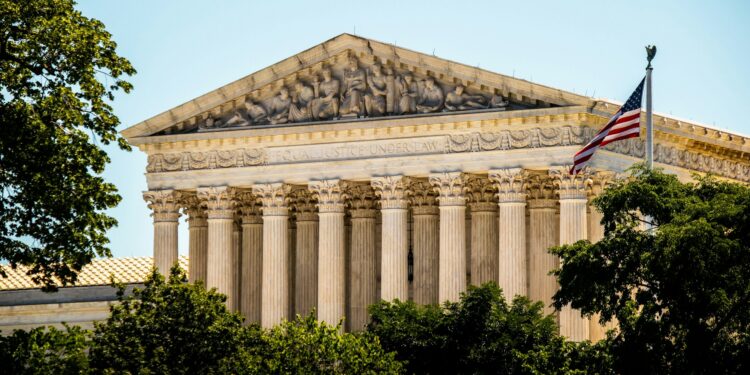
President Donald Trump received welcome news from the Supreme Court after conservative Justice Samuel Alito confirmed that he plans to remain on the bench for another term, ending months of speculation about whether the 76-year-old justice could soon retire.
Trump quickly celebrated the announcement, calling Alito’s decision “Great news for our Country!”
For Republicans, the development comes at a critical moment.
The 2026 midterm elections are approaching, control of the U.S. Senate could be at stake, and the future composition of the Supreme Court remains one of the most consequential issues facing both political parties.
Alito’s decision means Trump will not immediately have an opportunity to nominate a fourth Supreme Court justice. But it also means one of the court’s most prominent conservative members intends to remain in place as the justices prepare for another potentially important term.
And Trump made it clear he was pleased.
Trump Celebrates Alito’s Supreme Court Decision
Trump reacted enthusiastically in a late-night Truth Social post after Alito confirmed his plans.
“Great news for our Country! Supreme Court Justice Samuel Alito has announced that he is staying for another Term,” Trump wrote.
“He is one of the Greatest of All Time. We are all lucky!”
The president’s reaction highlights just how important the Supreme Court has become to his political legacy.
During his first term in the White House, Trump appointed Neil Gorsuch, Brett Kavanaugh and Amy Coney Barrett to the Supreme Court.
Those three appointments helped establish the court’s current 6-3 conservative majority.
Now, during Trump’s second administration, questions about the future of the court have once again moved to the forefront.
Samuel Alito Ends Retirement Speculation
Alito recently put months of speculation to rest by confirming that he intends to serve during the Supreme Court’s upcoming term.
“Obviously, I’m here for another term,” Alito told The Wall Street Journal.
The Supreme Court’s new term begins in October and generally runs until late June or early July.
Alito’s announcement matters because some conservatives had encouraged him and Justice Clarence Thomas, 78, to consider retirement while Republicans control both the White House and Senate.
The argument is straightforward.
If either conservative justice retired now, Trump could nominate a younger conservative judge who, if confirmed, could potentially serve on the Supreme Court for decades.
But Alito has chosen to remain.
Why Alito’s Decision Matters for Conservatives
Supreme Court appointments can shape American law for a generation.
Unlike members of Congress or presidents, Supreme Court justices do not face regular elections. Under the Constitution, federal judges hold their offices during “good Behaviour,” which in practice allows Supreme Court justices to serve for life unless they retire, resign, die or are removed through impeachment and conviction.
That makes every Supreme Court vacancy enormously important.
For conservatives, maintaining the court’s current majority is especially significant because the justices regularly decide major cases involving presidential authority, federal regulations, religious liberty, gun rights, abortion, immigration and other constitutional disputes.
Alito has long been regarded as one of the court’s most reliably conservative members.
His decision to remain therefore preserves the current lineup heading into the next Supreme Court term.
But there is another factor Republicans cannot ignore: the Senate.
2026 Midterms Could Change Everything
A president cannot simply place someone on the Supreme Court.
The president nominates a justice, but the U.S. Senate must confirm that nominee.
That gives control of the Senate enormous importance whenever a Supreme Court vacancy occurs.
Republicans currently hold a 53-47 advantage when the two independents who caucus with Democrats are counted on the Democratic side.
Democrats would need a net gain of four seats to reach an outright 51-seat majority.
A major Democratic victory in the 2026 midterm elections could therefore dramatically change Trump’s options if a Supreme Court vacancy develops later in his presidency.
A Democratic-controlled Senate could make confirmation of a conservative Trump nominee far more difficult.
That possibility is one reason Alito’s future has attracted so much attention from conservatives.
Trump Could Have Made Supreme Court History Again
Had Alito retired while Republicans controlled the Senate, Trump would have had an opportunity to nominate his fourth Supreme Court justice.
That would have added another extraordinary chapter to Trump’s judicial legacy.
Trump already appointed three justices during his first four years in office, an achievement few modern presidents have matched.
Neil Gorsuch joined the court in 2017.
Brett Kavanaugh followed in 2018.
Then came Amy Coney Barrett in 2020.
Those appointments transformed the ideological makeup of the Supreme Court and became one of the most enduring accomplishments of Trump’s first presidency.
Alito’s retirement would have presented Trump with another opportunity to influence the court long after his presidency ends.
For now, that opportunity will have to wait.
Alito Has Served Since 2006
Samuel Alito has been on the Supreme Court for more than two decades.
Born on April 1, 1950, Alito was nominated to the Supreme Court by Republican President George W. Bush and took his seat in January 2006.
Over the years, he has developed a reputation as one of the court’s strongest conservative voices.
That has made the question of his eventual replacement especially important to conservatives concerned about maintaining the court’s ideological balance.
Alito has also acknowledged the uncomfortable reality behind the retirement speculation.
“It’s not pleasant, in the sense that it’s a reminder of mortality,” he told The Wall Street Journal while discussing calls for him to step aside.
“It’s like, what are those vultures doing up there? They are flying around. But it goes with life tenure.”
For now, Alito apparently believes his work on the Supreme Court is not finished.
Questions About Alito’s Health
Any discussion surrounding an older Supreme Court justice naturally raises questions about health and longevity.
There has been no public indication that Alito is suffering from a serious medical condition that prevents him from performing his duties.
He did receive medical attention earlier this year after becoming dehydrated following a Federalist Society event in Philadelphia.
Rather than making the roughly three-hour journey home, Alito reportedly went to a hospital after his security detail encouraged him to seek medical attention.
He was released that evening, subsequently saw his physician and returned to work the following Monday.
The episode nevertheless attracted attention because of the existing speculation surrounding his age and possible retirement.
His latest announcement makes his intentions clear: he plans to continue serving.
The 2028 Presidential Election Could Become Crucial
Alito’s decision also creates a longer-term political question.
What happens if he remains on the Supreme Court throughout the rest of Trump’s presidency?
The answer could depend heavily on the 2028 presidential election.
If Republicans retain the White House, conservatives could still have an opportunity to replace Alito with another conservative justice whenever he ultimately decides to leave.
If Democrats win the presidency, however, the situation could look very different.
A Democratic president could have the opportunity to nominate Alito’s eventual replacement, depending on when a vacancy occurs and which party controls the Senate.
That could potentially alter the ideological balance of the Supreme Court.
Nothing about 2028 is predetermined, of course.
But modern American political history demonstrates how quickly control of Washington can change.
That uncertainty explains why Supreme Court retirement decisions attract so much attention from activists and political strategists on both sides.
Trump Knows How Quickly Supreme Court Politics Can Change
Trump has already experienced firsthand how an unexpected Supreme Court vacancy can transform a presidential election.
On Sept. 18, 2020, liberal Justice Ruth Bader Ginsburg died just weeks before Americans went to the polls.
Trump learned about her death after a campaign rally in Bemidji, Minnesota.
After learning of Ginsburg’s death, Trump expressed surprise at the news before paying tribute to her, describing the late justice as a remarkable woman who had lived an extraordinary life.
Washington immediately turned its attention toward the vacant Supreme Court seat.
Trump moved rapidly.
Just eight days after Ginsburg’s death, he nominated Amy Coney Barrett to replace her.
On Oct. 26, 2020, the GOP-led Senate approved Barrett’s confirmation to the Supreme Court in a 52-48 vote.
That was only eight days before Election Day.
Barrett’s confirmation cemented the Supreme Court’s conservative majority and ensured that Trump’s influence on the federal judiciary would continue long after his first term ended.
Trump’s Supreme Court Legacy
Trump’s three Supreme Court appointments during his first term represented a historically significant achievement.
Not since Richard Nixon’s first term had a president appointed at least three Supreme Court justices during a single four-year term.
Nixon ultimately appointed four justices before beginning his second term: Warren Burger, Harry Blackmun, Lewis Powell and William Rehnquist.
Trump came close to that number with Gorsuch, Kavanaugh and Barrett.
Those appointments have helped shape major Supreme Court decisions and remain an important part of Trump’s legacy among conservative voters.
A future vacancy could give him another opportunity.
But Samuel Alito has made clear that his seat is not becoming vacant yet.
What Happens Next at the Supreme Court?
For the immediate future, the answer is straightforward.
Alito intends to return for the Supreme Court term beginning in October.
That keeps the court’s existing nine-member lineup intact and maintains its 6-3 conservative majority.
Political attention will now increasingly turn toward November and the battle for control of Congress.
For Republicans, maintaining the Senate majority could prove critical if Trump gets another opportunity to nominate a Supreme Court justice during his remaining time in office.
For Democrats, winning control of the chamber could provide considerably greater influence over Trump’s future judicial nominees.
That means the battle over the Supreme Court is far from finished.
For now, however, Trump has something to celebrate.
One of the Supreme Court’s most prominent conservative justices has decided to stay on the bench for another term — preserving the court’s current conservative majority as Washington heads toward another consequential election.
And for Trump, who has already made the Supreme Court a defining part of his presidential legacy, Alito’s decision is unquestionably welcome news.