
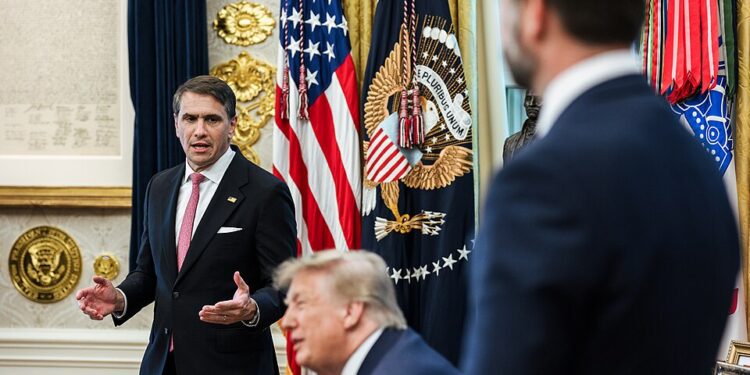
President Donald Trump is getting a powerful defense from Attorney General Todd Blanche as the administration fights to keep construction moving on the controversial White House ballroom project.
Blanche says the president does not need to return to Congress for new approval, arguing that lawmakers have already given presidents the legal authority needed to make improvements to the White House complex.
The dispute has now reached the Supreme Court, turning what began as a construction project into a much larger battle over presidential authority, congressional power and security at one of America’s most important government buildings.
Blanche said during an appearance on “Fox News Sunday” that the administration does not believe it needs additional approval from Congress because lawmakers have already provided the legal authority necessary to move forward.
His comments provide a forceful defense of Trump at a critical moment in the legal fight.
Blanche Defends Trump’s White House Authority
Blanche argued that Trump is not claiming some unprecedented new presidential power.
Instead, the attorney general pointed to the long history of presidents renovating, expanding and modernizing the White House.
“Many presidents have done a tremendous amount of work to the White House, as they should, and Congress has authorized them to do so,” Blanche said.
That distinction sits at the center of the administration’s argument.
The Justice Department’s position is that existing federal authority is sufficient for the president to oversee improvements to the White House complex without obtaining a separate act of Congress for every major project.
Opponents strongly disagree, arguing that a project of this magnitude goes far beyond ordinary renovation.
That disagreement has produced a major constitutional showdown.
Appeals Court Deals Trump A Setback
The administration suffered a significant setback when a federal appeals court ruled that construction on the ballroom must stop unless the Supreme Court intervenes.
The ruling has put additional pressure on the Trump administration to convince the nation’s highest court that the president possesses the necessary authority.
The administration has asked the Supreme Court to allow construction to continue while the broader legal battle plays out.
For Trump, the stakes extend beyond the ballroom itself.
A ruling against the administration could potentially limit how much freedom future presidents have to make substantial changes to the White House without first obtaining congressional approval.
A victory could strengthen the executive branch’s position that existing law already provides considerable authority over White House improvements.
White House Ballroom Cost Draws Attention
Money has also become a major part of the controversy.
The ballroom itself has been reported as a roughly $400 million project, while recent reporting has estimated that broader construction and modernization work across the White House complex could cost at least $900 million.
Questions about where that money comes from have intensified scrutiny in Washington.
The ballroom has been associated with private donations, while reports about the larger renovation effort have raised questions about the use of government funding for other improvements.
Those distinctions matter because the financing of the project has become part of the political and legal debate surrounding the construction.
Trump Administration Cites National Security
The administration is also making another argument that could prove critical before the Supreme Court: security.
Blanche says the construction should not be viewed merely as an elaborate room for state dinners, ceremonies and visits from foreign leaders.
He argues that the broader project includes meaningful security improvements designed to protect the president, his family, government officials and visiting world leaders.
“We’re hopeful that the Supreme Court recognizes that so we can get the ballroom finished as soon as possible,” Blanche said.
According to Blanche, the project is about more than providing a permanent location for large White House gatherings.
It is also about ensuring that some of the world’s most important political leaders can gather securely on White House grounds.
“And so it’s not just about a place for world leaders to come and have dinner, it’s also about making sure that the president and his family, guests, world leaders are safe when they’re in this city,” Blanche said.
That security argument has become increasingly important as the administration fights to persuade the courts that construction should be allowed to continue.
Democrats Demand Investigation
Democratic lawmakers aren’t buying the administration’s explanation.
They have called for greater scrutiny of the project and urged the Government Accountability Office to examine its financing and approval process.
Their concerns include the project’s cost, its effect on historic White House architecture, the combination of public and private financing and questions about whether traditional federal review procedures were properly followed.
Democratic lawmakers have argued that a project affecting such an important national landmark deserves significant congressional oversight.
The administration, meanwhile, maintains that existing presidential authority already covers the work.
The competing positions leave Americans with a fundamental question about the balance of power in Washington: When does a presidential renovation become a project that requires Congress to step in?
Fight Is Bigger Than A Ballroom
Although the dispute is frequently described as a fight over Trump’s ballroom, its consequences could extend much further.
The White House belongs to the American people and serves simultaneously as the president’s residence, a working government complex, a historic landmark and one of the most security-sensitive locations in the country.
Presidents therefore need some ability to repair and modernize it.
The unanswered question is how far that authority extends.
Blanche says Congress has already provided the necessary power.
The appeals court reached a different conclusion regarding the ballroom project, setting the stage for the administration’s appeal to the Supreme Court.
That makes the case another significant test of the boundaries between presidential authority and congressional oversight.
Supreme Court Could Decide What Happens Next
The Trump administration is now looking to the Supreme Court for relief.
If the justices allow construction to proceed, it would hand Trump an important victory and permit work on the ballroom to continue while the underlying litigation moves forward.
If the Court refuses to intervene, the administration could face further delays and potentially be forced to seek another route for completing the project.
Either way, the fight has become about far more than chandeliers, state dinners and White House architecture.
It now involves presidential power, taxpayer money, national security, historic preservation and the authority of Congress — issues that could affect presidents long after Trump leaves office.
And with the administration insisting that Congress has already granted the necessary authority, the next major decision may belong to the nine justices of the United States Supreme Court.