
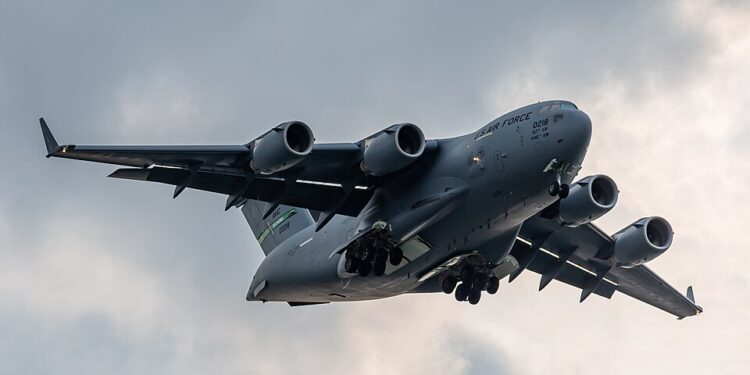
A U.S. Air Force mission to Antarctica was unexpectedly forced to turn back after aviation authorities issued a safety warning connected to a planned Russian missile launch, creating an unusual disruption for American military operations in one of the most remote regions of the world.
The C-17 Globemaster III, flying as ICE28, took off from Christchurch, New Zealand, at about 9 a.m. Tuesday. While en route to Antarctica, the military transport turned around and landed back in Christchurch less than three hours after its departure.
The decision followed a Notice to Airmen, commonly known as a NOTAM, issued by New Zealand aviation authorities warning aircraft operators about potentially hazardous activity.
Officials later disclosed an important detail: The warning involved a planned Russian missile launch.
Russian Missile Launch Prompts Aviation Warning
New Zealand’s Civil Aviation Authority stated Russian air traffic officials notified the agency about the scheduled launch and warned that it could pose a possible risk to international airspace.
The potential hazard was within New Zealand’s Oceanic Flight Information Region, a vast expanse where the country oversees air traffic services under international aviation arrangements.
After receiving the information, authorities established a danger area and issued a NOTAM so pilots and aircraft operators could consider the potential risk when determining their flight plans.
The advisory did not technically prohibit aircraft from entering the affected airspace. Instead, operators were given the safety information and allowed to decide whether proceeding with their flights was appropriate.
For the U.S. Air Force C-17, the decision was made to return to Christchurch rather than continue toward Antarctica.
There has been no indication that the American aircraft was targeted by Russia or that the incident represented an attack on the United States. The turnaround was a precautionary aviation decision made after authorities were alerted to the possible danger associated with the planned missile activity.
Warning Covered Massive International Airspace Region
The location involved makes the incident particularly noteworthy.
New Zealand’s Oceanic Flight Information Region covers approximately 30 million square kilometers, stretching across vast portions of the South Pacific Ocean, Southern Ocean and Tasman Sea.
Much of that territory is over international waters. New Zealand nevertheless plays an important role in managing aviation traffic throughout the region and distributing information about possible hazards.
A missile or space launch can potentially affect aviation far beyond the immediate launch site because aircraft operators must account for designated hazard zones and the possibility of falling debris or other risks.
That makes international coordination especially important when military or space activity overlaps with established aviation routes.
C-17 Was Supporting U.S. Antarctic Operations
The interrupted flight was not an ordinary passenger trip.
The Air Force mission was part of annual operations supporting scientific research and logistical activity in Antarctica.
During these missions, military aircraft transport personnel, supplies and essential equipment from Christchurch to Antarctic research facilities, including the United States’ McMurdo Station.
The flights help prepare researchers and support crews for the upcoming Antarctic summer research season.
Operating aircraft in Antarctica already presents significant challenges. Crews must contend with extreme temperatures, rapidly changing weather, limited landing locations and enormous distances between suitable airports.
Tuesday’s missile-related warning added another complication to an already demanding mission.
Why The C-17 Is Critical To The Mission
The C-17 Globemaster III is one of the U.S. Air Force’s most important strategic transport aircraft.
Designed to move troops, vehicles, equipment and cargo across long distances, the massive four-engine aircraft is capable of supporting operations in locations where conventional transportation can be extremely difficult.
That makes the C-17 particularly useful for America’s Antarctic operations.
The aircraft provides a vital transportation connection between New Zealand and research stations on the frozen continent, allowing the United States to move personnel and heavy supplies into an environment with few other transportation options.
International Security Concerns Reach A Remote Corner Of The World
Although the incident ended safely, it demonstrates how quickly international military activity can affect American operations — even in the remote Southern Ocean.
Russia’s notification ultimately resulted in aviation authorities distributing a warning that influenced the U.S. Air Force mission.
The development also comes as President Donald Trump and his administration continue navigating a complicated international security environment involving Russia and other major military powers.
For the Air Force crew involved Tuesday, however, the immediate issue was flight safety.
Rather than continue through an area covered by the warning, the C-17 returned safely to New Zealand.
The episode serves as another reminder that American military operations depend not only on aircraft and personnel, but also on constant monitoring of rapidly changing conditions around the world.
Even a routine supply mission to Antarctica can be altered without warning when military activity creates a potential danger in international airspace.
For now, the annual U.S. missions supporting Antarctic research remain an important logistical operation. But Tuesday’s unexpected turnaround showed just how far the consequences of global military activity can reach — even to one of the most isolated places on Earth.