
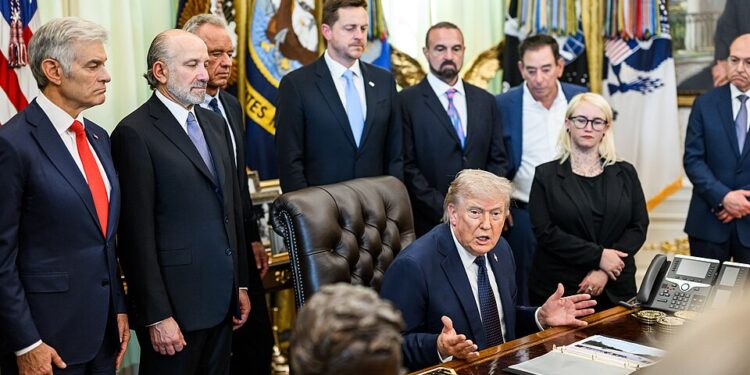
President Donald Trump is drawing sharp backlash from Democrats after forcefully rejecting calls to seek congressional approval for U.S. military operations involving Iran—labeling the demand “totally unconstitutional” and blasting critics as unpatriotic.
The remarks came as political tensions in Washington reached a new level, with opponents accusing Trump of overstepping his authority, while supporters argue he is doing exactly what strong leadership requires in a dangerous world.
Trump Rejects War Approval Demands
Speaking outside the White House, President Trump dismissed the idea that he must go through Congress before continuing military actions tied to Iran.
According to Trump, the expectation itself is flawed—and not supported by how past presidents have handled similar situations.
He pointed out that previous administrations from both parties have launched military operations without formally declaring war, arguing that his approach is consistent with long-standing presidential authority.
Trump also emphasized that his administration remains in contact with lawmakers, even if he does not agree with their demands.
War Powers Debate Reaches Boiling Point
At the center of the controversy is the War Powers Resolution of 1973, which requires presidents to end military engagements within 60 days unless Congress approves continued involvement.
That deadline has now passed since Trump first notified Congress about operations targeting Iran—prompting Democrats to claim the administration may be violating federal law.
However, Trump and his allies strongly disagree.
They argue that:
- The law itself is constitutionally questionable
- Past presidents have routinely ignored or bypassed it
- A recent ceasefire changes the timeline entirely
Supporters say critics are selectively enforcing a rule that has rarely been applied in practice.
Trump Fires Back at Critics
President Trump didn’t hold back when addressing those pushing for congressional approval.
He described the demands as politically motivated and accused critics of undermining U.S. success on the global stage.
Trump also framed the situation as a major win for America, pointing to military strength and recent developments as evidence that his strategy is working.
For many conservatives, this message resonates strongly—highlighting a commander-in-chief focused on results rather than political red tape.
Republicans Stand Firm Behind Trump
While Democrats continue to raise legal concerns, many Republicans are backing the president.
Efforts by Democrats to force votes limiting military action have largely failed, signaling strong GOP unity on the issue.
Supporters argue that:
- America needs decisive leadership in times of conflict
- Delays from Congress could weaken national security
- The president must have flexibility to act quickly
This divide reflects a broader battle in Washington over executive power and America’s role on the world stage.
A Bigger Fight Over Presidential Power
This clash is about more than just one conflict—it’s part of a long-running debate over who controls military decisions in the United States.
Presidents from both parties have expanded executive authority over time, while Congress has struggled to reassert its role.
Trump’s stance makes one thing clear: he is not backing down.
The Bottom Line
President Trump’s refusal to seek congressional approval is fueling a major political showdown—one that could have lasting consequences for how future presidents use military power.
To supporters, it’s a sign of strength and leadership.
To critics, it raises serious constitutional concerns.
Either way, the battle is far from over—and Americans will be watching closely as it unfolds.