
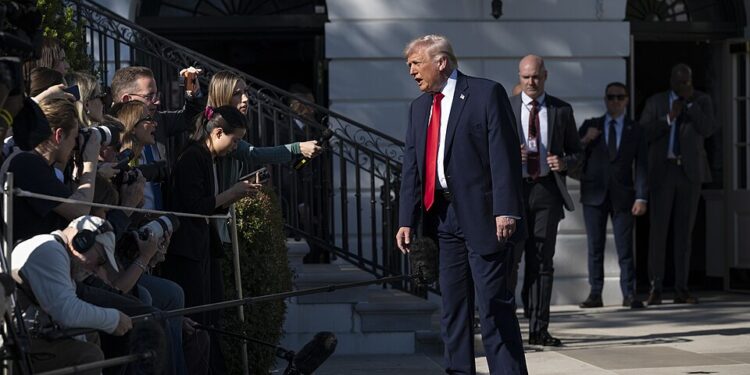
President Donald Trump is pushing for a massive new Middle East alliance as negotiations with Iran continue moving forward, calling on several Muslim-majority nations to officially join the historic Abraham Accords.
In a Memorial Day message posted on Truth Social, Trump revealed that he spoke Saturday with leaders from Saudi Arabia, Qatar, Egypt, Pakistan, Turkey, and Jordan about expanding the landmark peace agreement originally brokered during his first administration.
Leaders from the United Arab Emirates and Bahrain — two nations that already normalized relations with Israel under the Abraham Accords — were also part of the discussion.
Trump argued that nations seeking involvement in any future Iran agreement should also support broader peace efforts in the region by recognizing Israel and joining the diplomatic coalition established during his presidency.
“After all the work done by the United States to try and pull this very complex puzzle together,” Trump wrote, “it should be mandatory” for participating nations to sign onto the Abraham Accords.
The president described the effort as an opportunity to reshape the Middle East through diplomacy, economic partnerships, and stronger regional cooperation.
Trump Pushes To Expand Abraham Accords
The Abraham Accords were widely considered one of Trump’s biggest foreign policy victories during his first term. The agreements led several Arab nations to establish formal diplomatic ties with Israel for the first time in decades.
The United Arab Emirates and Bahrain signed the accords in 2020, followed later by Morocco and Sudan.
Now, Trump appears focused on expanding the agreement even further by bringing additional Muslim-majority countries into the coalition.
According to the president, most of the nations involved in the recent talks should be “ready, willing, and able” to support the effort.
Trump also warned that countries unwilling to participate could raise concerns about their long-term intentions regarding peace and regional stability.
Trump Suggests Iran Could Eventually Join
One of the most surprising moments from Trump’s statement came when he suggested Iran itself could eventually become part of the Abraham Accords if negotiations are successful.
Such a development would represent a dramatic shift after decades of hostility between Iran and Israel.
Trump said several Middle Eastern leaders indicated they would welcome Iran into the broader agreement if a final peace deal is reached.
“If Iran signs its Agreement with me, as President of the United States,” Trump wrote, “it would be an Honor to have them also be part of this unparalleled World Coalition.”
While such a scenario remains highly uncertain, the proposal immediately sparked international attention because of the long-standing tensions between Tehran and Jerusalem.
Saudi Arabia Remains Key To Regional Deal
Throughout both of his presidencies, Trump has worked to encourage Saudi Arabia to normalize relations with Israel.
Before the Hamas terrorist attack against Israel on October 7, 2023, Saudi leaders had signaled growing openness toward closer ties with the Jewish state.
However, the ongoing war in Gaza has complicated those discussions and increased tensions across the region.
Saudi officials and several Arab governments continue to insist that Palestinian issues must be addressed before full normalization can move forward.
Even so, Trump’s team appears optimistic that broader regional diplomacy could still be possible.
Trump Says Iran Talks Are “Proceeding Nicely”
The Trump administration is reportedly working on a broader framework agreement involving Iran’s nuclear program and regional security concerns.
One senior administration official recently claimed negotiators are close to finalizing the outlines of a possible agreement.
At the same time, Trump emphasized that his administration would not accept a weak or rushed deal.
“Trump said negotiations with Iran appear to be moving in a positive direction, adding that any agreement must benefit all sides or there will be no deal at all.”
The president also warned that failure to secure a deal could lead to increased instability in the Middle East.
For many conservatives, Trump’s latest diplomatic push reflects his long-standing “peace through strength” strategy — combining economic pressure, strong alliances, and aggressive negotiation tactics to pursue major international agreements while protecting American interests abroad.