
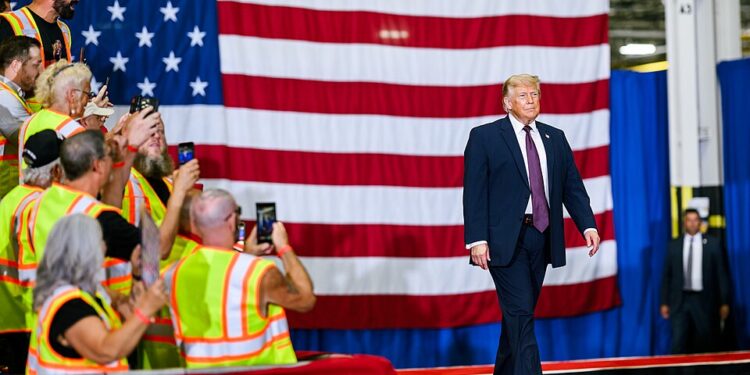
President Donald Trump is facing a new financial challenge as the U.S. government joins Japan in an unusual effort to stabilize global currency markets.
The coordinated move sent the U.S. dollar lower against the Japanese yen, creating fresh questions about the economy, interest rates, and America’s financial outlook.
The dollar traded at about 156.80 yen Monday, down sharply from nearly 164 yen in July, when it reached its strongest level against Japan’s currency in four decades.
U.S. And Japan Step Into Currency Markets
The decline followed a rare joint intervention by U.S. and Japanese officials designed to slow the yen’s dramatic swings.
According to reports, the U.S. Treasury sold euros to purchase Japanese yen through the Federal Reserve Bank of New York. Major financial firms Goldman Sachs and Morgan Stanley reportedly handled the transactions, although officials have not disclosed the total amount involved.
Japan also entered the market.
Japanese Finance Minister Satsuki Katayama confirmed Sunday that Tokyo purchased yen to counter what officials described as excessive currency volatility.
Bessent Signals More Action Could Come
Treasury Secretary Scott Bessent suggested the Trump administration is prepared to take additional steps if market instability continues.
In a post on X, Bessent said Friday’s coordinated intervention helped restore order to foreign exchange markets and emphasized that Treasury officials remain in close contact with Japan’s Ministry of Finance and the Bank of Japan.
He also pointed to the Foreign and International Monetary Authorities (FIMA) Repo Facility, a Federal Reserve program created during the COVID-19 pandemic that allows approved foreign central banks to temporarily exchange U.S. Treasury securities for U.S. dollars during periods of market stress.
Eligible countries can borrow up to $60 billion for periods of up to seven days.
Bessent added that he believes the lending program should eventually be expanded, saying Japan has taken decisive steps to strengthen its currency.
Why Americans Should Pay Attention
Although currency markets rarely dominate headlines, movements like these can have real consequences for American families.
A weaker dollar can influence import prices, investment returns, borrowing costs, and financial markets. Large currency swings also create uncertainty for businesses that operate internationally.
Investors are paying especially close attention to the yen carry trade, a strategy in which traders borrow low-interest Japanese yen to invest in higher-yielding assets around the world.
If the yen strengthens too quickly, those investors may be forced to unwind their positions, potentially triggering widespread selling across global markets.
Japan Holds Massive U.S. Debt
Another factor making the situation important is Japan’s enormous investment in U.S. government debt.
Japan remains the largest foreign holder of U.S. Treasury securities, giving it significant influence over global financial markets.
If Japanese officials ever decide they need to sell a meaningful portion of those Treasury holdings to defend the yen, U.S. bond yields could climb, increasing borrowing costs for the federal government while placing additional pressure on financial markets.
What Comes Next
For now, the coordinated intervention appears to have stabilized the yen after months of volatility.
Still, investors will be watching closely to see whether additional action becomes necessary if currency markets remain unstable.
As the Trump administration works to strengthen the U.S. economy while navigating growing geopolitical tensions and global financial uncertainty, the movement of the dollar and yen has become another key indicator that Wall Street—and Washington—will be monitoring in the weeks ahead.