
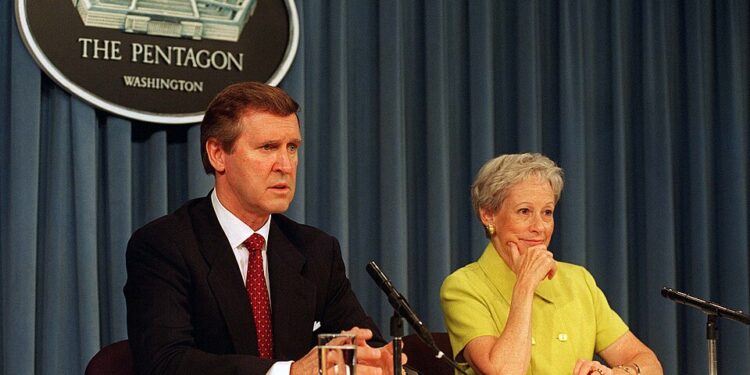
Former Republican Sen. Nancy Kassebaum Baker, a towering figure in Kansas politics who made history during her nearly two decades in Washington, has died at the age of 94.
Kassebaum Baker died Friday of natural causes, according to her son, Bill Kassebaum. Her passing marks the loss of a prominent figure from an earlier generation of the Republican Party and one of the most successful female politicians of her era.
She represented Kansas in the U.S. Senate for 18 years, winning three consecutive terms and building a reputation as an independent-minded Republican who was sometimes willing to challenge her own party.
Her son said his mother had a deep affection for Kansas and took tremendous pride in representing its people.
Nancy Kassebaum Baker Made Senate History
Kassebaum Baker entered the national spotlight in 1978 when Kansas voters elected her to the U.S. Senate.
Her victory was historic.
She became the first woman elected to the Senate in her own right without having previously followed a husband into congressional office.
Kassebaum Baker was also born into a prominent Kansas Republican family. Her father, Alf Landon, was a former Kansas governor who became the GOP’s presidential nominee in 1936, running against Democratic President Franklin D. Roosevelt.
But Kassebaum Baker eventually established a political identity separate from her famous father.
She became known for her low-key personality, willingness to work across party lines and refusal to automatically follow party leadership.
That approach helped make her remarkably popular with Kansas voters.
Kansas Voters Gave Her Overwhelming Support
Kassebaum Baker faced a crowded Republican primary when she first ran for the Senate in 1978.
Nine candidates competed for the GOP nomination, including experienced state lawmakers and a prominent businessman. Despite beginning the race as an underdog with a relatively small campaign operation, she emerged victorious.
Running as Nancy Landon Kassebaum, she went on to defeat former Democratic Rep. Bill Roy in the general election with nearly 54% of the vote.
Her political strength grew considerably from there.
When she sought reelection in 1984, Kassebaum Baker received approximately 76% of the vote. Six years later, Kansas voters returned her to Washington with roughly 74%.
Those enormous margins demonstrated her unusual ability to appeal to Republicans, independents and some Democrats.
She Didn’t Always Agree With Conservatives
Although Kassebaum Baker was a Republican, conservatives did not always agree with her positions.
She belonged to the moderate wing of the GOP that once played a much larger role in national Republican politics.
Early in her Senate career, Kassebaum Baker declined to support a proposed constitutional amendment requiring a balanced federal budget. She warned lawmakers against embracing political answers simply because they appeared straightforward.
She later supported the federal assault-weapons ban backed by Democratic President Bill Clinton, a decision that generated considerable opposition from conservatives.
Kassebaum Baker said the vote resulted in some of the most hostile mail she received during her Senate career.
Despite those disagreements, Kansas Republicans continued giving her overwhelming electoral support.
A Reputation for Bipartisanship
One of Kassebaum Baker’s most significant accomplishments came through her work on health care.
She joined Democratic Sen. Ted Kennedy of Massachusetts in advancing legislation that eventually became the Health Insurance Portability and Accountability Act of 1996, better known to millions of Americans as HIPAA.
The legislation became closely associated with both senators and demonstrated Kassebaum Baker’s willingness to negotiate with Democrats when she believed an agreement could benefit the country.
By the time she prepared to leave Washington, only eight women were serving in the U.S. Senate.
Kassebaum Baker stood out even among that small group. She chaired the Senate Labor and Human Resources Committee, making her the only female senator chairing a committee at the time she announced her retirement.
Her Kansas Roots Ran Deep
Nancy Landon Kassebaum was born July 29, 1932, as her father was beginning his rise through Kansas politics.
She earned a degree in political science from the University of Kansas and later received a master’s degree in diplomatic history from the University of Michigan.
Before becoming a senator, Kassebaum Baker worked as a radio station executive, served on the staff of Republican Kansas Sen. James Pearson and participated in local education as a school board member.
She had four children with her first husband and later became a grandmother and great-grandmother.
Even after reaching the highest levels of American politics, Kassebaum Baker maintained a reputation for avoiding the trappings normally associated with political power.
When the possibility arose of naming a highway in Topeka in her honor, she rejected the idea.
Her understated personality became part of her political appeal.
Marriage Connected Two Major Republican Careers
Kassebaum Baker made history in her personal life as well.
In December 1996, she married former Republican Sen. Howard Baker of Tennessee.
Their marriage was notable because both had previously served in the U.S. Senate.
Howard Baker was already a major figure in Republican politics. He represented Tennessee in the Senate from 1967 until 1985 and later served as White House chief of staff under President Ronald Reagan.
He was subsequently appointed U.S. ambassador to Japan by President George W. Bush in 2001.
Kassebaum Baker accompanied her husband to Japan during the four-year diplomatic assignment while continuing to participate in public-service efforts of her own.
Howard Baker died in 2014.
Kassebaum Baker Later Split With The Modern GOP
Perhaps the most striking chapter of Kassebaum Baker’s later political life was her growing disagreement with the direction of the Republican Party.
The former senator eventually endorsed several Democratic candidates in Kansas, including Democratic Gov. Laura Kelly.
That put her on the opposite side of many conservative Republicans who had once supported her.
Her differences with President Donald Trump were also significant.
Following the events at the U.S. Capitol on Jan. 6, 2021, Kassebaum Baker publicly called for Trump’s impeachment.
Her position illustrated the considerable political distance between the moderate Republican tradition she represented and the conservative, populist movement that has reshaped the GOP under Trump.
For today’s Republican voters, that history is an important part of understanding Kassebaum Baker’s complicated political legacy.
She was unquestionably a Republican trailblazer who achieved extraordinary electoral success in a conservative state. At the same time, she frequently departed from conservative orthodoxy and ultimately opposed Trump on one of the most consequential political controversies of his career.
An Earlier Era of Republican Politics Comes to an End
Whatever disagreements conservatives may have with her later political positions, Kassebaum Baker’s place in American history is difficult to dispute.
She entered the Senate at a time when women remained rare in the upper chamber of Congress and proceeded to build an 18-year career representing Kansas.
She won elections by margins that most modern politicians could only dream of achieving, chaired a powerful Senate committee and played a role in legislation that continues to affect Americans decades later.
Perhaps most importantly, Kassebaum Baker represented a dramatically different era of American politics.
Today’s Republican Party bears little resemblance to the GOP she entered in 1978. The rise of Trump and the MAGA movement has transformed the party’s priorities, coalition and relationship with the political establishment.
Kassebaum Baker herself ultimately found that transformation difficult to embrace.
But for generations of Kansans, she remained one of the state’s most recognizable political figures — a senator whose independent streak sometimes angered conservatives but rarely prevented voters back home from supporting her.
Her death at 94 closes another chapter in the history of the Republican Party and the U.S. Senate.