
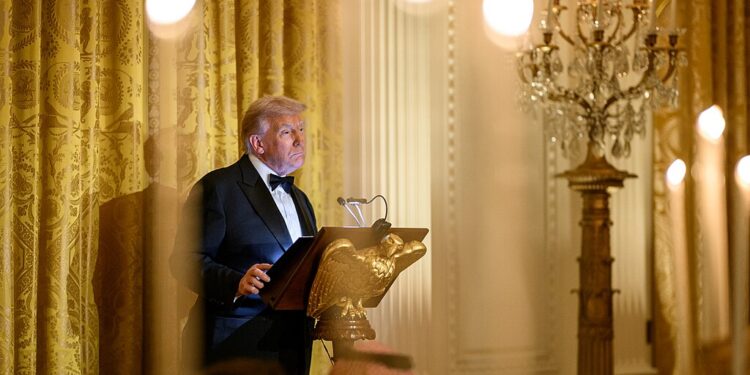
President Donald Trump is facing unexpected resistance from several foreign governments after unveiling a new international initiative aimed at rebuilding Gaza following years of unrest in the region.
The proposed “Board of Peace” was announced as part of Trump’s broader foreign-policy agenda, following a fragile ceasefire between Israel and Hamas that brought an end to a prolonged and destructive conflict. The administration says the initiative is designed to restore infrastructure, stabilize the region, and prevent future violence.
The plan was formally introduced at the World Economic Forum in Davos, Switzerland. Invitations were sent to roughly 60 nations, with President Trump slated to serve as chairman. Under the proposal, the chairman would hold veto authority over board decisions and membership. Permanent participation also requires a $1 billion financial contribution.
Several countries—including Israel, Argentina, Hungary, Saudi Arabia, and Russia—agreed to participate. However, a growing list of U.S. allies and Western nations have declined, citing constitutional concerns, legal limitations, or disagreements with the structure of the agreement.
Tensions escalated further after Trump withdrew an invitation previously extended to Canada, following a public dispute with Prime Minister Mark Carney over trade and tariffs.
Below is a breakdown of the countries that have refused to join the Board of Peace.
France
French officials quickly rejected the proposal, expressing concern over the level of authority granted to the board’s chairman. France’s foreign ministry suggested the structure conflicts with existing international norms. Trump later warned France could face steep tariffs if cooperation did not improve.
Germany
German Chancellor Friedrich Merz said Berlin could not participate under its constitution, though he emphasized Germany remains open to future cooperation with the United States outside the board’s current framework.
Greece
Greece’s prime minister stated the initiative extends beyond the authority of existing United Nations mandates, making participation difficult for many European nations.
Italy
Italian Prime Minister Giorgia Meloni said elements of the agreement conflict with Italy’s constitution. While not ruling it out entirely, she noted parliamentary approval would be required before any commitment.
New Zealand
New Zealand declined the invitation, saying it would not significantly contribute under the current structure and stressing the importance of alignment with United Nations principles.
Norway
Norwegian officials cited unanswered questions and declined to attend the formal signing, while still voicing support for broader peace efforts in the Middle East and Eastern Europe.
Slovenia
Slovenia warned the proposal’s scope was overly broad and could weaken existing international frameworks.
Sweden
Sweden announced it would not sign the agreement in its current form, citing unresolved legal concerns.
United Kingdom
British officials described the proposal as a complex legal arrangement with far-reaching implications and raised concerns about certain participating countries.
Ukraine
Ukraine rejected the invitation, objecting to sharing a peace-focused organization with Russia and Belarus as the conflict in Eastern Europe continues.
Supporters of President Trump argue the rejections reflect reluctance among global elites to accept American-led reforms to international diplomacy. Critics counter that the board concentrates too much authority in a single office.
Regardless, the pushback highlights the challenges Trump faces as he attempts to reshape global peace efforts on U.S. terms—and signals that not all allies are prepared to follow Washington’s lead.