
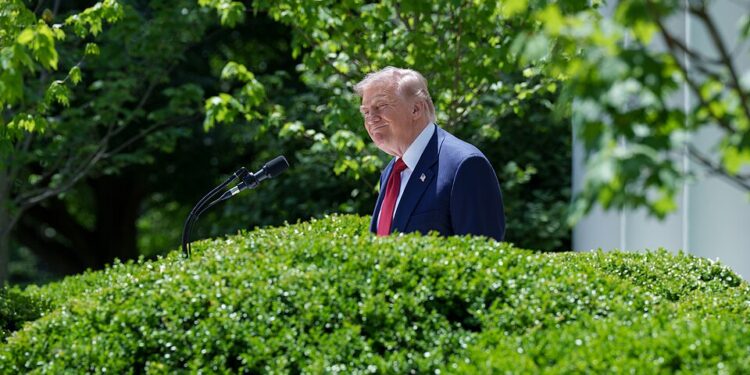
President Donald Trump is facing renewed political pressure after a series of national polls found his approval rating at its lowest point since returning to the White House. Three major surveys released this week showed the president struggling with voter concerns over the economy, inflation, gas prices, and the ongoing conflict with Iran.
While the White House dismissed the polling as a snapshot rather than a prediction, the results come as both parties begin looking ahead to the 2026 midterm elections.
Three Major Polls Show Similar Results
Several respected polling organizations reported nearly identical findings.
An AP-NORC survey conducted from July 23-27 found that 33% of Americans approve of Trump’s job performance, while 66% disapprove. The survey marked the president’s lowest approval rating in AP-NORC polling during his second term.
A Quinnipiac University poll conducted over the same period found 32% of registered voters approve of Trump’s performance, compared with 58% who disapprove. According to Quinnipiac polling analyst Tim Malloy, it is Trump’s lowest approval rating ever recorded by the university across both of his presidencies.
Meanwhile, a CNN poll conducted by SSRS placed Trump’s approval rating at 34%, matching the lowest level measured during his first administration. The survey also found that half of respondents strongly disapprove of the president, while strong approval reached a new low.
Although individual polls can vary, the consistency across multiple organizations suggests the administration is facing increasing political challenges.
Iran Conflict Continues To Influence Public Opinion
The renewed fighting involving Iran appears to be one of the biggest factors affecting public opinion.
Each of the major polls found that fewer than three in ten Americans approve of Trump’s handling of the conflict. Many respondents expressed concern about the possibility of a prolonged military engagement and questioned whether the United States has a clear long-term strategy.
The Quinnipiac survey found only 34% of voters support continued U.S. military action against Iran, while 60% oppose it. A majority also believe the conflict could continue for at least another year, and most respondents said they do not believe the costs of the war have been worth the outcome.
The AP-NORC poll found similar results, with Americans divided over the next step. Some favor continuing military operations, others want the United States to end its involvement, while another group prefers pausing military action to pursue diplomatic negotiations.
Economy Remains A Major Concern
Economic issues also continue to weigh heavily on the president’s approval ratings.
Across the surveys, Trump’s handling of the economy, inflation, and gas prices received lower marks than many other issues.
CNN’s poll found that only 30% approve of Trump’s handling of the economy, while large majorities expressed concern over rising fuel prices and the cost of everyday goods. Many respondents said they believe higher gasoline prices have created financial hardship for their households.
The Quinnipiac survey found that nearly half of voters believe they are financially worse off than they were one year ago. Most respondents also described the economy as either “not so good” or “poor,” while many said they expect economic conditions to continue worsening.
The AP-NORC survey likewise found that concerns over fuel prices remain widespread, with many Americans identifying gasoline costs as a significant source of financial stress.
Midterm Elections Already Drawing Attention
Political strategists are watching the latest polling closely as Republicans prepare to defend their congressional majorities in the 2026 midterm elections.
Historically, presidents with approval ratings below 40% have often faced difficult midterm environments. Several of the latest surveys also found weaker support among independent voters, a voting bloc that frequently decides competitive House and Senate races.
One poll found Democrats currently holding a narrow advantage on the generic congressional ballot while reporting higher voter enthusiasm than Republicans.
Still, campaign experts caution that the election remains months away and that economic conditions, international developments, and major policy decisions could significantly reshape the political landscape before voters head to the polls.
Additional Polls Reflect Similar Trends
The latest surveys mirror findings from several other national polls released during July.
Polling from The Economist/YouGov, Washington Post/Ipsos, CBS News/YouGov, and Pew Research Center also found Trump’s approval rating below 40%, reinforcing a broader trend that has developed in recent months.
Several polling averages likewise show the president with a negative net approval rating, although the exact figures vary depending on the methodology used.
White House Responds
The White House pushed back against the latest polling, arguing that public opinion surveys do not reflect the administration’s long-term record.
Officials pointed to President Trump’s victory in the 2024 election and said the administration remains focused on strengthening the economy, reducing inflation, improving housing affordability, securing the border, and advancing its broader policy agenda.
The administration also argued that many of its economic initiatives are still taking effect and said voters will ultimately judge the results based on long-term outcomes rather than short-term polling fluctuations.
Looking Ahead
With the midterm elections approaching, the administration will likely continue focusing on economic issues and foreign policy as it works to improve public confidence.
Whether these latest polls represent a temporary setback or the beginning of a longer political trend will depend on several factors, including inflation, gas prices, economic growth, and developments overseas.
For now, the newest surveys suggest the White House faces growing pressure to convince voters that its policies are producing the results Americans want to see.