
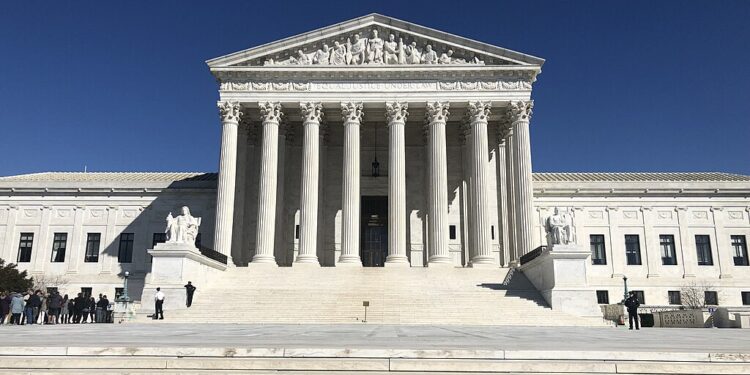
A closely watched federal immigration lawsuit is now raising broader concerns about judicial independence, political pressure, and the safety of America’s courts — all in the context of cases involving President Donald Trump.
The case, J.G.G. v. Trump, was filed by five Venezuelan nationals challenging their detention and potential removal from the United States. While the lawsuit focuses on immigration enforcement, a newly submitted court motion has injected serious constitutional questions into the proceedings, drawing national attention.
At issue is whether heightened political rhetoric surrounding President Trump may be placing improper pressure on federal judges — including members of the U.S. Supreme Court — during high-profile cases.
Unusual Court Filing Raises Questions About Judicial Pressure
Delaware attorney Meghan Kelly, who is not a party to the case, filed a request seeking permission to submit an additional amicus brief. Amicus briefs are designed to provide courts with broader legal or constitutional perspectives that may aid decision-making.
In her filing, Kelly argues that federal judges may be operating in an increasingly hostile political climate that could compromise impartial decision-making in cases involving President Trump.
She contends that courts must be able to operate independently, free from fear of retaliation or political leverage from either the executive or legislative branches.
Supreme Court Decisions Brought Into Immigration Dispute
Kelly’s motion specifically references two recent Supreme Court rulings:
- Trump v. United States (2024), which addressed presidential immunity
- Snyder v. United States (2024), which narrowed the scope of federal bribery laws
Justice Brett Kavanaugh authored the majority opinion in Snyder, joined by Chief Justice John Roberts and the Court’s conservative justices. The Court’s three liberal justices dissented.
Kelly suggests that trial courts should be permitted to consider whether intense political scrutiny or public pressure surrounding Trump-related cases could affect judicial reasoning.
Importantly, no court has found that Supreme Court justices were improperly influenced, and Kelly’s arguments reflect her personal legal theory — not established findings.
Claims of Political and Institutional Pressure
The filing argues that judges, attorneys, and litigants increasingly face pressure in politically charged cases.
Kelly claims that misuse of government authority — including public criticism, funding leverage, or legislative threats — could discourage fair adjudication if left unchecked.
She also expresses concern for attorneys working on sensitive cases, arguing that the legal system must ensure protection for those carrying out their professional duties.
There is no public evidence that President Trump or his advisers have issued threats toward judges or legal counsel. Neither the plaintiffs nor the federal government have endorsed Kelly’s allegations.
Concerns Raised About Congressional Influence
Kelly further argues that Congress could potentially influence court proceedings through impeachment rhetoric or budgetary pressure.
She asks the court to consider whether such actions, if taken, could interfere with due-process rights guaranteed under the Constitution.
She also notes that while her earlier amicus brief in the case was accepted, many state attorneys general later supported efforts to limit similar filings at the Supreme Court level — a move she views as troubling.
Attorney Expresses Safety Concerns
In supplemental statements, Kelly expresses personal concern about potential retaliation tied to her legal advocacy.
She claims that politically charged cases may expose attorneys to heightened risks, though these statements remain uncorroborated and have not been validated by the court.
The court has not indicated that it is investigating these claims.
What Comes Next in J.G.G. v. Trump
The underlying immigration lawsuit continues, with plaintiffs seeking class-wide relief related to detention and removal procedures.
The presiding judge may accept Kelly’s proposed amicus brief, decline it, or request responses from the parties. Such decisions are often made without oral argument.
Regardless of the outcome, any major ruling is expected to be appealed to the U.S. Court of Appeals for the D.C. Circuit, and potentially the Supreme Court — placing the judiciary once again at the center of a national political debate.
Why This Case Matters
While the case is formally about immigration enforcement, it highlights growing public concern over judicial independence, constitutional safeguards, and political polarization.
No court has substantiated claims of threats or improper influence. Still, the filing underscores how deeply legal disputes involving President Trump continue to resonate far beyond the courtroom.
As the case moves forward, its outcome could shape not only immigration law but also public confidence in the nation’s judicial system.