
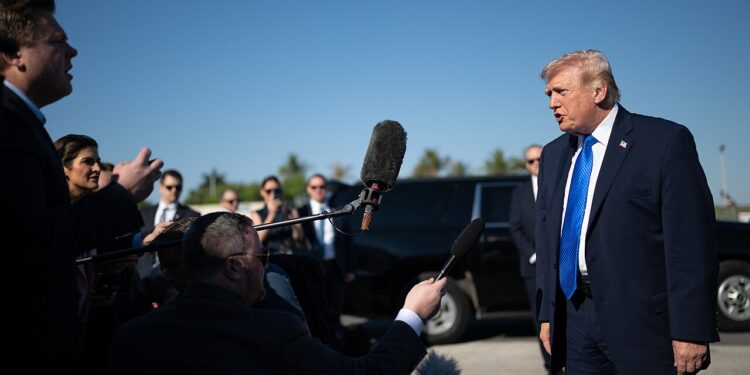
President Donald Trump renewed his criticism of the North Atlantic Treaty Organization (NATO) on Thursday, arguing that the United States continues to shoulder a disproportionate share of the alliance’s defense costs while many allies contribute far less.
In a series of Truth Social posts, Trump questioned whether America’s financial commitment to NATO is being matched by other member nations, reviving one of the central themes of his “America First” foreign policy.
Trump argued that the United States contributes far more to NATO than any other member nation, saying America spends heavily to defend its allies without receiving comparable benefits in return.
The president cited defense spending figures showing the United States at roughly $999 billion, compared with approximately $90.5 billion for the United Kingdom, $66.5 billion for France, $48.8 billion for Italy, and $44.3 billion for Poland. He also argued that several other major allies, including Germany, continue to spend significantly less.
According to NATO’s latest defense expenditure report, which includes estimated figures for 2025 based on data available through June 3, projected U.S. defense spending stands at approximately $980 billion. The report also estimates defense spending at $90.5 billion for the United Kingdom, $66.5 billion for France, $48.8 billion for Italy, and $44.3 billion for Poland.
Later Thursday, Trump expanded on his criticism, saying the alliance has not operated as an equal partnership.
“It is ridiculous for the U.S.A. to continue along this one-sided path when the relationship is not reciprocal,” Trump wrote. “They were not there for us.”
The comments come ahead of NATO’s upcoming summit in Ankara, Turkey, where Trump is expected to join leaders from across the alliance for discussions focused on defense spending, global security, and future strategic priorities.
Defense spending has been one of Trump’s most consistent issues with NATO. During both his first presidency and his current term, he has argued that many European nations have relied too heavily on American military power while failing to meet their own defense commitments.
Supporters of Trump’s approach say his pressure has encouraged allies to increase military investments and take greater responsibility for their own security. Critics, however, argue that his rhetoric risks creating unnecessary tensions within one of America’s longest-standing defense partnerships.
Last month, Trump met with NATO Secretary General Mark Rutte at the White House, where the two discussed international security challenges and the alliance’s future.
Trump has also questioned NATO’s role during recent tensions involving Iran. In an earlier Truth Social post, he said the alliance offered assistance only after the immediate crisis surrounding the Strait of Hormuz had eased. Trump argued that NATO should have taken a more active role earlier in the situation, reinforcing his broader position that America’s allies should do more to support shared security efforts.
With NATO leaders preparing to meet next week, defense spending and burden-sharing are expected to remain among the summit’s most closely watched topics. Trump’s latest remarks signal that he intends to keep those issues at the center of the conversation as the alliance faces growing global security challenges.spends more money on NATO than any other country