
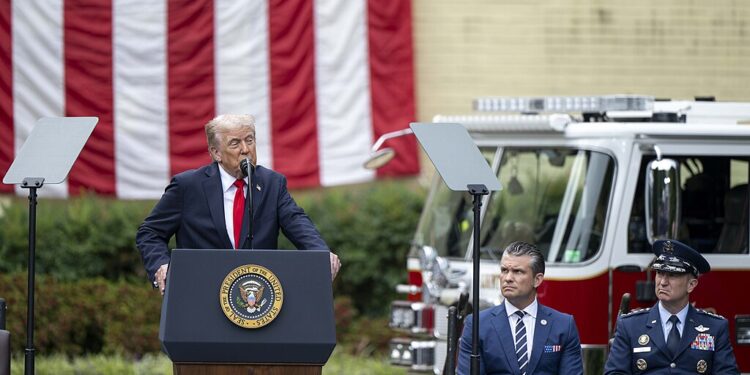
President Donald Trump sent a clear message to the world this week: America will not tolerate trade games.
After a major U.S. Supreme Court ruling limited parts of his emergency tariff authority, Trump responded with a forceful warning to foreign governments that attempt to exploit the decision. His message was simple — countries that try to sidestep agreements or manipulate trade terms will face even steeper tariffs.
For many Americans concerned about jobs, retirement savings, and rising prices, the stakes are significant.
Trump Responds to Supreme Court Tariff Decision
Last Friday, the U.S. Supreme Court ruled that President Trump exceeded his authority under the International Emergency Economic Powers Act (IEEPA) when he imposed sweeping tariffs on numerous U.S. trading partners.
The court determined that the emergency statute does not grant the president unlimited power to apply across-the-board import taxes without clear authorization from Congress.
The ruling temporarily invalidated tariffs affecting China, Mexico, Canada, members of the European Union, and other major trading partners.
But President Trump made it clear he does not view the decision as the final word.
On Truth Social, Trump warned that any nation attempting to “play games” in light of the court’s ruling — particularly those he says have taken advantage of America for decades — will be met with higher tariffs than previously negotiated.
A Proposed 15% Global Tariff
In response to the legal setback, Trump indicated support for a 15% global tariff baseline, up from the 10% rate previously outlined after the court’s decision.
One executive order already allows a 10% import tax to take effect this week, coinciding with the president’s State of the Union address.
Administration officials have emphasized that alternative legal tools remain available, including provisions within the Trade Act of 1974 that allow temporary tariffs under specific economic circumstances.
The White House has signaled that protecting American industry and reducing long-term trade imbalances remain top priorities.
Ongoing Trade Agreements Under Trump
Despite legal challenges, the administration has continued pursuing country-by-country trade negotiations.
Earlier this year, the United States finalized an Economic Prosperity Deal with the United Kingdom, establishing mutual tariff structures and broader economic cooperation.
The Office of the U.S. Trade Representative (USTR) has also announced:
- Reciprocal agreements with Malaysia and Cambodia
- Structured tariff frameworks with Vietnam and Thailand
- A completed Agreement on Reciprocal Trade with Indonesia
- Ongoing discussions with Japan, South Korea, India, and multiple Latin American partners
Supporters argue this bilateral strategy strengthens America’s leverage while ensuring fairer trade terms.
Constitutional Debate Over Trade Authority
Legal scholars quickly weighed in following the Supreme Court’s decision.
Some constitutional experts maintain that Congress holds primary authority over taxation and regulation of foreign commerce. Others argue that modern economic realities require flexible executive action during trade disputes.
The ruling has reignited debate over the separation of powers — particularly regarding how much authority a president should have in responding to foreign economic pressure.
For voters who prioritize constitutional boundaries, the decision represents an important legal clarification. For supporters of aggressive trade enforcement, it represents a hurdle — but not necessarily the end of the road.
Financial Markets React to Trade Uncertainty
Wall Street reacted cautiously as investors assessed the potential for renewed trade tension. Major stock indexes experienced volatility amid uncertainty about future tariff policy and possible retaliation from foreign governments.
Some business groups warned that a blanket 15% tariff could increase consumer prices in the short term. Others argue that strong trade enforcement could protect American manufacturing and create long-term economic stability.
For Americans nearing retirement or managing fixed incomes, trade policy is more than political debate — it can directly impact savings, investment portfolios, and household budgets.
What Happens Next?
With the State of the Union approaching, all eyes are on how the administration and Congress will respond.
Will lawmakers clarify presidential trade authority?
Will the White House pursue new tariff measures under alternative statutes?
Or will negotiations with key global partners reshape the landscape once again?
One thing is certain: President Trump has signaled he intends to maintain a firm negotiating posture — and nations around the world are paying attention.
Why This Matters to American Families
Trade policy affects:
- Manufacturing jobs
- Retirement accounts and stock markets
- Inflation and consumer prices
- Energy and supply chains
- National economic security
As global economic competition intensifies, the balance between constitutional authority and executive flexibility will remain at the center of the debate.