
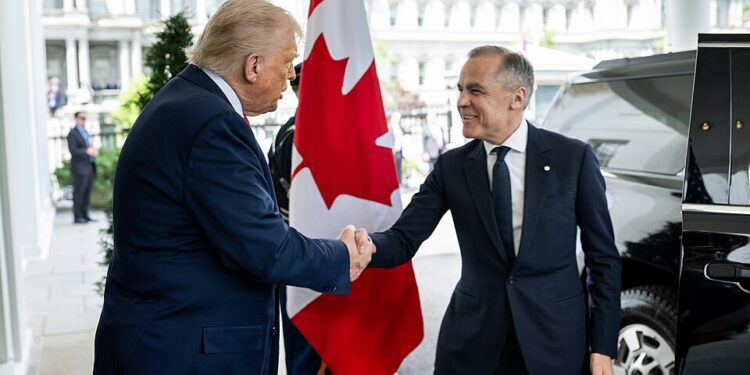
President Donald Trump’s growing trade showdown with Canada is taking a sharper turn, with Canadian Prime Minister Mark Carney acknowledging that negotiations between the two longtime allies have become increasingly contentious.
Carney said Thursday that Canada remains engaged in discussions with the Trump administration despite the president’s recent criticism of Canadian leadership and his threat to expand tariffs on goods entering the United States.
The dispute could have significant consequences for businesses, workers and consumers on both sides of the border, especially because the United States and Canada share one of the world’s largest trading relationships.
Carney described the negotiations as difficult and said his government views the dispute as a battle over Canadian jobs and the future of the country’s businesses.
His comments followed a blunt assessment from Trump during a Wednesday appearance in Las Vegas.
Trump said he has affection for the Canadian people but accused the country’s leadership of being “nasty” toward the United States.
Carney laughed when reporters asked about Trump’s description, but the underlying economic disagreement is serious.
The Canadian leader acknowledged that the two countries are now engaged in what he considers a tariff war.
Trump Threatens Canada With More Tariffs
The United States has already placed tariffs on major Canadian exports, including steel, aluminum and automobiles.
Trump is now threatening to increase the pressure considerably.
Additional Canadian products could face tariffs of up to 50% beginning Aug. 19 if Washington and Ottawa fail to resolve their differences.
The president has made tariffs a central part of his America First economic agenda, arguing that the United States should use its enormous consumer market as leverage when negotiating with foreign governments.
Trump’s broader argument is straightforward: Companies selling products to American consumers should have a powerful financial incentive to build factories, hire workers and manufacture more of those products inside the United States.
Supporters of Trump’s approach say decades of globalization and unfavorable trade arrangements contributed to the decline of American manufacturing communities while increasing the nation’s dependence on foreign suppliers.
They argue that aggressive trade negotiations could help bring investment, factories and good-paying manufacturing jobs back to the United States.
Critics counter that tariffs can increase expenses for American businesses that depend on imported materials. Those companies may eventually pass some of the additional costs to consumers through higher prices.
That makes the outcome of Trump’s battle with Canada particularly important for American families already watching household expenses closely.
Could Tariffs Raise Prices For American Consumers?
Tariffs are charges imposed on imported goods. Although the foreign country does not directly pay the tariff, the policy can make imported products more expensive for American companies purchasing them.
What happens afterward depends on the industry.
Businesses can absorb some of the additional expense, seek cheaper suppliers, reduce other costs, raise prices or move production.
Trump is betting that sufficiently high tariffs will encourage more companies to manufacture products in America rather than continue paying additional costs associated with importing them.
Whether that strategy produces significant long-term manufacturing growth without creating substantial short-term price increases remains one of the biggest economic questions surrounding the president’s trade agenda.
The issue is particularly important when tariffs involve a country as economically connected to the United States as Canada.
Why Canada Matters To The U.S. Economy
Canada is one of America’s most important trading partners, with an enormous amount of goods and services crossing the northern border each year.
The relationship affects industries ranging from automobiles and energy to agriculture, construction, manufacturing and consumer products.
Supply chains between the two countries are also deeply interconnected.
A product assembled in the United States may contain materials or components originating in Canada, meaning trade restrictions can affect American manufacturers even when the finished product is ultimately made domestically.
That economic integration raises the stakes considerably.
A prolonged trade dispute could potentially create difficulties for Canadian exporters while simultaneously increasing expenses for some American businesses.
Carney specifically pointed to aluminum as evidence of those concerns.
The Canadian prime minister claimed that existing U.S. tariffs have contributed to a 58% increase in American aluminum prices.
Carney argued that higher aluminum costs create an unfavorable situation for U.S. companies relying on the metal for manufacturing and production.
The Trump administration’s position is that tariffs can create the economic conditions necessary to encourage additional domestic production and reduce America’s reliance on foreign suppliers over the longer term.
Canada Pushes Back Against Trump
Canada has not simply accepted Washington’s trade measures.
U.S. Trade Representative Jamieson Greer has criticized Canada for retaliating against Trump’s tariffs. He has pointed to restrictions involving American alcohol sales in some Canadian provinces as one source of frustration.
Canadian officials maintain that their countermeasures were adopted in response to U.S. tariffs rather than as an unprovoked attack on American businesses.
Despite the disagreement, negotiations have continued.
Carney said Canadian representatives were in Washington this week discussing trade issues with American officials. He also indicated that additional conversations with Trump could take place after the two leaders spoke last week.
Whether those discussions produce a compromise before the threatened Aug. 19 tariffs take effect could determine whether the economic confrontation intensifies further.
Trump’s 51st State Comments Anger Canadians
Trade is not the only source of tension between Washington and Ottawa.
Trump has repeatedly suggested that Canada could become America’s 51st state, comments that have generated considerable controversy north of the border.
Many Canadians have strongly rejected the idea, and the worsening political relationship has reportedly affected attitudes toward travel to the United States.
Some Canadians have responded to the dispute by canceling or reconsidering American vacations, creating another potential economic consequence for U.S. destinations that traditionally attract Canadian visitors.
The increasingly strained relationship represents a major change between neighboring countries that have historically maintained close economic, military and diplomatic ties.
Trump And Carney’s Feud Has Been Building
The disagreement did not begin this week.
Tensions between Trump and Carney were already visible earlier this year.
During January’s World Economic Forum in Davos, Switzerland, Carney criticized powerful countries for using their economic strength to pressure smaller nations.
Trump responded by emphasizing Canada’s dependence on its relationship with the United States and directly challenged the Canadian prime minister over his remarks.
The exchange highlighted the dramatically different approaches of the two leaders.
Carney has portrayed Canada as a country defending its economic interests against pressure from a much larger neighbor.
Trump views America’s economic size as leverage that previous administrations failed to use aggressively enough.
For the president and his supporters, the question is why the United States should hesitate to use access to the world’s largest consumer economy to negotiate better trade arrangements for American workers and businesses.
Trump’s America First Strategy Faces A Major Test
The battle with Canada could become an important test of Trump’s broader economic philosophy.
The president has long argued that America’s traditional approach to international trade allowed factories, investment and jobs to move overseas while foreign manufacturers gained lucrative access to American consumers.
His answer has been a much more aggressive trade policy.
Trump believes tariffs can help level the playing field, protect strategic American industries and convince companies that manufacturing inside the United States makes better financial sense.
The potential reward would be increased domestic investment, stronger supply chains and additional American manufacturing jobs.
The potential risk is that businesses and consumers could face higher costs while the economic adjustment takes place.
How that balance ultimately develops could have significant consequences for Trump’s economic agenda.
Trade Fight Could Become A Midterm Election Issue
There is also an unavoidable political dimension.
Americans head to the polls for the Nov. 3 midterm elections, meaning the economy, inflation, jobs and the cost of living are likely to remain major issues for voters.
Republicans can point to Trump’s tariff strategy as evidence that the president is willing to confront foreign governments in an effort to defend American industries and workers.
Democrats are likely to focus on the potential for tariffs to increase costs for businesses and consumers.
For voters, however, the most important question may be much simpler: Is the strategy improving their financial situation?
If Trump’s tariffs result in major new investments, expanded manufacturing and additional American jobs, the administration will have a powerful argument that its aggressive approach produced results.
If prices climb without corresponding economic benefits, opponents will have an opening to argue that American families are paying the price for the trade confrontation.
What Happens Next With Canada?
The immediate focus is now on negotiations between Washington and Ottawa.
Canada says it intends to continue defending its businesses and workers while seeking an agreement with the Trump administration.
Trump, meanwhile, has given little indication that he intends to abandon tariffs as a negotiating tool.
The approaching Aug. 19 deadline could therefore become critical.
A new agreement could ease tensions between two countries whose economies have been closely connected for generations.
Failure to reach a deal could trigger another round of tariffs and retaliation, potentially increasing pressure on businesses and consumers on both sides of the border.
For Trump, the confrontation is about more than Canada. It represents a test of his broader promise to put American workers, manufacturing and economic interests first.
For Carney, it is about demonstrating that Canada will defend its own industries when confronted with economic pressure from Washington.
What began as a disagreement over tariffs has now become a high-stakes economic confrontation between two longtime allies — and American consumers, workers and businesses will be watching closely to see who ultimately gives ground.