
For years, President Donald Trump argued that America’s NATO allies were not paying their fair share for the alliance’s defense. His position drew criticism from leaders across Europe and Canada.
Now, one of Trump’s biggest foreign critics says the president was right.
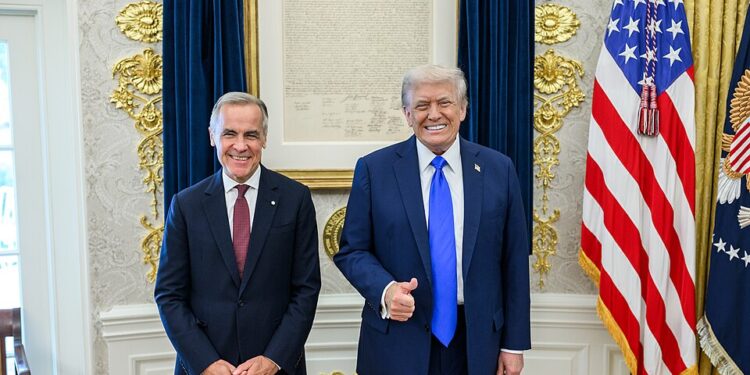
Canadian Prime Minister Mark Carney acknowledged Wednesday that Trump has successfully changed the conversation on NATO spending, saying years of pressure from the U.S. president have convinced allies to invest far more in their own defense.
Speaking during the NATO summit in Ankara, Turkey, Carney revealed that he spoke with Trump before the gathering and told him that NATO members increasingly recognize they must take greater responsibility for protecting themselves.
Carney argued that Trump is no longer simply making the case—he believes the debate has already been settled. According to the Canadian prime minister, NATO members now understand they must assume greater responsibility for their own defense because they recognize the growing security threats they face.
The remarks mark a dramatic shift from Carney, who has frequently clashed with Trump on trade and economic policy.
After winning Canada’s election in 2025, Carney sharply criticized Trump’s tariffs on Canadian goods, accusing the president of hurting Canadian workers, families and businesses. He also promised to keep retaliatory tariffs in place until the United States showed Canada greater respect.
Despite those disagreements, Carney admitted that Trump’s years-long campaign to pressure NATO members into spending more on defense has produced real results.
According to Carney, he personally shared that assessment during a phone call with Trump before both leaders arrived at the NATO summit.
“The president is here, and he’s in a good mood,” Carney told reporters.
Trump’s NATO Strategy Gains Momentum
Trump has spent years arguing that American taxpayers have carried too much of NATO’s financial burden while many European allies failed to meet their military commitments.
His message, once dismissed by many foreign leaders, is now becoming official NATO policy.
Alliance members have agreed to work toward spending 5% of their gross domestic product on defense and security by 2035—more than doubling the alliance’s longtime 2% benchmark.
The agreement represents one of the biggest shifts in NATO spending priorities in decades and reflects growing concerns over security threats, particularly from Russia.
While NATO cannot legally force member nations to meet the new goal, Trump’s administration has continued exploring ways to pressure allies that fall short.
Trump Increases Pressure On Allies
Trump made clear this week that he expects countries to follow through on their commitments.
The president singled out Spain after its government refused to fully embrace NATO’s new 5% defense spending target.
Trump criticized Spain as a weak partner within the alliance and urged stronger economic pressure until it contributes more toward collective defense.
Spanish officials argue they can satisfy NATO’s military capability requirements while spending roughly 2.1% of GDP, but that position has done little to ease concerns from Washington.
Other major NATO members, including Britain and France, have also pledged to increase military spending, although both remain well below the alliance’s new target.
As a result, questions remain about how aggressively the Trump administration will continue pressing America’s allies to accelerate their defense investments.
Earlier this month, U.S. NATO Ambassador Matthew Whitaker said the administration is evaluating possible responses for countries that fail to meet their commitments.
NATO Chief Credits Trump
Carney was not alone in recognizing Trump’s influence.
NATO Secretary-General Mark Rutte also praised Trump’s role in reshaping the alliance’s defense priorities.
According to Rutte, Trump accomplished what several American presidents had unsuccessfully pursued for generations by convincing European allies to assume a greater share of the financial responsibility for NATO’s security.
The comments represent one of the strongest public acknowledgments yet that Trump’s long-running campaign has fundamentally changed how NATO approaches defense spending.
Canada Expands Military Investment
Canada also announced several major defense initiatives during the summit.
The plans include purchasing new submarines, strengthening Arctic military communications through advanced satellite technology, and investing approximately $800 million in Joint Strike Missiles for Canada’s future fighter aircraft.
Carney said Canada was spending roughly 1.4% of its gross domestic product on defense when his government took office.
Under current plans, he expects that figure to climb to approximately 4% before the end of the decade using NATO’s accounting standards.
A Major Shift Inside NATO
For years, Trump argued that NATO members needed to stop relying so heavily on the United States and begin paying a larger share of the alliance’s defense costs.
Those arguments often sparked criticism from foreign leaders and political opponents.
Now, with NATO dramatically increasing its defense spending goals and even longtime critics acknowledging Trump’s influence, many of the policies he championed are becoming the alliance’s new standard.
Whether every member ultimately reaches the new spending target remains uncertain. But after years of debate, even some of Trump’s strongest international critics now concede that he fundamentally changed the conversation over NATO’s future.