
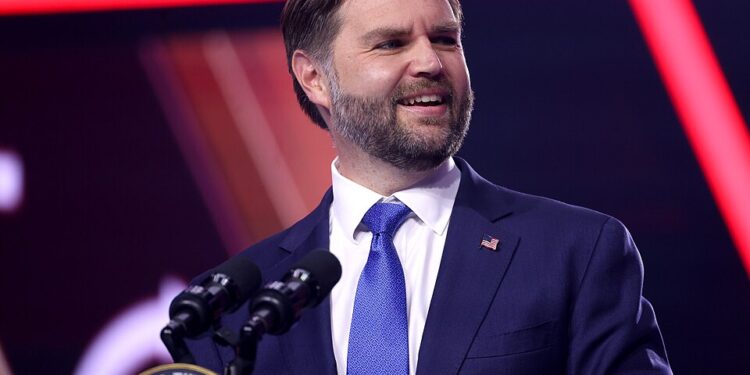
Vice President JD Vance is back in the middle of a social media fight — and this one started over the rising price of a burrito.
Vance fired off a cutting response to conservative Washington Post columnist Marc Thiessen after Thiessen mocked younger Americans who have complained about the high cost of eating out.
What might look like another political feud on social media actually touches on a much bigger issue facing American voters: inflation, food prices and the cost of living.
It also exposes a growing disagreement inside the Republican Party over how conservatives should respond to Americans struggling with higher everyday expenses.
JD Vance Fires Back Over Burrito Prices
The dispute began after Thiessen weighed in on complaints about burritos costing as much as $20.
Thiessen responded to a discussion involving Turning Point USA’s Andrew Kolvet and a college student’s complaints about food prices by writing, “cry me a river.”
He also argued that burritos available through a college cafeteria could already be covered under a student’s meal plan.
Vance apparently wasn’t impressed.
“I’m surprised to hear Mark say this,” Vance responded. “If you’ve ever met him in person, it’s quite obvious the man has never missed a burrito.”
The joke quickly attracted attention and marked something of a return to the vice president’s old social media style.
Vance became known for aggressively confronting political opponents and critics online, but those battles had become less frequent in recent months.
Now he’s jumping back into the ring.
Americans Are Still Worried About Food Prices
Behind the humor is an economic issue millions of Americans understand firsthand.
The price of restaurant meals has climbed substantially over the past decade.
At one Chipotle location in Illinois, for example, a chicken burrito with black beans, brown rice and roasted chili-corn salsa was recently priced at $9.65 before tax.
A receipt that went viral also provided a striking example of how prices have changed.
In 2015, two chicken bowls and a chicken burrito with guacamole reportedly cost $21.45 before tax. A comparable order roughly a decade later was estimated at $30.80.
That’s a significant increase.
And Americans aren’t only paying more when they go out to eat.
Inflation Has Changed The American Family Budget
The cumulative effect of inflation has dramatically changed what Americans can buy with their money.
According to the Bureau of Labor Statistics inflation calculator, the purchasing power of $1 in 2019 is roughly equivalent to $1.33 today.
That means families need considerably more money simply to maintain the purchasing power they had several years ago.
For older Americans, the issue can be especially important.
Retirees and households living on fixed incomes don’t necessarily have the ability to increase their earnings every time groceries, insurance premiums, utilities, housing costs or restaurant prices rise.
Working families have faced many of the same pressures.
Even when inflation slows, prices generally don’t return to where they were before the inflation occurred. Instead, consumers are often left paying those higher prices while hoping their wages and retirement income eventually catch up.
That distinction is becoming increasingly important politically.
Cost Of Living Could Decide The Midterm Elections
Affordability is shaping up to be one of the major political battles heading into the midterm elections.
Democrats believe they can use the issue against President Donald Trump and congressional Republicans.
It’s a familiar strategy.
Republicans hammered former President Joe Biden and Democrats over inflation, grocery bills, gasoline prices and housing costs during previous elections.
Democrats are now attempting to turn that same argument against the GOP.
They have particularly focused on Trump’s tariffs and foreign policy, arguing that administration policies are contributing to higher costs.
Trump strongly disputes that argument.
Trump Says Prices Are Coming Down
During a stop in Nevada, Trump insisted his administration is making progress on affordability.
“Costs are coming way down,” Trump said.
The president argued that he inherited an economy where Americans had already endured years of punishing price increases.
Trump has also criticized the sudden political focus on the word “affordability,” suggesting his opponents and the media are emphasizing the issue in an effort to damage Republicans politically.
For the White House, the challenge is straightforward.
Even if certain economic indicators improve, voters will ultimately judge the economy based on what they experience in their own lives.
That means grocery receipts, utility bills, mortgage payments, rent, insurance premiums, gasoline and restaurant checks could matter more politically than statistics coming out of Washington.
Vance Takes A Different Approach On The Economy
Vance has long positioned himself on the populist side of the Republican Party’s economic debate.
Rather than dismissing complaints about affordability, he has argued that America’s economic problems developed over decades under leaders from both parties.
Vance told Fox News host Laura Ingraham that, in his view, the economic policies pursued by both political parties over the last four decades have failed to deliver for Americans.
His argument is that Washington’s economic establishment allowed America’s industrial base to weaken while working- and middle-class communities paid the price.
Vance believes Trump’s economic agenda can reverse that decline by rebuilding domestic manufacturing and encouraging more investment inside the United States.
“Unfortunately for them, the Trump economy has made long-term investments in rebuilding that manufacturing base,” Vance said while discussing the rise of socialist political candidates.
That message has become central to the populist economic philosophy increasingly influential inside today’s Republican Party.
A Growing Debate Inside The GOP
The disagreement between Vance and Thiessen represents something bigger than a social media spat.
Republicans are having a serious debate about what conservatism should look like in the years ahead.
Traditional free-market conservatives generally emphasize lower taxes, limited government, free enterprise, personal responsibility and restrained government intervention in the economy.
Many conservatives in Trump’s populist coalition share those principles but argue that Washington must also confront economic policies they believe have hurt American workers.
That can include challenging China’s trade practices, imposing tariffs, bringing manufacturing jobs back to America and questioning decades of globalization.
Critics argue tariffs and other protectionist measures can increase costs for American consumers.
Trump’s allies counter that America’s dependence on foreign manufacturing carries its own enormous economic and national security costs.
The argument could help determine the future direction of the Republican Party.
Vance And Thiessen Have Another Major Disagreement
Economics isn’t the only issue separating the two men.
Vance and Thiessen have also clashed over foreign policy.
Vance has emerged as one of the most prominent Republican skeptics of extensive American involvement in overseas conflicts.
Thiessen has been more critical of that approach and repeatedly challenged Vance over the administration’s handling of Iran.
Those previous disagreements make the latest exchange more significant than a random joke about food.
There was already political tension between them.
The burrito battle simply brought it back into public view.
Vance’s Social Media Style Makes A Comeback
Vance’s willingness to jump into the dispute is also notable because his social media activity had become less combative.
The New York Times previously reported that White House Chief of Staff Susie Wiles and others had encouraged the vice president to tone down his online battles because of concerns that he could appear too abrasive.
The White House denied that account.
Vance later offered a different explanation, saying he removed X from his phone for Lent.
But he also made clear that he sees value in social media.
Vance said platforms like X allow him to hear “unfiltered raw opinions” from Americans — something he believes political leaders need.
Judging from his latest exchange, the vice president may once again be willing to engage directly with those opinions.
Why The Burrito Fight Matters
It’s easy to dismiss an argument about burritos as another silly Washington social media fight.
But the underlying disagreement is serious.
How much should an ordinary meal cost?
Why does a dollar buy less than it did several years ago?
Can younger Americans still afford the same middle-class lifestyle their parents enjoyed?
Can retirees maintain their standard of living as everyday expenses rise?
Those are questions politicians in both parties will have to answer.
Democrats believe affordability could be a political weakness for Republicans.
Trump and Vance are making the opposite case: that America’s economic problems are the product of decades of failed policies and that rebuilding American manufacturing offers a path toward greater long-term prosperity.
Vance’s jab at Thiessen may have generated the headlines.
But the fight behind the food fight — over inflation, affordability, trade and the future of the American economy — could have much bigger consequences for Republicans and the country.