
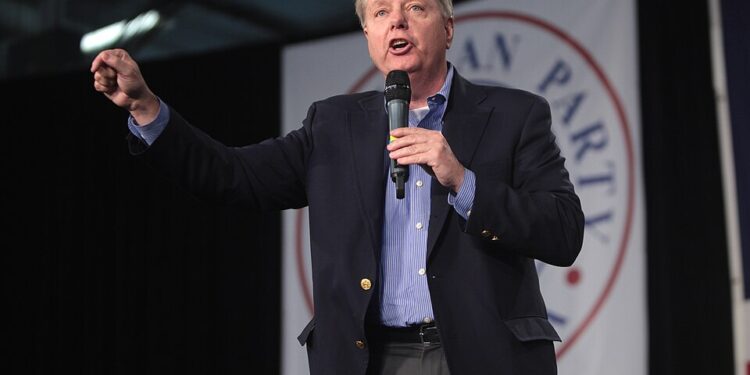
President Donald Trump delivered a playful but pointed warning to Sen. Lindsey Graham on Tuesday after the South Carolina Republican raised concerns about the administration’s emerging agreement with Iran.
Speaking to reporters during the G7 summit, Trump was asked about Graham’s public skepticism regarding the newly announced framework designed to bring an end to the conflict with Iran and restart diplomatic negotiations.
Trump joked that he might need to have a conversation with Graham, adding that the senator could find himself in trouble.
The president quickly followed up by downplaying any serious disagreement between the two longtime allies.
Trump dismissed the idea of any major disagreement, saying Graham was doing well and was not opposed to the deal.
The exchange highlighted growing interest among Republicans as details of the administration’s Iran strategy continue to emerge.
Over the weekend, reports surfaced that the United States and Iran had reached a preliminary framework agreement aimed at reducing tensions in the Middle East and paving the way for broader negotiations. The announcement was welcomed by many foreign policy observers after the reopening of the Strait of Hormuz, one of the world’s most important shipping routes for oil and energy supplies.
Still, Graham expressed caution regarding the deal’s long-term implications.
Graham said he has concerns that Iran may be interpreting the agreement differently than U.S. negotiators have described.
His comments reflected concerns shared by some conservatives who want to ensure any final agreement permanently prevents Iran from developing nuclear weapons.
President Trump and Vice President J.D. Vance formally signed a Memorandum of Understanding with Iran on Monday. However, the administration has not yet released the full text of the agreement, fueling questions from lawmakers, analysts, and supporters eager to review the details.
The White House says the memorandum serves as a framework for future negotiations and is intended to strengthen regional stability while addressing concerns about Iran’s nuclear program.
During remarks in France, Trump defended the agreement and argued that it represents a win for the United States.
“It covers something very nicely,” Trump said.
“We’re not paying for anything. We’re not doing anything. The markets now are higher than they were when we started.”
The president pointed to improving market conditions and reduced regional tensions as evidence that his approach is working.
Despite his earlier concerns, Graham later offered strong praise for Trump’s broader strategy toward Iran and the Middle East.
Graham said he hopes the upcoming talks will successfully eliminate Iran’s pursuit of nuclear weapons once and for all.
The senator also credited Trump’s actions with significantly weakening Iran and its proxy networks throughout the region.
The South Carolina Republican said Trump’s actions have substantially eroded Iran’s influence, weakened its proxy organizations, and significantly delayed its nuclear development efforts.
Graham went on to praise Trump’s efforts to expand the Abraham Accords, the historic agreements that normalized relations between Israel and several Arab nations during Trump’s first term.
Many conservatives view an expanded Abraham Accords framework as the key to long-term peace, greater economic cooperation, and increased security throughout the Middle East.
According to Graham, the ultimate goal extends far beyond a single agreement with Iran.
Graham argued that if the conflict ultimately leads to this result, it could rank among the most successful military achievements in U.S. history. He also praised Trump’s focus on promoting regional cooperation and securing long-term peace.
As negotiations move forward, Republicans will be closely watching whether the final agreement delivers on its promises. While questions remain about the details, both Trump and Graham appear united on one central objective: ensuring Iran never becomes a nuclear power while expanding America’s influence and strengthening peace in the Middle East.
The coming weeks could determine whether the agreement becomes one of the most significant foreign policy achievements of Trump’s presidency—or simply the first step in a much longer negotiation process.