
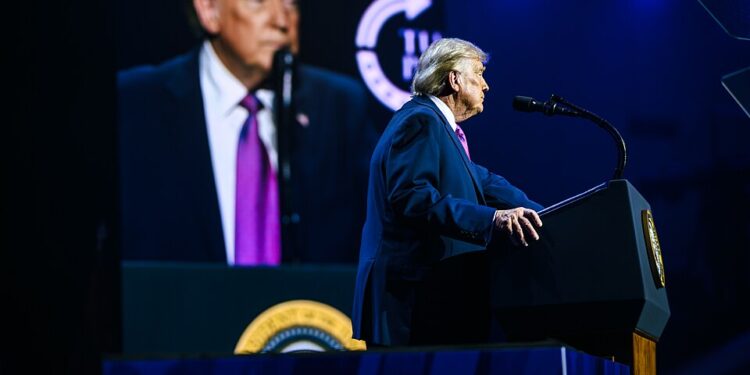
Fresh questions about President Donald Trump’s health erupted this week after a CNN medical analyst made alarming comments ahead of the president’s latest physical examination at Walter Reed Medical Center.
During a Tuesday appearance on CNN, Dr. Jonathan Reiner argued that Americans deserve more transparency regarding Trump’s overall health as the commander in chief approaches his 80th birthday next month.
The discussion quickly reignited debate over whether the mainstream media is once again attempting to place President Trump’s health under an intense political microscope while downplaying similar concerns involving other national leaders.
Reiner pointed to several recent public appearances involving Trump, including visible bruising on the president’s hands and reports of swelling around his ankles. The White House has previously explained the bruising as the result of Trump’s nonstop schedule and constant handshaking during public events and meetings.
But the CNN analyst drew the most attention when he suggested Trump may be dealing with what doctors call “daytime somnolence,” a condition involving excessive daytime tiredness.
“The president appears to struggle to stay awake during the day,” Reiner claimed during the interview while referencing moments critics have highlighted from recent public appearances and ceremonies.
According to medical experts, daytime somnolence — sometimes called hypersomnia — can involve persistent fatigue and daytime drowsiness. In some cases, experts say the condition may be associated with sleep disorders, stress, demanding schedules, or other health-related factors.
Reiner also argued that excessive daytime fatigue can sometimes be linked to reduced cognitive sharpness and cardiovascular concerns, though he acknowledged that only a full medical evaluation could determine the exact cause of any symptoms.
The remarks immediately sparked outrage among many Trump supporters online, with critics accusing CNN of pushing speculative narratives about the president’s health instead of focusing on his policies, leadership, and public schedule.
The White House strongly rejected the claims.
“President Trump is the sharpest and most accessible president in American history,” White House spokesperson Davis Ingle said in a statement to the Associated Press. “He is working nonstop to solve problems, deliver on his promises, and remains in excellent health.”
Supporters of the president were quick to defend him, pointing to Trump’s packed campaign schedule, lengthy rallies, frequent interviews, and high-energy public appearances as evidence that he continues to maintain a demanding workload few politicians could handle.
Others noted that Trump routinely speaks publicly for extended periods without teleprompters while continuing to dominate headlines and lead major policy discussions both at home and abroad.
The controversy also revived a broader debate about media coverage and political double standards, with many conservatives arguing that corporate media outlets appear far more aggressive when scrutinizing Republican leaders than Democrats.
As President Trump prepares for his latest medical examination at Walter Reed, Americans are expected to watch closely for any official updates from the White House regarding the president’s health and fitness for office.
At the same time, the latest controversy is likely to fuel even more debate over media credibility, political bias, and the growing role health speculation now plays in modern American politics.