
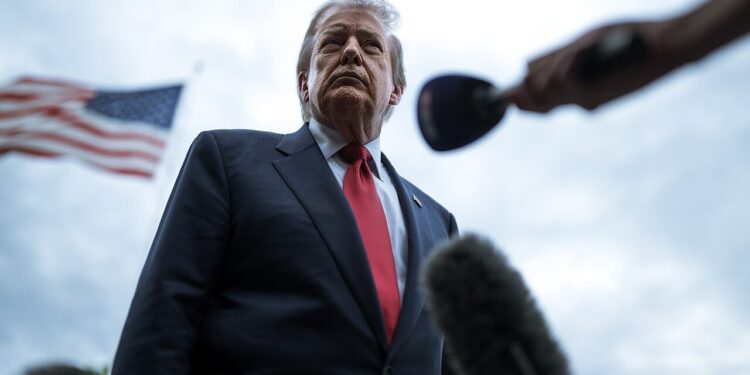
President Donald Trump defended his personal finances during a recent interview, saying he has little direct involvement in managing his investments while serving in the White House and that his family oversees the Trump Organization’s day-to-day business operations.
Speaking with CNBC, Trump said his wealth was built long before returning to office and emphasized his background as a businessman.
“I’ve always made money,” Trump said. “I’m a business person. I’m a really good business person.”
According to Trump, professional investment managers handle much of his financial portfolio, while his son Eric Trump oversees the family’s business interests. He said he does not direct those investments personally.
“I let people invest it,” Trump said. “My son Eric handles it. I don’t talk to him about things such as this.”
Trump explained that his assets are managed through trust arrangements overseen by large financial firms and suggested that recent gains in the stock market contributed to the growth of his overall net worth.
The discussion comes after Trump’s latest financial disclosure reported substantial income connected to cryptocurrency-related ventures. During the interview, however, Trump said he was not personally aware of the specific investments that generated those returns.
Trump also argued that even if he had known about the investments, federal law does not require the president or vice president to step away from every policy decision that could indirectly affect their personal financial interests.
“It just isn’t feasible to do it,” Trump said, adding that there is no legal requirement to recuse himself from every issue that could have some financial connection.
Before entering politics, Trump built his business empire through real estate development, hotels, golf resorts, licensing agreements, entertainment projects, and his television show The Apprentice. He said his financial success was established long before he first sought public office.
Trump also noted that he does not accept the president’s annual government salary, which is set at $400,000.
“This is the Oval Office,” Trump said. “It’s a much bigger purpose than whether or not I make money. I gave up my salary.”
The president also defended his children, saying they continue to face heightened public scrutiny because they operate businesses while he serves in office.
Trump argued that nearly any business decision made by his family is examined through the lens of his presidency, making it difficult for them to separate their private careers from public attention.
“They also have a life,” Trump said. “They were doing business long before I ever thought of running for president.”
When asked whether his cryptocurrency holdings could present a conflict of interest, Trump said he views digital assets as an issue of national competitiveness.
“We have to be at the top,” Trump said. “Otherwise China is going to take it over.”
Since returning to office, Trump has promoted policies aimed at expanding the U.S. cryptocurrency industry. His administration has supported reducing regulatory barriers for digital asset companies, encouraging innovation in blockchain technology, exploring a strategic Bitcoin reserve, and backing the growth of dollar-backed stablecoins.
Supporters of those policies argue they could strengthen America’s position in the rapidly evolving digital asset economy, while critics have questioned how elected officials should manage potential financial interests related to emerging technologies.
Trump’s financial disclosures, like those filed by other senior federal officials, are intended to provide public transparency regarding assets, investments, and sources of income while allowing voters and ethics experts to evaluate potential conflicts of interest.