
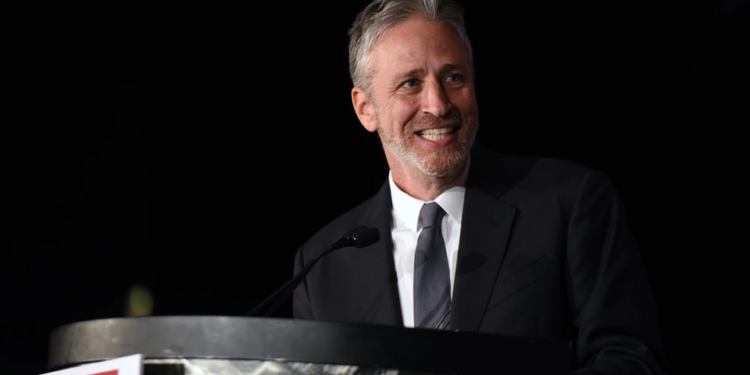
Late-night comedian Jon Stewart took aim at President Donald Trump during Monday night’s episode of The Daily Show, turning the president’s recent White House Correspondents’ Dinner remarks into a lengthy comedy critique.
Stewart spent several minutes analyzing Trump’s speech, joking that the president’s performance offered an unexpected lesson in how comedy routines should—and should not—be delivered. The segment quickly became one of the most talked-about moments in late-night television as Stewart dissected several of Trump’s jokes line by line.
Opening the show, Stewart referenced the White House Correspondents’ Dinner, noting that President Trump’s original appearance had been delayed after an earlier security incident disrupted the event.
With his trademark sarcasm, Stewart joked that Trump is widely known for his sense of humor before showing a montage of television commentators praising the president’s comedic style. Stewart then questioned those glowing reviews, suggesting viewers should judge the performance for themselves.
Still, Stewart argued that even experienced comedians occasionally deliver material that misses the mark.
“Everyone has jokes that don’t land,” Stewart suggested before introducing another portion of Trump’s speech. He encouraged viewers not to judge the president’s entire routine based on one moment and instead examine the full performance.
The focus then shifted to one of Trump’s biggest laughs of the evening—a proposal to hold weekly UFC fights on the White House grounds.
At first, Stewart complimented the idea, saying it had the makings of a simple, effective joke that audiences could easily follow.
According to Stewart, however, the delivery quickly lost momentum.
Instead of immediately revealing the punchline, President Trump spent several minutes discussing other topics, including the Indianapolis 500, Independence Day celebrations, and upcoming events before eventually circling back to the original premise.
Stewart paused the clip several times, arguing that successful comedy typically moves directly from the setup to the payoff instead of wandering through unrelated subjects.
When Trump finally returned to the joke, he initially appeared ready to poke fun at former New Jersey Governor Chris Christie before changing direction and instead mentioning Rep. Jerry Nadler (D-NY).
That switch became another target for Stewart’s commentary.
He joked that changing the subject of a roast midway through the joke makes it harder for audiences to follow, adding his own humorous observations about the two longtime political figures.
Trump later followed with another joke involving cheesecake, prompting Stewart to stare silently into the camera before bursting into another round of commentary.
The late-night host then decided to demonstrate how he believed the joke could have been delivered more effectively.
Using Rep. Alexandria Ocasio-Cortez (D-NY) as an example, Stewart created his own version of a punchline centered on foreign policy, arguing that a shorter, more direct joke would have connected more quickly with the audience.
When the video returned to President Trump’s speech, however, the president took a different approach.
Rather than delivering a quick punchline, Trump discussed Ocasio-Cortez’s response to a foreign policy question during a recent overseas appearance before eventually arriving at the conclusion of the joke.
As the clip continued, Stewart repeatedly interrupted with humorous reactions, urging the president to move more quickly to the payoff instead of explaining the setup in detail.
By the end of the segment, Stewart concluded that Trump’s biggest challenge as a comedian was pacing rather than material. He argued that audiences generally respond best to jokes that are concise, easy to follow, and quickly reach the punchline.
The exchange quickly spread across social media, with supporters and critics of President Trump offering sharply different reactions. Many Trump supporters dismissed Stewart’s criticism as another example of late-night television focusing disproportionately on conservative figures, while others simply viewed the segment as standard political satire.
The back-and-forth also reflects a broader trend that has defined American politics in recent years. President Trump has frequently criticized comedians, television hosts, and members of the news media, while many late-night programs have made him one of their most frequent subjects.
Supporters argue that Trump remains one of the few political leaders willing to challenge media figures directly, while critics contend that his speeches and public appearances naturally invite comedic commentary.
Regardless of where viewers stand politically, exchanges between President Trump and late-night television personalities continue to generate significant attention, fueling debate across television, social media, and the broader political landscape.
With the 2026 political season underway, clashes between President Trump and Hollywood entertainers are expected to remain regular headlines, keeping the ongoing battle between conservative politics and late-night comedy firmly in the national spotlight.