
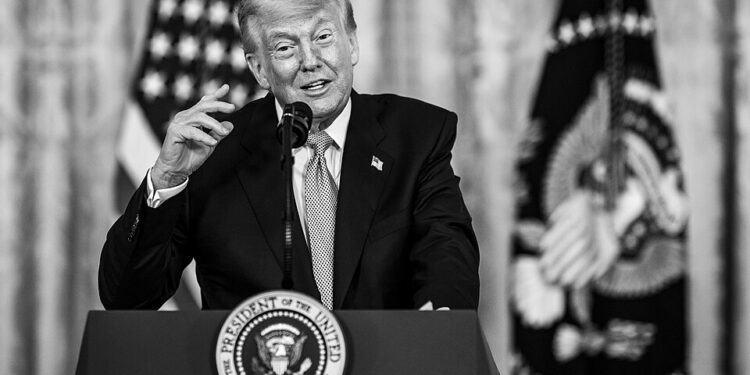
President Donald Trump has spent years warning Americans about socialism and the growing influence of the far left. Now comedian Bill Maher is attempting to turn that argument against Trump himself.
During Friday’s episode of HBO’s Real Time, Maher argued that some of the Trump administration’s economic policies resemble the kind of government intervention Republicans have traditionally associated with socialism.
His criticism focused heavily on Washington’s involvement with major corporations, particularly semiconductor manufacturer Intel.
The argument creates an unusual political debate at a time when democratic socialism is gaining greater attention inside the Democratic Party.
Trump supporters see his economic agenda as an America First strategy designed to protect U.S. manufacturing, jobs and national security. Critics, including some free-market conservatives, are asking whether government ownership of private companies crosses a line.
And Maher believes Republicans should be asking themselves that very question.
Bill Maher Turns the Socialism Debate on Trump
Maher accused Republicans of applying a double standard when discussing socialism.
Republicans have repeatedly criticized politicians associated with democratic socialism and warned that increasingly progressive economic policies could give Washington greater control over the lives and businesses of ordinary Americans.
Maher contends that Trump’s own policies deserve similar scrutiny.
The comedian pointed to federal involvement with Intel and other major corporations as evidence that Washington is assuming a larger role in private industry.
For Maher, the issue comes down to a basic question: How much ownership or influence can the federal government have over private companies before conservatives should become concerned?
It’s a question that is creating disagreement even among Republicans.
Trump’s Intel Strategy Takes Center Stage
Intel has become one of the clearest examples in this debate.
The semiconductor industry is enormously important to the modern American economy.
Computer chips are used in automobiles, smartphones, medical equipment, data centers, artificial intelligence technology and advanced military systems.
America’s ability to manufacture sophisticated semiconductors domestically has consequently become both an economic and national security concern.
Trump has defended federal investment in Intel as a successful deal for American taxpayers.
In April, the president said the government’s holdings in Intel had generated more than $30 billion in gains over several months.
Supporters of Trump’s approach can point to those returns while making a larger argument: If American taxpayers are helping strategically important corporations, taxpayers should receive something valuable in return.
That is considerably different from simply handing companies government money with no financial upside for the public.
Critics nevertheless remain concerned about the precedent.
Is Government Ownership Socialism?
The political argument ultimately revolves around the definition of socialism and the proper role of government in a free-market economy.
Traditional socialist economic systems generally favor substantial public ownership or control over important industries and economic resources.
America, by contrast, has historically relied primarily on private ownership, private investment and market competition.
A government purchasing a minority stake in a corporation does not automatically transform the entire U.S. economy into a socialist system.
However, critics argue that federal ownership of private businesses moves government into territory conservatives have historically viewed with suspicion.
That concern isn’t coming exclusively from Democrats or liberal television personalities.
One prominent Republican has raised it as well.
Rand Paul Sounds the Alarm
Sen. Rand Paul of Kentucky has criticized the federal government’s Intel investment from a conservative free-market perspective.
Paul called the idea a step toward socialism and questioned why the federal government should own part of a private semiconductor company.
His criticism exposes a significant philosophical disagreement within the Republican Party.
Traditional free-market conservatives generally believe government should create favorable conditions for businesses through lower taxes, fewer regulations and predictable laws — and then allow private companies to compete.
Trump’s economic philosophy can be more interventionist.
The president has embraced tariffs, domestic manufacturing incentives and other aggressive measures when he believes government action is necessary to protect American workers or strategically important industries.
Supporters call that economic nationalism.
Critics worry it gives Washington too much power.
Bernie Sanders Agrees With Part of Trump’s Approach
The story becomes even more politically unusual when Sen. Bernie Sanders enters the picture.
Sanders, one of America’s best-known democratic socialists, has supported the concept of taxpayers receiving ownership stakes when the government provides substantial financial assistance to major corporations.
Maher highlighted Sanders’ support as evidence for his argument.
If one of America’s most famous socialists approves of government taking corporate equity, Maher suggested, conservatives should consider whether Trump’s policy has moved away from traditional Republican economics.
But the overlap should not be exaggerated.
Trump and Sanders remain separated by enormous ideological differences.
They disagree sharply on taxation, health care, regulation, immigration, government spending and many other fundamental questions.
Agreement on one specific mechanism does not mean their broader economic philosophies are the same.
Still, the overlap demonstrates how dramatically American politics has changed.
Trump’s America First Economic Argument
Trump’s defenders have a powerful counterargument.
The global economy does not operate according to perfectly free-market principles.
Foreign governments frequently subsidize important industries, protect domestic manufacturers and use economic policy to advance national interests.
China, in particular, has spent years attempting to dominate strategically important industries and global supply chains.
That presents American policymakers with a difficult choice.
Should the United States maintain a hands-off economic philosophy while foreign governments aggressively support companies competing against American businesses?
Trump has largely answered that question with a resounding no.
His America First economic agenda argues that Washington should use tariffs, trade policy and other government tools when necessary to strengthen domestic manufacturing and protect America’s strategic interests.
For millions of Americans who watched factories close and manufacturing jobs move overseas over several decades, that message has been politically powerful.
Free Markets Versus Economic Nationalism
The Intel controversy therefore represents something much larger than another argument between Trump and a television comedian.
It highlights a major debate about the future of conservative economic policy.
One philosophy emphasizes traditional free-market principles: keep government small, reduce taxes and regulations, protect property rights and allow private markets to allocate capital.
The other argues that America sometimes needs a more muscular economic strategy to compete with countries that heavily subsidize their own industries.
Trump has increasingly represented the second approach.
That doesn’t necessarily make his economic program socialist.
But it does create legitimate questions about where government intervention should end.
Why Semiconductors Matter to America’s Future
Semiconductors aren’t an ordinary consumer product.
Modern economies cannot function without them.
American businesses depend on chips for transportation, communications, banking, health care, energy infrastructure and countless everyday products.
The explosive growth of artificial intelligence has made advanced semiconductor technology even more valuable.
There is also a national security dimension.
Modern military systems depend heavily on sophisticated computer chips, meaning access to semiconductor manufacturing capacity could become critically important during an international crisis.
That is why both Republican and Democratic administrations have treated semiconductor production differently from many ordinary industries.
The debate isn’t simply about whether Intel succeeds as a corporation.
It’s about whether the United States can maintain technological and manufacturing independence in an increasingly competitive world.
Trump Has Warned About Democratic Socialism
The controversy also carries political significance because Trump has repeatedly warned Americans about socialism.
He has compared democratic socialism with communism while criticizing the growing influence of progressive politicians.
Candidates associated with the Democratic Socialists of America have won elections in different parts of the country, raising the organization’s national profile.
Progressive Democrats generally reject Republican claims that their policies amount to communism.
They argue that democratic socialism can exist alongside democratic elections and civil liberties.
Conservatives counter that proposals for massive government programs, higher taxes and greater economic control inevitably increase Washington’s power over private citizens and businesses.
Maher’s argument attempts to expose what he sees as a contradiction.
If Republicans oppose government control when progressives propose it, he argues, they should also scrutinize government ownership when a Republican president supports it.
Maher Escalates His Attack
Maher didn’t stop with a philosophical disagreement over economics.
He portrayed Trump’s corporate strategy as an extraordinary threat and used some dramatic historical comparisons to make his point.
The comedian referenced World War I, World War II, Pearl Harbor and the September 11 terrorist attacks while describing what he sees as the danger posed by Trump’s approach to government power.
For many Americans, particularly Trump supporters, those comparisons are likely to sound wildly disproportionate.
There is an obvious difference between debating government investment policy and confronting wars or terrorist attacks that killed thousands of Americans.
But Maher’s comments demonstrate how heated the argument over Trump’s presidency remains.
Even economic policy can quickly become part of the country’s larger partisan battle.
Conservatives Have a Legitimate Debate to Settle
Strip away the television rhetoric and there is a serious policy question underneath this controversy.
What should America do when strategically important private companies need government assistance?
One option is traditional government subsidies.
Another is tax incentives.
Washington could also provide loans or loan guarantees.
Or, as Trump’s strategy demonstrates, taxpayers could potentially receive an ownership interest in exchange for government support.
Each approach carries advantages and risks.
An equity stake could allow taxpayers to benefit financially if the company becomes more valuable.
But government ownership also raises questions about political interference, favoritism and Washington’s influence over corporate decision-making.
Those are issues fiscal conservatives have warned about for generations.
What It Means for American Taxpayers
Ultimately, voters may care less about the political label and more about the results.
If government investment strengthens American manufacturing, creates good-paying jobs, protects national security and generates a return for taxpayers, supporters will argue that the policy has succeeded.
If political officials begin picking corporate winners and losers, interfering with business decisions or putting taxpayer money at unnecessary risk, critics will have a much stronger case.
That is why transparency and accountability matter.
Americans deserve to know how taxpayer money is being used, what financial risks the government is assuming and whether political influence is affecting private business decisions.
Those questions should matter regardless of which party controls the White House.
The Bottom Line
Bill Maher is trying to flip one of Trump’s strongest political arguments against him.
After years of Republicans warning about socialism on the Democratic left, Maher says Trump’s willingness to give Washington ownership interests in major companies deserves the same scrutiny.
But calling Trump’s entire economic agenda “socialism” oversimplifies a far more complicated debate.
Trump supporters view his approach as an America First strategy built around protecting U.S. manufacturing, strengthening national security and making sure American taxpayers benefit when Washington supports major corporations.
Free-market conservatives such as Rand Paul worry that government ownership creates a dangerous precedent.
And the fact that Bernie Sanders supports aspects of the idea makes the political picture even more unusual.
The larger question isn’t whether politicians can find another inflammatory label to throw at one another.
It’s whether America’s traditional free-market system can compete in a world where foreign governments aggressively support strategic industries — and how far Washington should be allowed to go in response.
For conservative voters, that’s the question worth watching.
Because the debate over Intel could ultimately become a much larger debate about American manufacturing, artificial intelligence, national security, taxpayer money and the future direction of the U.S. economy.