
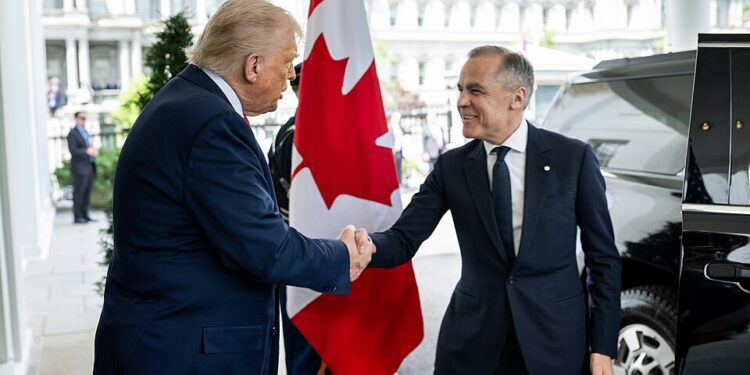
The trade battle between President Donald Trump and Canada has entered a dramatic new phase, with Canadian Prime Minister Mark Carney declaring that his country is effectively “at war” after the United States imposed sweeping new tariffs.
Carney’s extraordinary language came as Trump’s 50% tariffs on roughly $20 billion worth of Canadian goods took effect following the collapse of negotiations between Washington and Ottawa. Canada is now preparing retaliatory tariffs of its own, raising the possibility of a prolonged economic showdown between two of the world’s closest trading partners.
For Trump, the confrontation is another major test of his America First trade agenda and his promise to demand better treatment for U.S. workers, farmers and businesses.
For Canada, Carney says the dispute has become about something much larger than money.
Carney Says Canada Was ‘Attacked’
Carney used unusually forceful language while discussing the escalating dispute Saturday.
Carney told reporters that Canada had been targeted, describing the confrontation as the kind of conflict that amounts to an economic war.
The Canadian prime minister said his government was prepared to respond and argued that Canada has the financial resources and economic resilience necessary to withstand the confrontation.
Carney also accused the Trump administration of attempting to pressure Canada into accepting a deal that Ottawa considered unacceptable.
The comments show just how dramatically relations between Washington and Ottawa have deteriorated.
Trump Hits Canada With 50% Tariffs
The latest Trump tariffs impose a 50% levy on a range of Canadian imports after last-minute negotiations failed to produce an agreement.
The measures affect roughly $20 billion in Canadian goods and cover multiple industries, adding another layer to an already complicated trade relationship involving products such as steel, aluminum, lumber and automobiles.
Trump has long argued that America’s trading partners have enjoyed generous access to the enormous U.S. market while maintaining policies that disadvantage American producers.
The president made that argument again Sunday while taking direct aim at Canada.
“Canada wants the benefits of being a State, without being one!!!” Trump wrote on Truth Social.
Trump also criticized Canadian tariffs affecting American farmers and declared, “No more!!!”
It was vintage Trump: a blunt public warning that his administration intends to challenge trade arrangements it believes put American producers at a disadvantage.
Trump Revives His 51st State Argument
The dispute also comes against the backdrop of Trump’s repeated comments about Canada potentially becoming America’s 51st state.
Those remarks have generated fierce opposition north of the border and have become intertwined with the larger disagreement over trade and Canadian sovereignty.
Carney argues that Washington’s demands go far beyond ordinary negotiations.
Carney characterized the move as an attempt to exert leverage over Canada, arguing that it raised serious concerns about the country’s sovereignty.
“We’re a proud independent country,” he added, insisting that Canada intends to determine for itself how and with whom it conducts international trade.
That disagreement is now at the center of the deteriorating relationship between the neighboring countries.
Quebec Culture Becomes Part of Trade Fight
Another surprising issue has emerged in the negotiations: Canada’s cultural and language protections.
Carney alleged that Washington was demanding changes involving the French language, Quebec culture and Canadian identity as part of negotiations over tariff relief.
Carney argued that the dispute had moved beyond trade negotiations and had become a broader fight over Canada’s independence, sovereignty and national identity.
The underlying dispute involves whether certain Canadian cultural and language policies create obstacles for American businesses seeking access to Canadian markets.
The Trump administration’s broader argument is straightforward: American companies should receive fair access when foreign companies benefit from selling their products to U.S. consumers.
Canada sees some of Washington’s demands very differently, arguing that decisions involving its culture and national identity should remain entirely under Canadian control.
Canada Announces Retaliatory Tariffs
Ottawa isn’t planning to accept Trump’s tariffs without a response.
Carney announced that Canada will impose retaliatory tariffs on American goods beginning Sept. 8.
Canada intends to match the new U.S. tariffs “dollar for dollar,” potentially exposing American industries to additional costs as the dispute escalates.
The retaliation could affect U.S. products across several important sectors.
But Washington is already warning Canada against taking that step.
U.S. Trade Representative Jamieson Greer defended the administration’s position, arguing that Canada has historically enjoyed extraordinary access to American consumers.
“For decades, Canada has enjoyed the most favorable access to the U.S. market of any country,” Greer said.
He added that Canada has continued receiving highly favorable treatment under Trump’s trade policies.
What Trump’s Tariffs Could Mean for Americans
The political rhetoric may be centered in Washington and Ottawa, but ordinary Americans could ultimately feel some of the consequences.
Canada is one of the United States’ largest trading partners, with businesses on both sides of the border relying on deeply interconnected supply chains.
That means a prolonged tariff fight could affect American manufacturers, farmers, retailers and consumers.
Supporters of Trump’s strategy argue that short-term economic pressure may be necessary to secure fairer trade arrangements and protect American industries over the long run.
Critics counter that tariffs can raise costs for U.S. businesses importing foreign goods, potentially resulting in higher prices for consumers.
That debate is likely to intensify if Canada’s retaliatory measures take effect in September.
Farmers Could Become a Major Issue
Agriculture is particularly important to Trump’s argument.
The president has repeatedly complained about Canada’s protection of certain agricultural industries, especially its system of supply management for products including dairy.
Trump argues that American farmers should not face major barriers while Canadian businesses benefit from access to U.S. consumers.
For many voters in agricultural communities, the question is whether Trump’s aggressive approach can ultimately produce better market access for American producers.
The answer may depend on whether Canada returns to negotiations or chooses to continue retaliating.
Trade Fight Could Spill Into US Elections
The economic confrontation could also become a political issue inside the United States.
States including Michigan and Maine conduct substantial cross-border commerce with Canada, meaning businesses and workers there could be particularly sensitive to disruptions in trade.
With competitive Senate races potentially affected, candidates could face questions about whether Trump’s tariffs strengthen American negotiating power or create too much economic uncertainty.
Republicans are likely to emphasize Trump’s determination to defend American industries and demand reciprocal treatment.
Democrats and other critics are likely to focus on the possibility of higher costs and disruptions for businesses.
Either way, the Canada trade fight could become difficult for candidates to ignore.
Trump Uses Powerful Tariff Law
The administration is relying on Section 338 of the Tariff Act of 1930 as the legal basis for the new tariffs.
The rarely used provision allows tariffs of up to 50% against imports from countries determined to discriminate against American commerce.
For Trump, the law provides another tool to pursue the trade agenda that has defined much of his political career.
His basic philosophy has remained consistent: countries that want access to American consumers should provide fair treatment to American companies, farmers and workers in return.
US-Canada Trade Battle Is Far From Over
The language surrounding the dispute is becoming almost as dramatic as the tariffs themselves.
Canada’s prime minister is openly describing the situation as a “war.” Trump is accusing Canada of wanting the advantages of U.S. statehood without actually becoming a state. And both governments are threatening additional economic consequences.
Canada’s retaliatory tariffs are scheduled to begin Sept. 8, creating another potential flashpoint.
There is still time for Washington and Ottawa to return to negotiations before the situation escalates further.
But for now, neither Trump nor Carney appears ready to back down.
The result could determine far more than the price of Canadian imports. It could reshape America’s economic relationship with its northern neighbor — and test whether Trump’s hard-line tariff strategy can deliver the better trade terms he has promised American workers and businesses.