
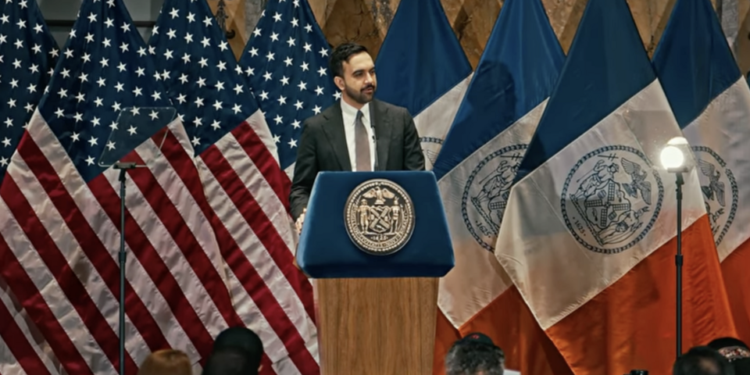
New York City Mayor Zohran Mamdani has found himself in the middle of a growing Democratic Party battle in Brooklyn, where a fight over internal rules, voting power and political control is exposing divisions inside the party.
The controversy centers on proposed changes to the Brooklyn Democratic Party that could dramatically expand the number of people allowed to vote in an upcoming leadership election.
Critics say the changes could dilute the influence of district leaders elected by voters in June. Supporters argue the overhaul would make the organization more inclusive and give additional Democrats a voice in major party decisions.
Mamdani isn’t buying that argument.
The mayor has publicly opposed the proposals from Brooklyn Democratic Party Chair Rodneyse Bichotte Hermelyn, saying the changes could undermine the message voters delivered at the ballot box.
The showdown has now become much bigger than a routine dispute over obscure party rules.
Mamdani Opposes Brooklyn Democratic Party Changes
Mamdani said Monday that he strongly opposes the proposed changes, arguing that party leaders should respect the results produced by voters.
The dispute comes after reform-minded Democrats scored significant victories during the June primary.
Reform candidates won 22 district leader seats, putting them in a strong position to influence who controls the Brooklyn Democratic Party going forward.
Those newly elected district leaders, however, do not take office until the fall.
That timing is crucial.
Current party officials are considering major changes before the incoming district leaders formally assume their positions.
Proposed Changes Could Reshape Leadership Vote
Bichotte Hermelyn’s proposal would add more than two dozen voting members to the party’s executive committee.
That committee will play a major role in choosing the next Brooklyn Democratic Party chair.
Under the existing structure, the reformers’ victories gave them significant leverage heading into that contest. Expanding the executive committee before the election could change the political math.
That is why opponents are sounding the alarm.
They argue that voters elected district leaders under one set of rules, only for party officials to consider changing the structure before those newly elected leaders can exercise their influence.
Bichotte Hermelyn has presented a different argument.
She says the proposed changes are intended to expand participation and representation inside the Brooklyn Democratic Party.
The debate therefore comes down to a basic question: Would the changes broaden participation, or would they dilute the power voters handed to the reform faction?
Reform Democrats Back Julio Peña
Reformers have rallied behind longtime Sunset Park district leader Julio Peña III to become the next Brooklyn Democratic Party chairman.
Their June victories appeared to put Peña in a strong position ahead of the upcoming leadership contest.
But adding new voting members could make the outcome considerably less predictable.
The fight has consequently turned into a battle between Brooklyn’s existing Democratic leadership and reformers seeking greater control of the organization.
Mamdani says the party should reflect what New Yorkers demanded through the electoral process.
He has also warned against the type of internal political maneuvering that can leave ordinary voters feeling disconnected from government and politics.
Other Top Democrats Join the Fight
Mamdani is far from alone.
Several prominent New York Democrats have pushed back against the proposed overhaul.
New York Attorney General Letitia James and Public Advocate Jumaane Williams have urged the Brooklyn Democratic Party not to move forward with the changes.
Their argument focuses heavily on timing.
James and Williams said party officials should not rewrite the composition of an executive committee immediately before a major leadership election.
Other major Democratic figures have also reportedly expressed opposition as the controversy has intensified, turning what might normally be an obscure internal party dispute into a much broader political story.
Former Party Chairs Could Receive Voting Power
One of the most controversial proposals goes beyond the upcoming leadership election.
Under another proposed change, former Brooklyn Democratic Party chairs could receive voting privileges in future leadership contests even if they no longer serve as elected district leaders.
That provision has attracted particular scrutiny because of former party chairman Clarence Norman.
Norman resigned from his leadership position in 2005 following multiple corruption convictions, including a conviction involving the solicitation of bribes from judicial candidates.
Under the proposed structure, Norman could potentially have a vote in future party leadership decisions.
For critics of the overhaul, that possibility provides another reason to question whether the changes would genuinely strengthen accountability.
Brooklyn Democratic Committee Could Grow Much Larger
Additional changes could eventually expand the executive committee even further.
After the upcoming leadership election, more voting members could potentially be appointed from individual Assembly districts.
The result could be an executive committee containing roughly 90 members.
Supporters believe a larger committee could create broader representation inside the Democratic organization.
Opponents see a different danger.
They worry that expanding the number of appointed or additional voting members could reduce the influence of district leaders who earned their positions directly through elections.
That distinction is at the heart of the entire controversy.
Why This Democratic Party Fight Matters
Internal party rules rarely attract widespread public attention.
But this fight raises a much simpler issue that voters across the political spectrum can understand: Who should control a political party — officials already holding power or representatives chosen by voters?
The June primary gave reform-minded Democrats substantial new influence inside Brooklyn’s party organization.
Now, before those newly elected leaders take office, the existing organization is considering changes that could alter how much power they actually possess.
Bichotte Hermelyn and her allies maintain that their proposals would increase representation and participation.
Mamdani and other opponents argue that changing the structure at this moment risks undermining the voters who participated in the June election.
Democrats Now Face a High-Stakes Decision
The dispute has created an unusual confrontation involving some of New York’s most recognizable Democratic politicians.
Mamdani may frequently find himself battling Republicans and conservative critics over policy, but this time his fight is coming from inside his own political party.
And the stakes extend beyond the identity of Brooklyn’s next Democratic chairman.
The outcome could determine who holds power inside one of the country’s largest local Democratic organizations, how future leadership elections operate and how much influence elected district leaders have over party decisions.
For voters watching from outside New York, the story also highlights a familiar political concern: whether party organizations respect election results when those results threaten the people already in charge.
The coming vote could determine whether Brooklyn Democrats move forward with the proposed overhaul — or whether growing pressure from Mamdani and other Democratic officials forces party leaders to retreat.