
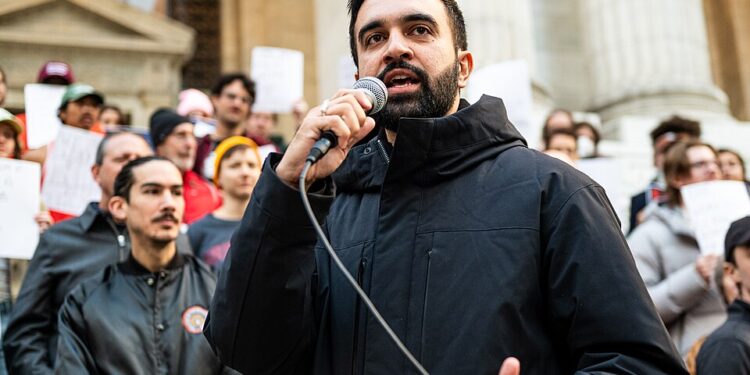
New York City Mayor Zohran Mamdani is celebrating another victory for the democratic socialist movement, pointing to a stunning mayoral primary result in Providence, Rhode Island, as evidence of a changing political landscape inside the Democratic Party.
David Morales, a 27-year-old Rhode Island state representative and democratic socialist, defeated incumbent Providence Mayor Brett Smiley in the Democratic primary, delivering another high-profile win for the party’s progressive wing.
The result quickly attracted Mamdani’s attention as Democrats prepare for the November midterm elections.
Speaking at a Thursday news conference in New York City, Mamdani argued that election results around the country are revealing what Democratic voters increasingly want from their candidates.
“We’re seeing that the voters across this country are eager for not only a change, but also for a vision of something that we are fighting for,” Mamdani said.
His remarks highlight a larger battle taking place inside the Democratic Party over housing, government spending, affordability and the growing influence of democratic socialist candidates.
Mamdani Sees a Bigger Message
Mamdani connected Morales’ victory to an issue that helped fuel his own political rise: the cost of living.
Housing and childcare were major topics during Mamdani’s Thursday appearance, where he discussed efforts in New York aimed at reducing costs for families.
When asked about the Rhode Island election, however, Mamdani turned his attention to Morales’ emphasis on rent stabilization and housing affordability.
Mamdani said that, from what he knows about the likely incoming mayor, rent stabilization and delivering meaningful relief on affordability were among the defining issues of his campaign.
There is one important qualification: Morales has won the Democratic primary, not the mayor’s office itself. He still faces the November general election.
Democratic Socialist Scores Major Upset
Morales’ victory was significant because he defeated a sitting Democratic mayor.
The young state representative ran on an unabashedly progressive platform that included rent stabilization and stronger protections for tenants.
His campaign also received the endorsement of Sen. Bernie Sanders of Vermont, one of America’s best-known democratic socialists.
Morales portrayed his victory as proof that a young progressive candidate could defeat better-funded political opposition.
The result gives democratic socialists another victory to highlight as they seek greater influence within the Democratic Party.
It also gives Republicans and moderate Democrats another example to examine as the national debate intensifies over how far the Democratic Party should move toward progressive economic policies.
Housing Becomes the Battleground
The Providence primary was shaped heavily by one issue affecting Americans across the political spectrum: housing costs.
Rents in Providence have increased substantially since 2020, making affordability a major concern for residents.
Morales advocated rent stabilization as part of the solution.
Smiley took a different approach, warning that rent controls could discourage developers from building additional housing.
That disagreement reflects a much larger national policy debate.
Supporters of rent controls argue that limits can protect tenants from sudden and unaffordable increases. Critics contend that restricting rents can reduce incentives to construct or maintain rental properties, potentially worsening housing shortages over the longer term.
Those competing arguments are increasingly important as cities around the country struggle with rising housing costs.
Immigration Adds Another Divide
Immigration enforcement has also become part of the political divide in Providence.
Morales has advocated stronger protections for immigrants and has sharply criticized federal immigration enforcement.
During his primary victory speech, Morales pledged that Providence would use the tools available to city government to protect immigrant communities.
Republicans have taken a substantially different position on the broader issue.
Vice President JD Vance and other Republicans have argued that high levels of immigration can increase demand for limited housing supplies, particularly in communities already experiencing shortages.
Housing economists and policymakers continue to debate the relative importance of immigration alongside other factors affecting prices, including insufficient construction, zoning restrictions, interest rates, population growth and development costs.
Why Providence Matters Beyond Rhode Island
Providence is overwhelmingly Democratic, making its Democratic primary especially consequential.
The city has no Republicans on its City Council, and Democratic presidential candidates have historically performed strongly there.
That political makeup means Morales’ primary victory is likely to receive attention far beyond Rhode Island as Democrats debate which policies and candidates should define the party’s future.
Mamdani clearly sees a connection.
His own political message has focused heavily on affordability, housing and an expanded role for government in reducing household expenses. Morales campaigned on several similar themes.
Their victories therefore provide progressive Democrats with evidence that those ideas can appeal to Democratic primary voters in major urban areas.
But opponents argue that electoral success does not necessarily establish whether policies such as rent stabilization will produce the promised economic results.
That policy debate is unlikely to disappear anytime soon.
A Growing Fight Over the Democratic Party’s Direction
Morales’ victory arrives as Democrats face an increasingly visible disagreement between the party’s progressive, moderate and democratic socialist factions.
Progressives argue that voters frustrated by housing costs and other household expenses want more aggressive government action.
Moderates have warned that moving too far left could create political and economic risks, particularly outside heavily Democratic cities.
Republicans, meanwhile, are expected to use the rise of democratic socialist candidates as part of their broader argument against Democratic economic policies heading into the midterm elections.
For Mamdani, however, the Providence result carries a simpler message.
Another candidate campaigning heavily on affordability and rent stabilization just defeated an incumbent Democrat.
Now the political fight moves toward November — and the outcome in Providence is likely to remain part of the larger national debate over where the Democratic Party is headed.