
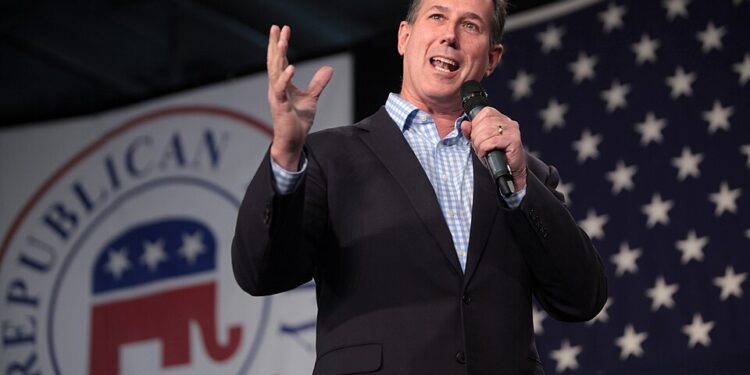
Former Republican Sen. Rick Santorum is breaking with President Donald Trump over one of the president’s most attention-grabbing economic proposals: a plan to provide $5,000 payments to American adults if Republicans maintain control of Congress.
Santorum, who represented Pennsylvania in the U.S. Senate, said Sunday that he has serious concerns about the potential economic consequences of sending another large round of government payments to Americans.
“I’m not a big fan of it,” Santorum said during an appearance on Newsmax’s “Sunday Report.”
His objection is centered primarily on government spending, inflation and America’s massive national debt.
Santorum argued that distributing $5,000 payments across the country would not necessarily generate lasting economic growth. Instead, he warned that injecting such a large amount of money into the economy could contribute to higher prices.
That puts the former senator at odds with Trump on a proposal that could become an important part of the economic debate heading into the November midterm elections.
Trump Promises Americans a $5,000 Dividend
Trump announced the proposed payments during the Republican midterm convention in Dallas.
Under the proposal outlined by the president, adult U.S. citizens would receive $5,000 if Republicans retain control of both the House and Senate.
Trump has promoted the idea as a “dividend” for Americans while arguing that the United States is bringing in enough revenue to make the payments possible.
However, major questions remain about exactly how such a program would work, including how it would be funded, who would qualify and what role Congress would have in authorizing the money.
Those unanswered questions could become increasingly important as lawmakers and voters examine the proposal more closely.
Santorum Warns About Inflation
Santorum’s primary objection is economic.
The former senator argued that another large federal payment program could put additional money into circulation without producing a corresponding increase in economic output.
From his perspective, that creates a risk of additional inflation.
Santorum also questioned whether sending checks directly to millions of Americans would provide the type of sustained economic growth supporters hope to achieve.
“The economic side of this, I just don’t think it washes very well,” he said.
The disagreement highlights a longstanding debate within Republican economic circles.
One side emphasizes returning money to Americans and providing immediate financial relief to households. The other emphasizes controlling federal spending, reducing deficits and preventing government policies from contributing to inflation.
Santorum is firmly emphasizing the latter concerns when it comes to Trump’s proposed dividend.
America’s $40 Trillion Debt Looms Over Debate
Santorum also pointed to another enormous financial issue facing Washington: the national debt.
Federal debt has surpassed $40 trillion, adding urgency to arguments over government spending and the country’s long-term finances.
Santorum said Americans are becoming increasingly aware of the size of the debt and argued that Washington should be moving toward greater fiscal discipline.
“People are more and more concerned about the fact that we have a $40 trillion debt,” Santorum said. “That’s not sound.”
The sheer scale of a nationwide $5,000 payment program means the funding question could become one of the biggest issues surrounding Trump’s proposal.
Even before eligibility requirements and other restrictions are determined, providing thousands of dollars to a large portion of the adult population would carry an enormous price tag.
For fiscal conservatives, the central question is whether the government could finance those payments without increasing federal borrowing or creating additional inflationary pressure.
Santorum Defends Trump Against ‘Bribe’ Accusation
Despite opposing the proposed payments on economic grounds, Santorum rejected the argument that Trump is attempting to “bribe” Americans into voting Republican.
Santorum said Trump’s broader argument is that Republican control of Congress is necessary for the president to enact major parts of his agenda.
“I don’t believe it’s a bribe,” Santorum said.
He pointed out that presidents depend heavily on congressional majorities when attempting to pass tax legislation, spending measures and other major economic policies.
A president facing an opposition-controlled House or Senate can encounter significant obstacles when attempting to move legislation through Congress.
“What the president says, if you give me a House, you give me a Senate, I can pass a tax bill,” Santorum said.
Santorum therefore separated the political argument from the economic one.
He defended Trump’s right to tell voters that Republican congressional victories would make it easier to advance his agenda while simultaneously questioning whether the $5,000 payment itself represents sound economic policy.
Poll Shows Voters Skeptical of $5,000 Payments
Questions also remain about whether Americans believe the proposed payments would actually materialize.
Patrick Allocco, founder of the Zoose Political Index, discussed polling during the Newsmax segment that indicated substantial skepticism among respondents.
According to the CBS News/YouGov figures cited by Allocco, 20% believed they would probably or definitely receive the proposed $5,000 payment.
By comparison, 64% believed they probably or definitely would not receive it.
Allocco also said the proposal itself had more opposition than support among those surveyed, with 35% supporting it and 45% opposing it.
But another number could help explain the political appeal behind Trump’s announcement.
According to Allocco, 18% said the promise made them more likely to vote Republican.
He suggested Republicans could be particularly interested in whether the proposal motivates younger male voters who do not regularly participate in elections.
Republicans Debate Their Economic Message
The discussion went beyond Trump’s dividend and turned toward the broader Republican economic message heading into the midterms.
Santorum argued that Republicans should spend more time explaining the specific policies they oppose rather than relying heavily on ideological labels.
He specifically questioned whether repeatedly describing political opponents as “socialists” or “communists” is enough to persuade voters.
“Most people, frankly, don’t know what socialism is,” Santorum said.
His argument was that Republicans could be more effective by explaining how particular policies would affect taxes, government spending, businesses, jobs and household finances.
Allocco raised a similar concern about the economy.
He said Republicans need to confront voter concerns over present economic conditions, including gasoline prices, instead of focusing exclusively on what their policies could accomplish years from now.
His suggested message is that some economic difficulties may represent short-term costs associated with policies Republicans believe will eventually produce greater prosperity.
Whether voters accept that argument could become an important part of the political debate heading toward November.
$5,000 Proposal Exposes a Republican Fiscal Divide
The disagreement between Trump and Santorum highlights a larger debate that has existed within the Republican Party for decades.
Republicans have traditionally emphasized lower taxes, restrained federal spending and smaller government. At the same time, Trump has periodically embraced economic policies that involve direct government intervention or payments to Americans.
The proposed $5,000 dividend brings those two approaches into direct conflict.
Supporters of direct payments can argue that Americans should benefit when the federal government generates additional revenue and that putting money into household bank accounts could provide immediate financial relief.
Critics can counter that Washington cannot ignore deficits, debt and inflation when considering a program potentially costing hundreds of billions of dollars or more.
Santorum’s comments show that opposition to the proposal is not limited to Democrats.
Some Republicans and fiscal conservatives are also asking whether the numbers make sense.
What Happens Next?
For now, Trump’s $5,000 dividend remains a proposal rather than money Americans can count on receiving.
Important details would have to be resolved before payments could become reality, including eligibility requirements, financing and the federal government’s legal mechanism for distributing the money.
That distinction is especially important for Americans making household financial decisions. Until a program is formally authorized and implemented, families should not treat a proposed $5,000 payment as guaranteed income.
The political significance of the proposal, however, is already becoming apparent.
Trump is using the dividend to emphasize what he says Republicans could accomplish with continued control of Congress. Santorum agrees with Trump that congressional majorities matter, but he is unwilling to embrace the president’s proposed checks without confronting the potential financial consequences.
That leaves Republicans with a debate extending far beyond one $5,000 payment.
Should additional federal revenue be returned directly to Americans, or should Washington prioritize reducing deficits and controlling the national debt?
Santorum has made his position clear: He supports advancing Republican economic policies, but when it comes to Trump’s proposed $5,000 dividend, he believes the potential cost to the country deserves much closer scrutiny.