
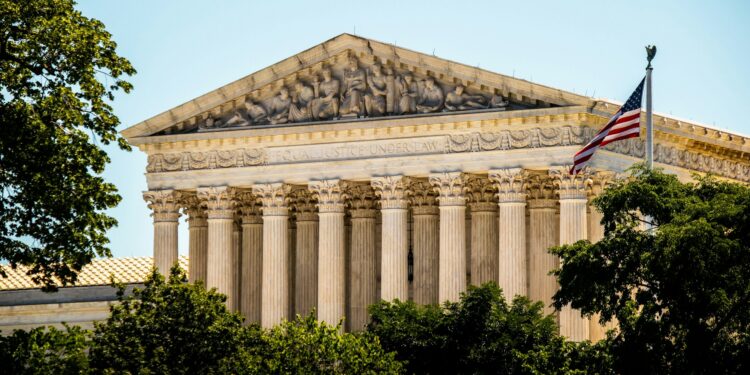
The U.S. Supreme Court has delivered a significant setback to Missouri Republicans in a closely watched congressional redistricting battle, blocking the state from using newly drawn boundaries that could have improved the GOP’s chances of gaining another seat in the U.S. House.
The decision means Missouri is currently expected to use its 2022 congressional map in the November midterm elections instead of the newer boundaries supported by President Donald Trump and Republican state lawmakers.
The development could have major political consequences in a year when control of Congress is at stake.
Republicans currently hold six of Missouri’s eight congressional seats, while Democrats control two. GOP leaders had hoped the newer map would give Republicans an opportunity to increase their advantage to seven seats.
Now those plans face a major obstacle.
Supreme Court Blocks New Missouri Map
At the center of the dispute is a newer congressional map designed to change the boundaries of several districts across Missouri.
One of the most important changes involved the Kansas City-area district represented by Democratic Rep. Emanuel Cleaver.
Under the newer boundaries, portions of Cleaver’s district would have been shifted into more Republican-leaning territory. That could have made the seat considerably more competitive and potentially created another pickup opportunity for the GOP.
Returning to the 2022 map leaves Cleaver with district boundaries that are more favorable to Democrats.
For Republicans fighting to maintain or expand their strength in the House, the difference of even one congressional seat could prove important.
Missouri Voters Face an Unusual Situation
The court fight has also created an unusual problem for voters.
Missouri already conducted its August congressional primaries using the newer district map. Candidates therefore secured their party nominations under boundaries that are not currently expected to be used in the November general election.
As a result, some Missouri residents could vote in a different congressional district in November than the district in which they participated during the primary.
More than 1 million voters could potentially be affected by the boundary change, according to an Associated Press estimate.
That leaves election officials, campaigns and voters with little time to adjust before Election Day.
Why Congressional Maps Matter
Congressional districts are normally redrawn once every 10 years following the U.S. Census.
The process is intended to account for population changes and ensure districts contain roughly equal numbers of residents.
But Missouri became part of a broader national fight over mid-decade redistricting as political parties looked for opportunities to strengthen their positions ahead of crucial congressional elections.
Missouri Republicans backed a new map that could have made the state’s congressional delegation even more favorable to the GOP.
The proposal quickly became the subject of legal challenges, setting off a lengthy fight over which boundaries should ultimately be used.
Legal Battle Reaches Supreme Court
The dispute moved through state and federal courts before eventually reaching the U.S. Supreme Court.
A federal judge had ordered Missouri to use the newer congressional boundaries for the November election, in part because the state had already conducted its primary under that map.
The Supreme Court then stepped in and stayed that order.
The justices did not provide an explanation for their decision in the brief order, and no dissenting votes were publicly noted.
That distinction is important.
The Supreme Court’s action does not necessarily settle every legal question surrounding Missouri’s redistricting fight. Instead, it determines which court order remains in effect while the broader dispute continues.
For the November election, however, the immediate impact is substantial.
Missouri is currently preparing to return to its 2022 congressional boundaries.
Republicans Lose Potential Pickup Opportunity
The political stakes are easy to understand.
Republicans already dominate Missouri’s congressional delegation, controlling six of the state’s eight House seats.
The newer map offered the GOP a potential path toward capturing a seventh.
Cleaver’s Kansas City district was the most obvious target because the proposed boundaries would have added more Republican-leaning voters to the district.
With the older map restored, Democrats have a stronger position for defending that seat.
That makes the Supreme Court’s intervention an important development not only for Missouri but also for the nationwide battle over control of the House.
Candidates Must Quickly Adjust
The changing district lines could also force campaigns to rethink their strategies just weeks before voters head to the polls.
Candidates who spent months campaigning under one set of boundaries may now find themselves competing under another.
Campaign organizations could have to redirect advertising, voter outreach and resources toward communities that were not part of their districts during the primary.
Election officials also face the challenge of making sure residents understand where they will vote and which congressional contest will appear on their ballot.
Voters should therefore verify their congressional district and ballot information through official state or local election authorities before voting.
A Bigger National Redistricting Fight
Missouri’s dispute reflects a much larger political battle taking place across the country.
Congressional maps can have enormous influence over which party controls individual districts and, ultimately, the House of Representatives.
That is why redistricting fights routinely produce lawsuits and intense political disagreements.
Mid-decade redistricting has added another layer to that debate because congressional boundaries traditionally remain in place until the next census-driven redistricting cycle.
Supporters of new maps argue that states have legal authority to reconsider their congressional boundaries under certain circumstances.
Critics argue that repeated redrawing can allow whichever party controls state government to seek additional political advantages between census cycles.
Those questions are likely to remain important well beyond Missouri.
What Happens Next?
For now, Missouri election officials must prepare for the November election using the 2022 congressional boundaries unless another court development changes the situation.
The immediate political effect is clear: Republicans have lost the benefit of a newer map that could have increased their chances of winning another Missouri congressional seat.
Democrats, meanwhile, will head into November with boundaries that provide a more favorable environment for defending Cleaver’s Kansas City-area district.
But perhaps the biggest challenge belongs to Missouri voters.
After participating in a primary conducted under one congressional map, some residents may now cast their general-election ballots under another.
With control of Congress at stake, Missouri’s unusual redistricting battle has transformed what might normally be a state-level map dispute into a closely watched part of the national midterm election.