
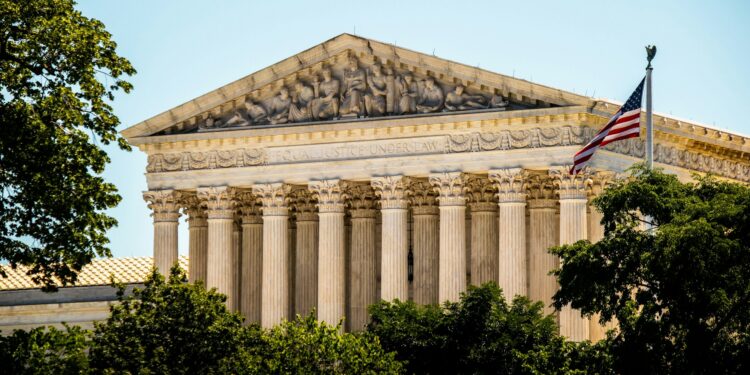
One of the biggest legal battles surrounding President Donald Trump’s immigration agenda is headed to the U.S. Supreme Court.
The Supreme Court agreed Thursday to hear a major dispute over the Trump administration’s use of mandatory immigration detention, putting the justices in position to decide whether certain immigrants facing deportation must be given access to bond hearings.
The case could have significant consequences for ICE enforcement, immigration detention and Trump’s broader deportation policies during his second term.
At issue is a disagreement over federal immigration law that has already divided appeals courts across the country.
Some courts have rejected the Trump administration’s interpretation of a 1996 immigration law, while others have concluded that federal officials may keep certain immigrants detained without providing an immediate opportunity for release on bond.
Now the Supreme Court will have an opportunity to establish a nationwide rule.
Supreme Court Takes Up Major ICE Detention Case
The dispute focuses on how federal authorities may handle immigrants who are arrested by Immigration and Customs Enforcement while deportation proceedings are underway.
The Trump administration argues that federal law requires certain individuals to remain in detention throughout their immigration cases.
Attorneys challenging the policy say another provision of the Immigration and Nationality Act applies, allowing immigration judges to consider whether a detainee should be released on bond.
The difference is significant.
Under the administration’s interpretation, qualifying immigrants could remain in federal custody without receiving an individualized bond hearing.
Under the opposing interpretation, an immigration judge could examine factors such as whether the person presents a danger to the public or is likely to miss future immigration hearings.
Federal Courts Have Reached Different Conclusions
Federal appeals courts have split over which interpretation of the law is correct.
Nine federal appeals courts have rejected the Trump administration’s position, according to the case record, while the Fifth and Eighth Circuits have reached conclusions more favorable to the government.
The case now reaching the Supreme Court grew out of a decision by the Second U.S. Circuit Court of Appeals.
That disagreement between federal courts is one reason the Supreme Court’s involvement could prove especially important.
Instead of immigration detention rules differing depending on where a case is filed, the justices could establish one legal standard for the entire country.
Brazilian Immigrant At Center Of Supreme Court Fight
The case involves Ricardo Aparecido Barbosa da Cunha, a Brazilian citizen who entered the United States without inspection more than two decades ago.
Barbosa da Cunha applied for asylum in 2016 and received authorization to work while that application remained pending.
ICE arrested him in September 2025.
Federal officials argued that he was subject to mandatory detention and therefore was not entitled to seek release through a bond hearing while his removal proceedings continued.
Barbosa da Cunha challenged that position in federal court.
His attorneys argued that a different section of immigration law governed his detention and permitted an immigration judge to consider bond.
A federal district court agreed.
The Second Circuit later upheld that conclusion.
Immigration Judge Ultimately Approved His Release
After the lower-court ruling, Barbosa da Cunha received a bond hearing.
An immigration judge determined that he did not present a sufficient flight risk or danger to the community to justify keeping him in custody and ordered his release on bond.
His attorneys have pointed to his long residence in the United States, family connections, business ownership and lack of a criminal record while arguing that individualized bond hearings are necessary.
Attorney Paul Dwyer said Barbosa da Cunha has lived in the United States for approximately 22 years and has a U.S. citizen family.
Dwyer argued that keeping him detained without the possibility of bond was unnecessary and said he expects the Supreme Court to uphold the lower courts’ interpretation.
ACLU Challenges Trump Administration’s Position
The American Civil Liberties Union has also criticized the administration’s interpretation of federal immigration law.
Michael K.T. Tan of the ACLU’s Immigrants’ Rights Project said courts have repeatedly rejected the government’s argument and maintained that immigrants should not be detained for lengthy periods without an opportunity to seek bond.
The Trump administration, however, maintains that federal law gives immigration authorities broader power to impose mandatory detention in cases covered by the statute.
The Supreme Court will now decide which interpretation Congress intended.
Decision Could Affect Trump’s Deportation Strategy
The case arrives as immigration enforcement remains one of the defining policies of Trump’s second term.
Trump has made increased deportations and stronger border and interior immigration enforcement central priorities of his administration.
Federal authorities have carried out immigration enforcement operations around the country while the administration has also moved to expand detention capacity.
That makes the Supreme Court case particularly important.
A ruling supporting the administration could provide federal immigration officials with greater authority to keep certain detainees in custody throughout their removal proceedings.
A ruling against the administration could require more immigrants to receive bond hearings before an immigration judge.
That would not automatically mean detainees are released.
Instead, immigration judges would determine whether an individual should remain detained based on factors including public safety and the likelihood of appearing for future proceedings.
ICE Detention Population Has Increased
The immigration detention system has expanded as enforcement activity has increased.
According to the American Immigration Council, the number of people held in immigration detention had climbed above 73,000 by mid-January, representing a substantial increase compared with the previous year.
The growing detainee population has placed additional attention on the legal rules governing who must remain in custody and who can ask an immigration judge for release.
Those questions could become even more significant as the Trump administration continues pursuing its immigration enforcement goals.
Another Mandatory Detention Case Faced Legal Complications
The Supreme Court dispute also follows another case involving questions over mandatory immigration detention.
That case, Genalo v. D.C., concerned detention rules involving immigrants who had committed crimes.
The legal dispute changed after New York Gov. Kathy Hochul pardoned the immigrant involved, leading to arguments that the case had become moot.
The Barbosa da Cunha case now gives the Supreme Court another opportunity to address federal immigration detention authority.
What Happens Next At The Supreme Court?
The Supreme Court’s decision to hear the case does not indicate how the justices will ultimately rule.
Both sides will submit legal arguments explaining how they believe federal immigration law should be interpreted.
The justices are expected to hear oral arguments later in the Court’s term.
A final ruling could clarify the federal government’s detention powers and potentially affect immigration cases across the United States.
For the Trump administration, the case could become one of the most important Supreme Court tests of its second-term immigration agenda.
If the justices agree with the government, ICE could retain broader mandatory detention authority in qualifying cases.
If the Court sides with Barbosa da Cunha, more immigrants facing deportation could become eligible to request bond hearings before immigration judges.
Either outcome could shape how immigration enforcement operates nationwide for years to come.