
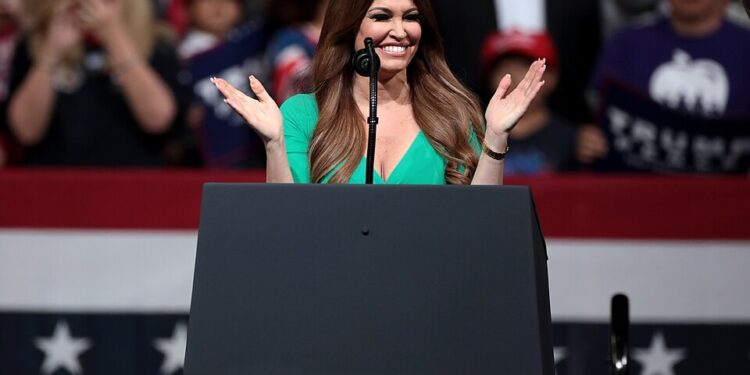
A prominent member of President Donald Trump’s political circle is facing serious questions after a new report revealed allegations involving a $100,000 payment request, a wealthy Republican donor, and promises of access to powerful government officials.
Kimberly Guilfoyle, the former Fox News host and former fiancée of Donald Trump Jr., has come under scrutiny over private messages that reportedly show her asking a major Trump supporter to help pay a substantial credit card bill.
The allegations are particularly significant because Guilfoyle currently serves as the United States ambassador to Greece, a high-profile diplomatic position she received following Trump’s return to the White House.
According to an investigation by The Wall Street Journal, the reported financial discussions occurred shortly before Guilfoyle’s Senate confirmation hearing in July 2025.
The revelations are raising fresh questions about political connections, financial arrangements, and the responsibilities of public officials.
Kimberly Guilfoyle Faces Questions Over $100,000 Request
At the center of the controversy is Eric Deters, a Kentucky attorney, former congressional candidate, and longtime supporter of President Trump.
According to the Journal, Guilfoyle contacted Deters on July 3, 2025, requesting immediate assistance with a $100,000 American Express credit card balance.
The messages were reportedly sent through Signal, a private messaging application.
Guilfoyle allegedly provided instructions for transferring the money directly to American Express and encouraged Deters to complete the payment quickly.
One particularly notable aspect of the reported exchange was her suggestion that sending the money directly to the credit card company would not attract attention.
Deters ultimately refused to make the payment, reportedly explaining that providing such a large sum could create problems in his marriage.
Despite his refusal, Guilfoyle allegedly continued asking for financial assistance.
The timing of the request has attracted attention because Guilfoyle was scheduled to appear before the Senate Foreign Relations Committee just six days later.
Her attorney has disputed the authenticity of the messages, making their reliability a central issue in the controversy.
Trump Donor Allegedly Sought Access To Administration Officials
The reported financial request was not the only issue raised by the investigation.
According to the Journal, Deters had previously discussed paying Guilfoyle as much as $1 million if she could help bring his legal and tax concerns to the attention of senior officials in the Trump administration.
Deters reportedly wanted assistance with matters involving the Internal Revenue Service and the Justice Department.
One issue concerned a tax deduction associated with the sale of part of his family’s business.
Another involved his efforts to draw federal attention to a criminal case concerning an Ohio physician who had fled to Pakistan after facing accusations of insurance fraud.
The report alleges that Guilfoyle discussed using her political connections to help Deters reach influential figures in Washington.
Among the officials mentioned in their communications was former IRS Commissioner Billy Long.
The allegations raise an important question: Were the reported financial discussions simply part of a personal relationship, or did they involve an inappropriate attempt to exchange money for political access?
There has been no established finding that Guilfoyle committed a crime or that federal officials provided improper favors.
Private Communications Become Major Part Of Controversy
Another aspect of the investigation concerns Guilfoyle’s alleged efforts to keep certain conversations private.
According to the Journal, she repeatedly encouraged Deters to avoid putting sensitive discussions into written messages.
In one reported exchange, Guilfoyle expressed concern that the growing collection of communications could create problems for her diplomatic appointment.
She allegedly urged Deters to discuss matters through private calls rather than continuing to send lengthy written explanations.
Those communications have drawn scrutiny because they reportedly involved financial requests and efforts to arrange contact with senior government officials.
However, Guilfoyle’s attorney, Jesse Binnall, has challenged the authenticity of the messages cited in the investigation.
That denial is significant. Until the disputed communications are independently authenticated or examined through an appropriate process, the allegations should not be treated as proven misconduct.
Guilfoyle’s Financial Ties To Republican Donor Revealed
The relationship between Guilfoyle and Deters reportedly began several years before Trump returned to office.
Deters organized conservative political events known as Freedom Fest, which attracted Republican personalities and members of the Trump family.
According to the Journal, Guilfoyle received approximately $300,000 for speaking appearances connected to those gatherings.
Federal Election Commission records cited in the report also indicate that Deters contributed $125,000 to a political action committee supporting Trump in 2022.
Their relationship reportedly became closer after the 2024 presidential election.
As Guilfoyle prepared to become ambassador, Deters allegedly sought her assistance in obtaining meetings and attention from officials in the new administration.
The reported exchanges illustrate how relationships between political donors, prominent supporters, and individuals entering public service can create difficult ethical questions.
Political donations and paid speaking appearances are not inherently improper. However, concerns can arise when personal payments are allegedly connected to promises of government access.
Senate Confirmed Guilfoyle Despite Reported Financial Discussions
President Trump selected Guilfoyle to serve as ambassador to Greece in December 2024.
Her nomination attracted considerable attention because of her longstanding involvement in Republican politics, her media career, and her previous relationship with Donald Trump Jr.
Guilfoyle appeared before the Senate Foreign Relations Committee in July 2025.
The Senate ultimately confirmed her appointment on September 18, 2025, by a vote of 51-47.
The newly reported communications took place before that confirmation vote, raising questions about whether lawmakers were aware of the alleged financial discussions during the confirmation process.
An official associated with the American Embassy in Greece defended Guilfoyle, emphasizing that she had undergone the Senate’s review process and received confirmation.
The official also praised her commitment to representing American interests abroad.
Guilfoyle has continued serving in her diplomatic role while disputing the allegations surrounding the reported messages.
Marco Rubio Pushes Back Against Media Report
Secretary of State Marco Rubio addressed questions about the controversy Thursday while visiting Greece.
Rather than offering a detailed response to the allegations, Rubio challenged the idea that information appearing in a newspaper should automatically be accepted as fact.
Rubio told reporters that published claims should not be considered definitive merely because they were attributed to unnamed sources or included in a major news report.
His response came as Guilfoyle stood nearby.
The secretary’s comments underscored the administration’s position that allegations should be evaluated carefully before conclusions are reached.
At the same time, senior Democratic lawmakers have called for further examination of Guilfoyle’s conduct.
The controversy now presents another political challenge for an administration seeking to keep attention focused on its policy agenda.
What This Means For President Trump
President Trump has repeatedly emphasized the importance of restoring confidence in federal institutions and ensuring that government officials remain accountable to the American people.
The allegations involving Guilfoyle could complicate that message if additional evidence emerges.
For Republican voters who supported Trump’s promises to reform Washington, questions about political influence and government ethics are especially relevant.
Americans deserve confidence that public officials make decisions based on the national interest rather than personal financial considerations.
That principle applies equally to Republicans and Democrats.
However, the distinction between allegations and proven wrongdoing remains essential.
The available reporting indicates that Deters refused to provide the requested $100,000. It has not established that Guilfoyle received that payment or that federal officials granted improper assistance.
Her legal team has also disputed the authenticity of the communications at the heart of the report.
Those facts must remain part of any fair examination of the controversy.
Will The Trump Administration Take Further Action?
The allegations have placed renewed attention on the standards governing political appointments and diplomatic service.
As ambassador to Greece, Guilfoyle holds a position involving important American relationships, international diplomacy, and national interests.
Maintaining public confidence in that role requires both transparency and fairness.
Any further investigation would need to establish whether the reported messages are authentic, whether financial agreements actually existed, and whether government resources or influence were improperly used.
For now, the questions remain unresolved.
President Trump’s administration has defended Guilfoyle’s service, while critics are seeking additional scrutiny of the reported financial arrangements.
The larger issue is one that extends beyond any single administration: Americans expect their government representatives to uphold the highest standards of integrity, regardless of political connections.
As this controversy develops, the central question will be whether additional evidence supports the serious allegations or whether Guilfoyle’s defense ultimately puts the matter to rest.