
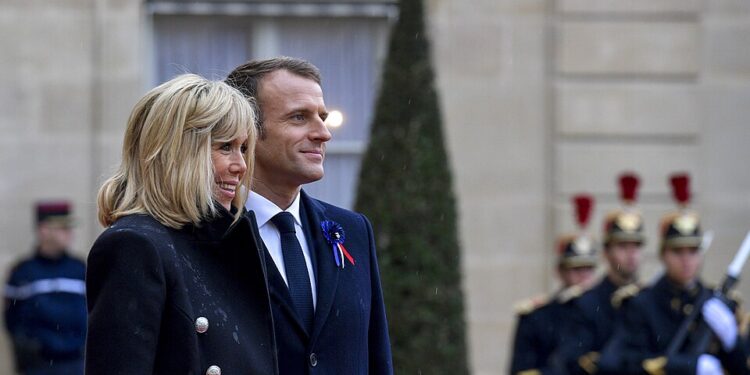
French President Emmanuel Macron is facing intense criticism after attending a major celebrity concert while his country was preparing for widespread demonstrations that ultimately erupted into violent riots, leaving hundreds injured and businesses devastated.
The French leader, who has repeatedly clashed with President Donald Trump over major international issues, attended a Celine Dion concert with his wife, Brigitte, on Friday evening, October 16.
Just one day later, France experienced some of its most destructive demonstrations in recent weeks, raising serious questions about government leadership, public safety, and the country’s growing economic problems.
With nearly 1,800 arrests reported nationwide and more than 500 emergency personnel injured, Macron is now under mounting pressure to explain how his administration intends to restore stability.
Macron Attends Concert Before Nationwide Riots
According to French media reports, Macron and his wife attended Dion’s performance at the Plenitude Arena in Nanterre, located just outside Paris.
The presidential couple reportedly joined approximately 35,000 spectators at the concert, arriving and leaving discreetly.
Macron had spent the previous two days in Brussels attending a European Council meeting, where he discussed international matters with other European leaders.
During a Friday news conference, the French president urged demonstrators to remain peaceful ahead of the planned nationwide protests.
However, his decision to spend Friday evening at a concert quickly became controversial after the demonstrations descended into chaos on Saturday.
Critics questioned the appearance and whether the government was adequately prepared for the unrest.
The concert took place before the worst violence unfolded, but the resulting controversy has added to the political challenges facing Macron.
Nearly 1,800 Arrested As France Descends Into Chaos
The situation deteriorated dramatically on Saturday, October 17, when hundreds of thousands of demonstrators gathered across France to protest rising living expenses, deteriorating public services, and economic uncertainty.
French authorities estimated that more than 550,000 people participated in the nationwide demonstrations. Protest organizers placed the number closer to 800,000.
Although many protesters expressed their concerns peacefully, violence erupted in several major cities.
Businesses were vandalized, stores were looted, and public buildings were targeted by destructive groups.
Authorities reported nearly 1,800 arrests, including approximately 855 in the Paris region alone.
French Interior Minister Laurent Nuñez confirmed that more than 500 police officers, firefighters, and other emergency personnel suffered injuries during the unrest.
Authorities also reported that one demonstrator died after suffering cardiac arrest during protests in Paris.
The scale of the violence has renewed concerns about public safety and the government’s ability to protect ordinary citizens.
Historic Government Building Destroyed By Fire
Among the most disturbing incidents occurred in Limoges, where a fire caused extensive damage to the city’s historic town hall.
Authorities said the blaze was deliberately started during the unrest.
The destruction of such an important public building became a powerful symbol of the disorder spreading across the country.
Meanwhile, businesses in Paris, Marseille, Lyon, Bordeaux, and other cities suffered significant property damage.
French retail giant Carrefour reported that approximately 50 of its stores were damaged, including 20 locations that were looted.
Company officials estimated that the financial losses could reach tens of millions of euros.
For business owners and employees, the damage represents more than a political disagreement.
Destroyed storefronts, lost merchandise, interrupted operations, and expensive repairs could create financial hardships long after the demonstrations end.
Local officials are now seeking additional government assistance to help affected communities recover.
Macron Responds As Political Pressure Mounts
Following Saturday’s violence, Macron condemned the destruction and promised consequences for those responsible.
In a public statement, the French president criticized attacks on law enforcement, businesses, and public institutions.
He emphasized that peaceful demonstrations are a legitimate democratic right but insisted that violence and property destruction must not be tolerated.
Macron also expressed support for police officers and emergency responders who faced dangerous conditions throughout the demonstrations.
However, his response has not silenced critics.
French conservative leader Marine Le Pen condemned the looting and destruction, while left-wing political leader Jean-Luc Mélenchon criticized the government’s handling of the protests.
The competing responses highlight the deep political divisions surrounding France’s economic problems and the government’s approach to public safety.
Growing Economic Problems Fuel Public Anger
The demonstrations did not emerge overnight.
France has experienced weeks of protests involving students, workers, and other citizens frustrated with the direction of the country’s economy.
Rising living expenses, concerns about education, and dissatisfaction with public services have contributed to growing public anger.
Many demonstrators argue that government policies have failed to address the financial pressures confronting ordinary families.
The unrest also raises difficult questions about balancing the right to peaceful protest with the government’s responsibility to maintain law and order.
While peaceful protesters have legitimate opportunities to express their concerns, the violence has placed additional burdens on taxpayers, local businesses, and emergency personnel.
For French families already dealing with economic uncertainty, the destruction could make an already difficult situation worse.
Macron’s Differences With Trump Draw Attention
The crisis is also attracting international attention because of Macron’s complicated political relationship with President Donald Trump.
The two leaders have maintained diplomatic relations while frequently disagreeing over trade, national security, and the future of international alliances.
Trump has emphasized national sovereignty, stronger borders, and domestic economic priorities throughout his presidency.
Macron has often promoted greater European cooperation and coordinated international responses to economic and security challenges.
Their differences have occasionally produced public disagreements, making Macron’s domestic political difficulties particularly noteworthy to American observers.
However, the demonstrations in France are primarily driven by domestic economic and political concerns rather than disagreements with Washington.
France Faces Uncertain Political Future
The controversy comes at a difficult moment for Macron as France approaches its 2027 presidential election.
With public dissatisfaction growing, his administration faces pressure to address economic grievances while preventing further destruction.
The mayors of several major French cities have requested additional discussions with government officials about the damage and recovery efforts.
Meanwhile, authorities are pursuing legal action against individuals suspected of participating in looting, arson, and attacks on public property.
Macron is also facing questions about whether his government adequately anticipated the scale of Saturday’s demonstrations.
His Friday concert appearance has become part of that broader political debate, even though it occurred before the most serious violence.
Ultimately, the French president’s greatest challenge will be restoring public confidence while addressing the economic frustrations driving the protests.
For ordinary French citizens, the stakes are substantial.
Families want financial stability, businesses need protection, and communities are demanding an end to the violence.
As France struggles to recover from the unrest, Macron’s ability to deliver meaningful results could have lasting consequences for his political legacy and the country’s future.