
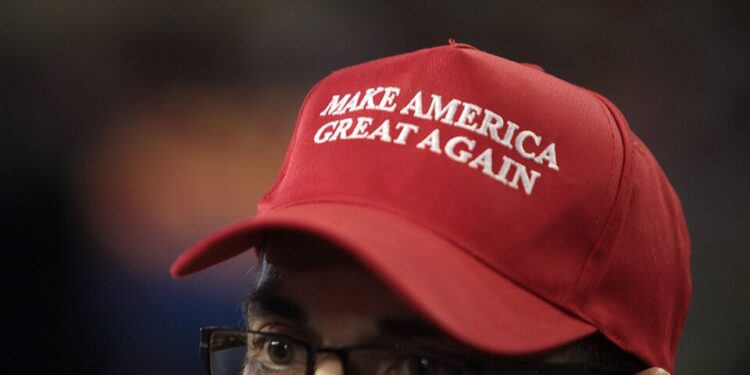
President Donald Trump’s endorsement is one of the most valuable assets a Republican candidate can have. But one of Trump’s high-profile Senate picks is now facing questions after refusing to identify himself as a MAGA Republican.
Former Michigan Congressman Mike Rogers, the Republican nominee in one of the nation’s most competitive Senate races, repeatedly avoided answering whether he considers himself part of Trump’s Make America Great Again movement.
The uncomfortable exchange happened Sunday during an appearance on NBC’s Meet the Press, where host Kristen Welker pressed Rogers about his political allegiance.
Instead of embracing the MAGA label, Rogers turned his attention to the national media and his Democratic opponent.
The moment raised questions about how closely Trump-backed Republicans want to associate themselves with the president’s political movement as the November midterm elections approach.
Mike Rogers Dodges Direct MAGA Question
During the October 25 interview, Welker asked Rogers whether he considered himself a MAGA Republican.
The former congressman declined to give a direct answer.
Instead, Rogers criticized the national news media for what he characterized as inadequate scrutiny of Michigan Democratic Senate candidate Abdul El-Sayed.
Rogers argued that journalists were overlooking divisions within the Democratic Party and the growing number of voters he claimed were supporting his Republican campaign.
Welker repeatedly attempted to return the conversation to her original question.
At one point, Rogers insisted that he had already answered.
“I’ve already answered the question, Kristen,” Rogers said.
However, he never explicitly identified himself as a MAGA Republican.
The exchange was particularly notable because Rogers has received Trump’s endorsement and has campaigned with the president’s support.
Trump-Backed Republican Blasts National Media
Rather than discussing his political identity, Rogers accused national journalists of overlooking developments he believes could influence Michigan’s Senate election.
He pointed to Democrats who have expressed opposition to El-Sayed and argued that his own campaign was attracting support from traditionally Democratic communities.
Rogers specifically highlighted Detroit, Flint, and Pontiac, three Michigan cities where Democratic candidates have historically enjoyed substantial support.
The Republican candidate maintained that residents in these communities were increasingly concerned about El-Sayed’s political positions.
He also criticized journalists for concentrating on national political labels instead of issues affecting Michigan families.
Rogers suggested that reporters should spend more time speaking directly with Michigan voters to better understand the race.
His response indicated that he would rather focus on his campaign’s message and potential crossover support than answer questions about his relationship with the MAGA movement.
Trump Endorsement Creates Political Dilemma
President Trump has strongly supported Rogers’ campaign as Republicans attempt to win Michigan’s Senate seat.
The race represents an important opportunity for the GOP to strengthen its position in Washington.
However, Rogers faces a difficult political challenge.
He needs support from Republicans who strongly identify with Trump while also attracting independents and moderate voters who could determine the election’s outcome.
Michigan has repeatedly demonstrated its importance in national elections, with competitive contests drawing attention from both political parties.
Rogers appears to be emphasizing issues such as the economy, manufacturing jobs, public safety, and Michigan’s future rather than allowing national political labels to define his campaign.
That strategy could broaden his appeal, but declining to embrace the MAGA description also creates questions about his relationship with Trump’s political movement.
Importantly, Rogers has not announced that he is abandoning Trump or withdrawing support for the president’s agenda.
His refusal to accept the label is not the same as a formal break with the president.
Rogers Also Faces Questions About Trump Tariffs
The NBC interview also highlighted differences in how Rogers discusses some of Trump’s economic policies.
Michigan’s manufacturing industry is closely connected to Canada, particularly through automobile production and cross-border supply chains.
Tariffs affecting Canadian goods have therefore become a significant political issue in the state.
Rogers has raised concerns about the effects of certain trade restrictions on Michigan businesses and workers.
While Trump has defended tariffs as a tool for protecting American industries and encouraging domestic manufacturing, Rogers has emphasized the importance of addressing economic challenges facing Michigan employers.
The issue underscores the balancing act Republican candidates face when defending the president’s broader economic agenda while responding to concerns from businesses in their states.
For Michigan voters, questions about manufacturing employment, economic stability, and the cost of living could carry considerable weight in November.
Michigan Senate Race Could Have Major Consequences
Rogers is running against Democratic nominee Abdul El-Sayed in the contest for the seat being vacated by retiring Democratic Sen. Gary Peters.
The election is receiving national attention because of its potential implications for the balance of power in the U.S. Senate.
Republicans see Michigan as an opportunity to expand their influence, while Democrats are working to retain a seat their party currently controls.
Both campaigns have focused on attracting voters outside their traditional political bases.
Rogers has emphasized his experience in Congress and national security while criticizing his opponent’s progressive positions.
El-Sayed, meanwhile, has campaigned on his own economic and political priorities and challenged Rogers’ approach to the issues facing Michigan.
With the November 3 election approaching, the candidates have limited time to persuade undecided voters.
The outcome could influence congressional debates over taxes, immigration, federal spending, trade policy, and other major issues.
Is Mike Rogers Moving Away From Trump’s MAGA Movement?
The controversy surrounding Rogers illustrates a broader challenge facing Republican candidates in competitive states.
Trump’s endorsement can provide valuable support from committed Republican voters, but candidates must also decide how prominently to feature their association with the president when speaking to a wider electorate.
Rogers has not publicly renounced Trump’s political movement.
Nevertheless, his reluctance to identify himself as MAGA during a nationally televised interview has brought renewed attention to his campaign strategy.
The former congressman appears determined to present himself as a candidate focused primarily on Michigan’s economic and political concerns.
Whether that approach helps him build a winning coalition remains uncertain.
For Republicans, the immediate priority is winning a Senate seat that could affect the party’s ability to advance its legislative agenda.
For Trump, a Rogers victory would represent another electoral success for a candidate carrying his endorsement.
But the interview has left an important political question unanswered.
Why would a Republican candidate endorsed by President Trump decline repeated opportunities to identify himself with the MAGA movement?
With Election Day rapidly approaching, Michigan voters will soon determine whether Rogers’ campaign strategy succeeds.