

President Donald Trump’s Justice Department has suffered a notable legal setback after a federal grand jury refused to indict a former White House aide whose controversial testimony about the January 6 Capitol riot sparked years of political disputes.
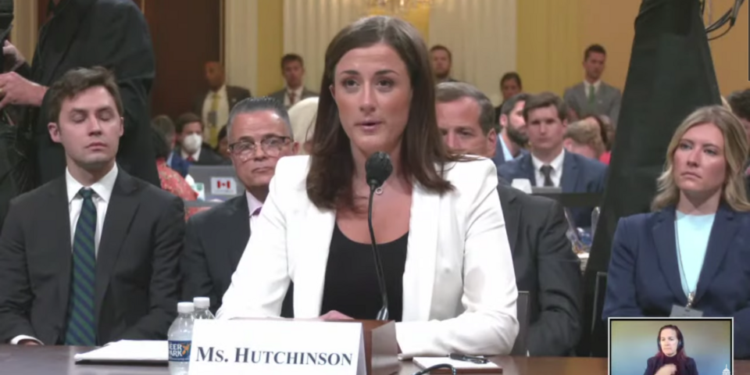
The decision involves Cassidy Hutchinson, a former aide to White House Chief of Staff Mark Meadows who became a central witness during the congressional investigation into the events of January 6, 2021.
Federal prosecutors had been investigating whether Hutchinson made false statements while testifying before Congress. However, a grand jury in Washington, D.C., declined to approve criminal charges against her on Tuesday, October 27.
The decision represents a significant setback for the Justice Department, particularly because grand juries rarely reject indictments requested by federal prosecutors.
It also renews attention on one of the most disputed chapters of the congressional investigation into January 6.
Federal Grand Jury Rejects Indictment Against Former Trump Aide
According to multiple news reports, the Justice Department attempted to secure an indictment against Hutchinson over statements she made during the House January 6 committee’s investigation.
However, federal grand jurors declined to authorize the proposed prosecution.
During a federal court proceeding Tuesday, Justice Department attorney Neville Hedley informed U.S. Magistrate Judge Zia Faruqui that a grand jury had rejected an indictment.
Although Hutchinson was not publicly identified during that courtroom announcement, officials and other individuals familiar with the proceedings subsequently confirmed that she was the subject of the rejected indictment.
The outcome is particularly noteworthy because prosecutors generally face a relatively low legal threshold when seeking grand jury approval.
Unlike a criminal trial, where guilt must be established beyond a reasonable doubt, a grand jury determines whether sufficient probable cause exists to justify bringing charges.
In this instance, prosecutors did not obtain the indictment they sought.
The decision does not determine whether Hutchinson’s testimony was truthful or false. It means the proposed criminal case did not advance past the grand jury.
Cassidy Hutchinson’s January 6 Testimony Sparked Controversy
Hutchinson attracted national attention in June 2022 when she testified before the House committee investigating the January 6 attack on the U.S. Capitol.
Her testimony focused on events inside the Trump administration as demonstrations unfolded in Washington following the disputed 2020 presidential election.
One of the most controversial portions of her account involved Trump’s reported efforts to travel to the Capitol after delivering a speech near the White House.
Hutchinson testified that she had been told Trump became angry when members of his security detail would not take him to the Capitol.
She also described an account she had heard involving Trump allegedly reaching toward the steering wheel of the presidential vehicle.
The allegation quickly became a major point of disagreement.
Subsequent testimony from a Secret Service driver challenged the steering-wheel allegation, although other accounts confirmed that Trump wanted to travel to the Capitol that day.
Republican lawmakers questioned the reliability of Hutchinson’s statements and argued that conflicting testimony warranted closer examination.
Hutchinson, however, has maintained that she provided truthful testimony during the congressional investigation.
Republicans Previously Questioned Hutchinson’s Statements
Following the conclusion of the House January 6 committee’s investigation, Republican lawmakers continued examining testimony and evidence gathered during the proceedings.
Their concerns included whether Hutchinson’s statements accurately described conversations and events involving Trump and senior White House officials.
Republican congressional investigators raised questions about inconsistencies between her account and testimony from other witnesses.
Those disputes became part of a broader disagreement over the committee’s conclusions and its handling of evidence.
Trump and several Republican allies have repeatedly criticized the congressional investigation, arguing that it presented an incomplete or politically biased account of January 6.
Supporters of the committee have maintained that the investigation documented important evidence concerning the Capitol attack and the actions of government officials.
The Justice Department’s investigation into Hutchinson placed those longstanding disagreements under renewed legal scrutiny.
But the grand jury’s refusal to authorize charges means prosecutors were unsuccessful in their latest attempt to move the matter into federal criminal court.
Why the Grand Jury’s Decision Matters
The rejection is unusual because federal grand juries generally approve indictments presented by prosecutors.
A grand jury does not decide whether a defendant is guilty. Instead, it examines evidence to determine whether criminal charges should proceed.
When a grand jury declines to indict, it indicates that prosecutors did not obtain the necessary approval to bring their proposed charges.
That distinction is important in the Hutchinson case.
The decision does not amount to a judicial finding that every statement she made was accurate.
Likewise, the allegations and conflicting testimony surrounding her account do not, by themselves, establish that she committed a crime.
The outcome simply means federal prosecutors failed to secure an indictment.
For the Trump administration, the ruling represents a legal disappointment in a politically sensitive investigation that has attracted widespread attention.
Justice Department Faces Questions Following Legal Setback
The failed indictment comes amid broader scrutiny of how the Justice Department handles investigations involving individuals who have publicly challenged Trump.
Critics of the administration have expressed concerns that some investigations involving Trump’s opponents could be politically motivated.
Others argue that allegations of false testimony should receive appropriate legal scrutiny regardless of the witness’s political significance.
The Hutchinson case highlights the challenge of separating disputed political testimony from conduct that prosecutors can establish as criminal.
Although conflicting witness accounts can raise legitimate questions, obtaining a criminal conviction for false statements requires proof of the applicable elements of the offense, including the required state of mind.
Prosecutors must also work within established constitutional protections and federal criminal procedures.
The grand jury process serves as an important safeguard by requiring independent review before certain federal criminal charges can proceed.
In Hutchinson’s case, that review ended without approval of the proposed indictment.
Could Cassidy Hutchinson Still Face Criminal Charges?
The grand jury’s decision does not necessarily mean the Justice Department is permanently barred from investigating Hutchinson.
Federal prosecutors can sometimes pursue additional evidence or present a revised case following an unsuccessful attempt to obtain an indictment, subject to applicable legal restrictions.
However, there has been no confirmed public announcement that prosecutors intend to renew their efforts against her.
It is also important to distinguish a rejected indictment from a criminal acquittal.
Hutchinson was not tried and found innocent by a jury. Rather, the proposed charges were not approved for prosecution.
For now, she faces no criminal charges arising from the rejected indictment.
Any additional legal developments would depend on future decisions by federal prosecutors and the evidence available to them.
January 6 Remains a Major Political Issue
More than five years after the Capitol riot, January 6 continues to influence national political debate.
Trump and his allies have questioned the congressional investigation’s methods and findings, while critics of the president continue to emphasize the significance of the events surrounding the certification of the 2020 election.
The legal disputes have also extended far beyond the original congressional hearings.
In 2023, special counsel Jack Smith secured a federal indictment against Trump related to his efforts to overturn the 2020 presidential election results.
That case was subsequently dismissed after Trump’s victory in the 2024 election, consistent with the Justice Department’s longstanding position against prosecuting a sitting president.
The Hutchinson investigation is a separate matter, but it demonstrates how legal questions surrounding January 6 continue to surface during Trump’s second term.
With the November 2026 midterm elections approaching, debates about government accountability, congressional investigations, and federal law enforcement remain prominent in Washington.
What Happens Next?
The immediate result is straightforward: the Justice Department attempted to obtain criminal charges against a prominent January 6 witness, but a federal grand jury rejected the proposed indictment.
Whether prosecutors decide to pursue further investigative steps remains unknown.
The ruling leaves unresolved the political disagreements over Hutchinson’s testimony while establishing an important legal boundary in this particular proceeding.
For Trump and his administration, the outcome is a setback in a closely watched January 6-related investigation. For Hutchinson, it means the government’s latest effort to bring criminal charges against her has failed.
The case serves as another reminder that political controversy and criminal prosecution are different matters, and allegations must satisfy established legal standards before they can proceed through the federal justice system.