
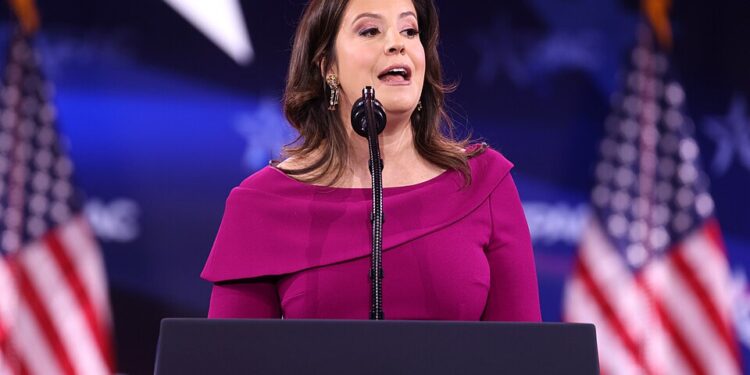
A bitter Republican feud has erupted in New York following a devastating election defeat, with prominent GOP leaders exchanging personal attacks and blaming one another for the party’s poor performance in the 2026 midterm elections.
Nassau County Executive Bruce Blakeman, who suffered a crushing loss to Democratic Gov. Kathy Hochul, has launched a blistering attack against Republican Rep. Elise Stefanik after she publicly criticized his unsuccessful campaign.
The dispute has quickly escalated into a broader fight over the future of the New York Republican Party, with several influential conservatives demanding major changes to party leadership.
The public infighting comes at a particularly difficult moment for Republicans, who are struggling to regroup following significant election setbacks nationwide.
Blakeman Unleashes On Fellow Republican Elise Stefanik
The controversy began after Stefanik sharply criticized Blakeman’s gubernatorial campaign and questioned the effectiveness of New York’s Republican leadership.
Stefanik described the campaign as lacking energy and argued that the party’s election performance demonstrated the need for substantial organizational changes.
Blakeman responded Thursday with a highly personal attack on the outgoing congresswoman.
In a social media post, he accused Stefanik of being a “selfish, do-nothing politician” who failed to help Republican candidates during the election cycle.
He also questioned her political accomplishments, suggesting that her career had been defined by a single notable achievement.
The unusually harsh criticism immediately attracted attention because both politicians have maintained prominent positions within Republican politics.
Rather than concentrating exclusively on the Democratic victory, the exchange exposed longstanding disagreements over the direction of the state GOP.
Stefanik Fires Back After Blakeman’s Personal Attack
Stefanik responded by defending her political record and reminding Blakeman of her history of winning elections.
The congresswoman pointed out that she had won all seven of her congressional elections, a pointed contrast with Blakeman’s unsuccessful gubernatorial campaign.
She also acknowledged that emotions were running high following the election and indicated that she was willing to give Blakeman some leeway as he processed the defeat.
Stefanik rejected the accusation that she had failed to support Republicans.
She explained that she had voted for Blakeman and supported the Republican ticket in New York.
The congresswoman also highlighted her fundraising record, saying she had helped raise more than $100 million for Republican candidates and organizations over the previous decade.
Despite the sharp exchange, Stefanik maintained that Republicans needed to work together to rebuild their political influence.
Her response suggested that the party’s long-term recovery would require more than simply assigning blame for one election.
Hochul’s Landslide Victory Sparks Republican Finger-Pointing
The political dispute followed Blakeman’s decisive defeat in New York’s November 3 gubernatorial election.
According to unofficial results reported by the New York State Board of Elections on Thursday, Hochul received approximately 59.1% of the statewide vote, compared with 39.7% for Blakeman.
That represented a defeat of nearly 20 percentage points.
The outcome was especially disappointing for Republicans because their previous gubernatorial nominee, Lee Zeldin, had mounted a much more competitive challenge against Hochul in 2022.
Zeldin lost that contest by approximately six percentage points, giving Republicans hope that New York could become more competitive in future statewide elections.
However, the 2026 results revealed significant obstacles for the party.
Hochul even held a narrow lead in Nassau County, Blakeman’s political home base, according to preliminary returns.
The apparent setback in a county where Republicans had previously demonstrated substantial strength raised questions about the party’s ability to attract suburban and independent voters.
For Republican leaders, the results presented a difficult reality: the party had lost ground in important communities despite years of organizing around issues such as taxes, public safety, and affordability.
Trump’s Endorsement Becomes Part Of The Debate
The disagreement also renewed attention on the Republican gubernatorial nomination process and President Donald Trump’s involvement in the race.
Stefanik initially pursued the Republican nomination for governor, positioning herself as a conservative alternative to Hochul.
However, Blakeman’s decision to enter the contest created the possibility of a costly Republican primary.
Stefanik withdrew from the race in December 2025, explaining that a prolonged intraparty battle would consume valuable campaign resources.
She also cited her desire to spend more time with her family.
Trump endorsed Blakeman the following day, helping the Nassau County executive consolidate Republican support and move toward the party’s nomination.
The endorsement gave Blakeman a significant political advantage, but it did not translate into victory in November.
Following the election, Republicans began debating whether the party had made the right strategic decisions.
Some critics questioned the effectiveness of Blakeman’s campaign organization, while others pointed to the difficult national political environment facing Republican candidates.
There is no clear evidence that a different nominee would have defeated Hochul, but the dispute has intensified scrutiny of the decisions that shaped the campaign.
Another Republican Joins The Fight
The confrontation soon expanded beyond Blakeman and Stefanik.
Anthony Constantino, the Republican businessman who won the race to succeed Stefanik in New York’s 21st Congressional District, also criticized the party’s leadership.
Constantino argued that New York Republicans needed a significant organizational overhaul following the election.
He specifically called for state Republican Chairman Ed Cox to be removed from his position.
Constantino also took aim at Blakeman’s campaign, arguing that the gubernatorial candidate spent too much time courting political insiders instead of building stronger connections with ordinary voters.
Blakeman responded with another personal attack.
He criticized Constantino’s performance as a candidate and claimed that his own campaign had helped the incoming congressman secure victory.
The exchange added another layer to an already contentious Republican dispute.
Instead of presenting a unified message about rebuilding the party, several prominent GOP figures were publicly questioning one another’s political judgment and qualifications.
New York GOP Chairman Defends Blakeman
While some Republicans demanded leadership changes, state GOP Chairman Ed Cox offered a different interpretation of the election results.
Cox defended Blakeman’s campaign, arguing that the Republican nominee had focused on important policy issues affecting New York residents.
He also attributed the party’s defeat largely to the broader national political environment rather than shortcomings in Blakeman’s campaign operation.
That assessment differed sharply from Stefanik’s criticism of the state’s Republican organization.
The disagreement highlights a fundamental question facing New York Republicans: Was the defeat primarily the result of unfavorable national political conditions, or did the state party fail to develop an effective campaign strategy?
The answer could shape future decisions about candidates, campaign spending, grassroots organization, and party leadership.
Republicans Face Difficult Questions About Their Future
The internal fighting comes as Republicans confront broader concerns about their political standing following the midterms.
Democrats made major gains nationally, creating additional pressure on Republican leaders to reconsider their approach before the next election cycle.
For New York Republicans, the challenges are particularly significant.
The party must find ways to attract voters in Democratic-leaning communities while maintaining enthusiasm among its conservative supporters.
Economic issues could remain central to that effort.
New York residents continue to face concerns involving property taxes, housing affordability, utility expenses, government spending, and the overall cost of living.
Republicans have frequently emphasized those issues in statewide campaigns.
However, the latest election results suggest that focusing on voter concerns alone may not be enough without effective organization, fundraising, and a message capable of attracting a broader coalition.
The party must also decide whether its current leadership can successfully implement those changes.
Stefanik and Constantino have openly questioned the existing structure, while Cox and Blakeman have defended important aspects of the campaign.
Reconciling those competing positions could prove difficult.
Can Republicans Rebuild Before The Next Election?
The fallout from New York’s gubernatorial election has exposed divisions that could influence Republican politics for years.
Stefanik is preparing to leave Congress at the conclusion of her term, while Blakeman remains Nassau County executive despite his statewide defeat.
Constantino, meanwhile, is entering Congress after securing the seat Stefanik is vacating.
All three remain influential Republican voices, although their public disagreements demonstrate how divided the party has become.
For Republicans hoping to regain political momentum, the immediate priority may be establishing a clear strategy for future elections.
That could involve leadership changes, stronger voter outreach, improved fundraising, and a more coordinated effort to compete in suburban communities.
But those discussions are taking place against the backdrop of an increasingly personal feud involving some of the state’s best-known Republican figures.
The central question now is whether New York Republicans can put their differences aside and rebuild—or whether the internal fighting will make their next election challenge even more difficult.