
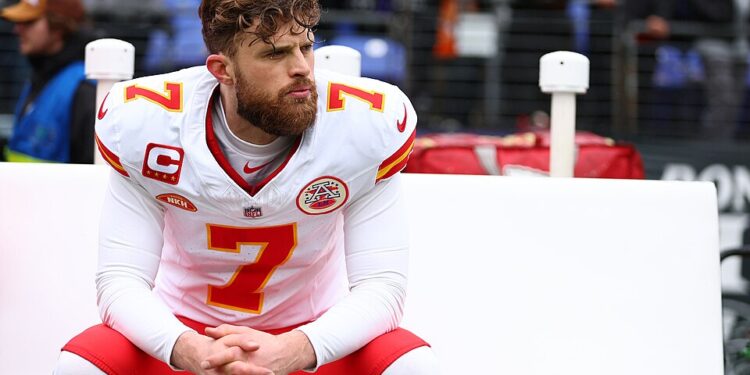
Kansas City Chiefs kicker Harrison Butker is once again finding himself at the center of a controversy involving professional sports, religious freedom, and political beliefs in America.
The three-time Super Bowl champion, who has openly expressed his Catholic faith and support for President Donald Trump, is facing renewed criticism following a disappointing Thanksgiving Day performance against the Buffalo Bills.
While Butker’s struggles on the football field deserve legitimate scrutiny, some of the reactions from media personalities and sports fans have extended well beyond his athletic performance.
The controversy has raised a broader question about whether professional athletes can openly embrace their religious convictions without having those beliefs become a recurring source of personal ridicule.
Thanksgiving Miss Sparks Political Backlash
Butker missed an important 46-yard field goal against Buffalo on Thanksgiving, prompting an immediate wave of reactions across social media.
However, not everyone was focused exclusively on football.
Denver television news anchor Kyle Clark mocked the missed kick before referencing his objections to Butker’s previous remarks about women and family life.
Meanwhile, MeidasTouch editor-in-chief Ron Filipkowski shared an image of Butker alongside President Trump while highlighting the kicker’s disappointing statistics.
The reactions demonstrated how Butker’s political affiliations continue to follow him onto the football field, even when the immediate issue has little to do with Washington or public policy.
Butker’s Catholic Beliefs Remain Under Scrutiny
Much of the controversy surrounding Butker dates back to his 2024 commencement address at Benedictine College, a private Catholic institution.
During that speech, Butker discussed marriage, motherhood, Christianity and the importance of family. His remarks generated a nationwide debate over traditional family values and the role of women in modern society.
Critics argued that his comments diminished women’s professional aspirations. Supporters maintained that celebrating motherhood and homemaking should not be interpreted as opposing women who pursue careers.
Butker has also publicly supported Republican candidates, including Missouri Senator Josh Hawley, and has made no secret of his admiration for President Trump.
Those positions have made him a recognizable figure in the ongoing intersection of American politics, Christianity and professional sports.
Despite the controversy, the Kansas City Chiefs demonstrated confidence in Butker by awarding him a four-year, $25.6 million contract extension in August 2024.
Butker Faces Genuine Challenges On The Field
Political disagreements aside, Butker’s recent football statistics present legitimate concerns for Kansas City.
The veteran kicker had converted more than 94 percent of his field goal attempts during the 2023 season, establishing himself as one of the NFL’s most dependable special teams players.
His success rate has fallen considerably during the 2026 season, particularly on attempts from 50 yards or farther.
His struggles are especially notable considering his previous accomplishments, including a 57-yard field goal during Super Bowl LVIII.
Professional football is a highly competitive business, and players receiving multimillion-dollar contracts are understandably expected to deliver consistent results.
Nevertheless, evaluating an athlete’s professional performance is different from passing judgment on his religious identity or personal convictions.
Religious Freedom And Professional Accountability
The debate surrounding Butker reflects a larger discussion about freedom of expression in American workplaces, entertainment and professional athletics.
Athletes routinely use their public platforms to discuss social causes, political candidates and issues they consider important. Those statements may attract disagreement, but the ability to express different perspectives remains an important part of American public life.
That principle should apply consistently, regardless of an athlete’s political affiliation or religious background.
It is equally important to recognize that freedom of expression does not shield anyone from criticism. Butker’s statements can be debated, just as his performance can be evaluated by coaches, analysts and football fans.
The distinction comes down to whether criticism addresses what an individual has actually said or done, rather than treating religious affiliation itself as a personal failing.
For now, Butker faces the difficult task of regaining his consistency and demonstrating why Kansas City invested so heavily in his future.
Whether fans agree with his political views or share his Catholic faith, his professional future should ultimately depend on his ability to perform on the football field.