
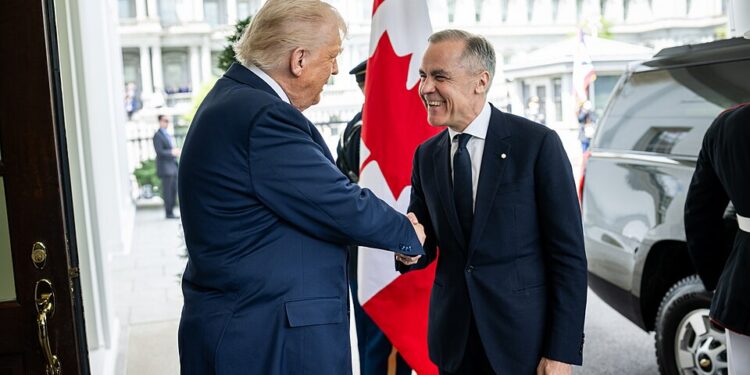
Canadian Prime Minister Mark Carney has issued a new warning to President Donald Trump, suggesting that Canada could strengthen its automobile manufacturing relationship with China if ongoing trade negotiations with Washington fail.
The possibility of Canada turning to Chinese automakers has raised concerns about the future of American manufacturing, North American trade, and the economic competition between the United States and China.
Carney’s comments come as Trump continues pushing to bring automobile production back to American factories, a major priority of his administration’s economic agenda.
But Canada’s latest warning suggests that the trade dispute between the two neighboring countries could become even more complicated.
Canada Sends Trump A Warning Over China
Speaking to reporters in Cambodia on Monday, November 16, Carney indicated that Canada is prepared to consider new manufacturing partnerships if negotiations with the United States do not produce an acceptable agreement.
The Canadian leader said maintaining a strong North American automobile industry remains his preferred outcome.
However, he also suggested that companies from China, Japan, and Europe could provide alternative opportunities for Canadian manufacturing workers.
Carney argued that American trade policies have weakened the economic relationship that previously allowed automobile manufacturers to operate across both sides of the border.
Although he insisted that potential Chinese investment was not intended as a negotiating tactic, his remarks delivered a clear message to Washington.
Canada is prepared to explore other options.
Trump Administration Responds To Canada’s Warning
The suggestion quickly drew criticism from White House trade adviser Peter Navarro, who questioned Canada’s willingness to consider closer economic cooperation with Beijing.
Navarro argued that relying on Chinese manufacturers could expose Canada to significant economic risks.
His response reflected broader concerns within the Trump administration about China’s growing influence over international manufacturing.
China has become a major force in the electric vehicle industry, with manufacturers expanding production and competing aggressively in global markets.
Trump has repeatedly argued that American companies should manufacture more vehicles domestically rather than depend heavily on foreign factories.
The president’s trade policies are intended to encourage investment in American manufacturing facilities and protect domestic industries from international competition.
However, those policies have also created disagreements with longtime trading partners, including Canada.
Canada Already Reached A Major Deal With China
Carney’s latest warning follows an earlier agreement between Canada and China that significantly changed how Chinese electric vehicles enter the Canadian market.
In January 2026, Canada agreed to reduce its tariff on a limited number of Chinese electric vehicles from 100 percent to 6.1 percent.
The arrangement initially allows up to 49,000 Chinese electric vehicles into Canada annually at the reduced tariff rate, with the limit expected to increase over time.
In exchange, China agreed to lower tariffs on certain Canadian agricultural products, including canola.
The agreement was presented as an opportunity to strengthen Canada’s international trade relationships and attract investment.
But it also generated concerns about competition from Chinese manufacturers and the possible effects on established North American automobile companies.
Ontario Premier Doug Ford criticized the arrangement, warning that increased Chinese competition could threaten manufacturing employment and complicate Canada’s access to the American automobile market.
Those concerns could become more significant if Canada pursues additional manufacturing partnerships with Beijing.
What This Could Mean For American Auto Workers
The growing disagreement between Washington and Ottawa could have consequences for American automobile manufacturers and their employees.
For decades, the United States and Canada have operated through an interconnected manufacturing system.
Ford, General Motors, and Stellantis maintain production operations throughout North America, with automobile components frequently crossing international borders before finished vehicles reach dealerships.
That arrangement has supported manufacturing activity in both countries.
Trump, however, has made expanding American production a central part of his economic strategy.
His administration has encouraged automobile companies to invest in American factories and increase domestic employment.
Supporters of this approach believe stronger domestic manufacturing can improve economic security, support skilled workers, and reduce dependence on foreign suppliers.
Critics warn that tariffs and changes to established trade arrangements could increase manufacturing expenses and ultimately affect vehicle prices.
For American consumers, the potential impact on automobile costs remains an important consideration.
Any major restructuring of North American manufacturing could influence where vehicles are built, how components are sourced, and how much consumers eventually pay.
Carney Sets Conditions For Chinese Investment
Despite discussing potential partnerships with Chinese manufacturers, Carney emphasized that Canada would not simply allow foreign companies to import automobile components and assemble them with minimal domestic involvement.
Instead, he said future investment would need to support meaningful Canadian manufacturing operations.
That would include creating production facilities, employing Canadian workers, developing domestic supply chains, and utilizing Canadian resources.
The Canadian government is particularly interested in creating opportunities involving critical minerals used in electric vehicle batteries and other advanced technologies.
Carney’s position suggests that Canada wants to attract international manufacturers while maintaining control over important parts of its domestic automobile industry.
Whether Chinese companies would agree to those conditions remains uncertain.
Trump’s Tariffs Remain A Major Issue
The latest disagreement comes amid continuing tensions over Trump’s trade policies.
The president has argued that tariffs can encourage manufacturers to relocate production to the United States and help rebuild domestic industry.
Canada, however, has raised concerns that American trade restrictions threaten factories and employment opportunities north of the border.
Those tensions have become especially visible in the automobile industry.
Canada recently threatened legal action against Stellantis after the company shifted planned Jeep Compass production from Ontario to Illinois.
The dispute illustrated how decisions to move manufacturing operations can create economic benefits for one country while raising concerns in another.
Carney has maintained that any future trade agreement with Washington must protect Canada’s ability to sustain a competitive automobile industry.
At the same time, he has acknowledged that negotiations with the Trump administration are continuing and that progress has been made on certain issues.
Could China Gain More Influence In North America?
One of the larger questions surrounding Canada’s warning is whether Chinese automobile manufacturers could establish a stronger presence in North America.
Such a development could create new competition for American automakers while giving Canadian officials additional options for attracting foreign investment.
It could also raise questions about supply chain security, industrial competition, and the long-term economic relationship between the United States and Canada.
However, the possibility of new Chinese manufacturing investments should not be confused with a completed agreement.
Carney has discussed potential alternatives, but no comprehensive replacement for the existing North American automobile manufacturing system has been announced.
Much will depend on whether Washington and Ottawa can resolve their differences.
What Happens Next Between Trump And Canada?
Carney’s remarks came ahead of a planned meeting with Chinese President Xi Jinping in Shenzhen, where economic cooperation and manufacturing opportunities were expected to be discussed.
Meanwhile, negotiations between Canada and the United States remain an important priority for both governments.
For Trump, the challenge is balancing his goal of expanding American manufacturing with the realities of a deeply connected North American automobile industry.
For Canada, the challenge is preserving domestic manufacturing jobs while avoiding excessive dependence on any single trading partner.
The outcome could shape future investment decisions, automobile production, and economic relationships across the continent.
American workers and consumers also have a stake in how the dispute unfolds.
A successful trade agreement could help preserve established manufacturing relationships while addressing some of the concerns raised by both governments.
A prolonged disagreement, however, could encourage Canada to pursue stronger partnerships with China and other international manufacturers.
For now, Canada’s warning places additional pressure on the Trump administration as both countries confront important decisions about manufacturing, trade, and the future of the North American automobile industry.