
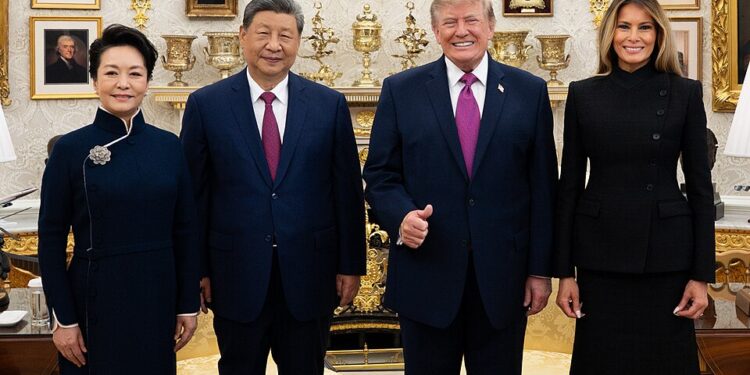
China’s President Xi Jinping has proposed welcoming 100k Americans to China over the next five years as part of an initiative aimed at improving relations between the two nations.
But the massive student-exchange initiative is also drawing scrutiny from critics who are raising questions about Chinese government propaganda, academic freedom, personal safety and the potential targeting of Americans by foreign intelligence services.
Xi unveiled the proposal Thursday at a White House welcoming ceremony during his trip to Washington for discussions with President Donald Trump.
The meeting comes as the United States and China continue to confront major disagreements involving trade, artificial intelligence, intellectual property, national security and rare-earth minerals.
Now, China’s plan to dramatically expand educational exchanges is becoming another issue in the complicated relationship between Washington and Beijing.
Xi Offers 100,000 Americans Trips To China
Xi’s plan calls for China to host 100k younger Americans over the next five years through academic, cultural, and educational exchange programs.
The initiative would build upon programs that have already brought American students to China for university visits, summer courses, youth forums and other educational activities.
Chinese officials have portrayed the exchanges as an opportunity to improve relations between younger generations in both countries.
China later launched the Young Envoys Scholarship program following Xi’s 2023 commitment to bring 50,000 young Americans to the country for educational and cultural exchange opportunities.
The program is administered by the China Education Association for International Exchange.
Depending on the specific program, some participants have received fully funded trips while others have been responsible for some of their own expenses.
Supporters argue that Americans can benefit from learning firsthand about China’s language, culture and society.
Critics say the programs deserve much closer scrutiny.
Critics Raise Propaganda Concerns
Some observers worry that government-supported trips could give Beijing an opportunity to present American students with a carefully managed view of China.
Daniel Di Martino argued on X that the program was designed to influence the views of young Americans while they are in China.
He argued that visiting Americans should also be exposed to controversial subjects involving the Chinese government, including the treatment of Uyghurs, political prisoners, rural poverty and Beijing’s policies toward Hong Kong.
Other social media users similarly questioned whether young Americans participating in official exchange programs would receive an accurate picture of political and social conditions inside the country.
Those concerns come amid longstanding criticism of China’s restrictions on speech, political dissent and independent media.
Congressman Supports Exchanges — With A Warning
Democratic California Rep. Ami Bera offered a more supportive response while also acknowledging serious concerns.
“I welcome Xi Jinping’s invitation for 100,000 American students to visit and study in China,” Bera said.
Bera, who serves as co-chair of the Congressional International Exchanges Caucus, said educational and cultural programs can help Americans develop greater knowledge of China.
He said legitimate academic exchanges require students and researchers to study, communicate, and participate freely without the threat of harassment or wrongful detention.
Bera also raised concerns about academics, human rights activists, and diaspora groups that have faced scrutiny from Chinese officials over their speech or activities.
His comments illustrate the broader debate surrounding Xi’s proposal.
Educational exchanges can potentially improve understanding between countries, but critics say those benefits must be weighed against China’s political system and restrictions on individual freedoms.
Former China Student Says The Country Has Changed
Isaac Stone Fish, a visiting fellow at the Atlantic Council who previously lived and studied in China, also expressed serious reservations.
Fish said he spent years in China and majored in Chinese literature while in college.
Despite his own extensive experience in the country, he said he would have difficulty recommending that young Americans make the same decision today.
According to Fish, conditions for foreigners have changed as the Chinese government has become more restrictive.
He also raised the possibility that American students could face additional danger if relations between Washington and Beijing sharply deteriorated.
That concern is especially significant because Americans traveling abroad remain subject to the laws and legal system of the country they are visiting.
U.S. Officials Have Warned About Intelligence Recruitment
Concerns surrounding American students in China are not limited to political debate.
U.S. authorities have previously warned that Americans studying or working overseas can become potential targets for foreign intelligence services.
One of the best-known cases involved Glenn Duffie Shriver.
Shriver, a student from Michigan, spent time studying in Shanghai from 2002 to 2003 before returning to China by finishing college.
According to federal authorities, Chinese intel officers eventually recruited him.
Shriver received money while seeking employment with U.S. government agencies, including the State Department and CIA, according to prosecutors.
Those positions could potentially have given him access to sensitive government information.
Authorities stopped Shriver before he obtained a government job.
He pleaded guilty in 2010 to conspiring to provide national-defense information to Chinese intelligence officers.
A federal court sentenced him to four years in prison in 2011.
U.S. officials have subsequently used cases like Shriver’s to warn students about recruitment efforts conducted by foreign intelligence organizations.
Why China’s Offer Is Receiving So Much Attention
China’s proposal comes at a sensitive moment in relations between the world’s two largest economies.
Washington and Beijing are competing across an increasingly broad range of issues, including artificial intelligence, advanced technology, trade, military power and access to strategically important minerals.
At the same time, both governments continue to maintain diplomatic, educational and commercial ties.
That creates a difficult balancing act.
Supporters of international student exchanges argue that Americans benefit from experiencing foreign countries firsthand instead of relying entirely on secondhand information.
Learning Mandarin, studying Chinese history and understanding China’s political and economic system can also provide valuable expertise.
Critics, however, argue that government-sponsored programs deserve additional scrutiny when they operate inside a country with extensive censorship and political controls.
For American parents, students and universities, questions about academic freedom, surveillance, political restrictions and personal security may therefore be just as important as the educational opportunities themselves.
The Debate Is Likely Just Beginning
Xi’s invitation for 100,000 young Americans may sound like a straightforward cultural exchange program, but it arrives during a period of intense strategic competition between Washington and Beijing.
That means the proposal is likely to receive attention far beyond America’s college campuses.
Supporters see an opportunity for a new generation of Americans to better understand one of the country’s most important global competitors.
Critics see potential risks involving propaganda, security and foreign influence.
As additional details about the program emerge, American families and educational institutions will have to examine exactly who controls the trips, what participants will be allowed to study and whether adequate safeguards are in place.
For a program involving as many as 100,000 Americans, those questions are unlikely to disappear anytime soon.