
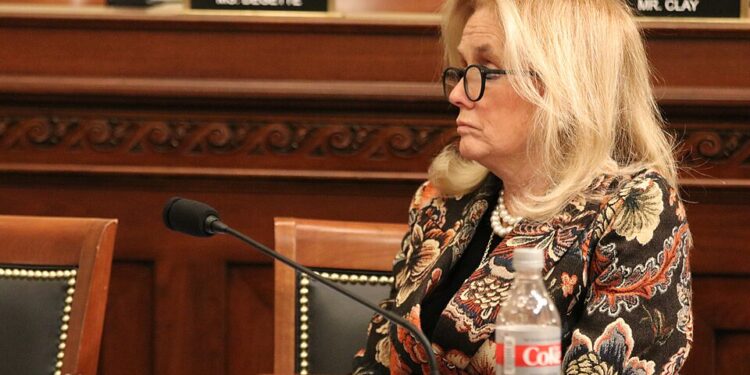
A Democratic congresswoman has ignited a political firestorm after making a pointed remark about President Donald Trump and one of his closest White House aides.
Rep. Debbie Dingell, D-Mich., took aim at Trump while criticizing his decision to rename Lake Ontario “Lake America,” a move that comes amid heightened tensions between the United States and Canada.
But rather than limiting her criticism to the president or his policy, Dingell brought Trump aide Natalie Harp into the dispute.
“Let’s just call it Lake Natalie so we know you’ll start protecting our Great Lakes,” Dingell wrote on X.
The comment quickly spread across social media, drawing criticism from Trump supporters and praise from the president’s political opponents.
The controversy is also putting renewed attention on Harp, a member of Trump’s inner circle who has increasingly found herself mentioned in Democratic attacks against the president.
Debbie Dingell Targets Trump Over Lake America
Trump signed an executive order Thursday renaming Lake Ontario “Lake America” as his administration remains locked in a contentious trade dispute with Canada.
The decision immediately generated political opposition.
Dingell, whose home state of Michigan is closely connected economically and geographically to the Great Lakes, has been particularly outspoken.
She has argued that the Great Lakes represent an important partnership between the United States and Canada and has announced plans to pursue legislation attempting to reverse Trump’s action.
Her “Lake Natalie” remark, however, transformed what had largely been a policy fight into a far more personal political controversy.
The “Natalie” in Dingell’s post was widely understood as a reference to Natalie Harp, a close Trump aide who frequently travels with the president.
Who Is Natalie Harp?
Harp has become an increasingly recognizable member of Trump’s inner circle.
Her proximity to the president has also attracted growing attention from Democrats and the media.
Harp recently received additional scrutiny after reports that she was among a small number of people who traveled with Trump aboard a separate aircraft following concerns about a potential Iranian plot involving Air Force One.
For Trump supporters, Dingell’s decision to invoke a White House staff member represented an unnecessary escalation.
Critics argued that political disagreements with Trump should be directed at the president rather than members of his staff.
That disagreement quickly exploded online.
Trump Supporters Fire Back at Dingell
GOP commentator Melik Abdul accused Democrats of displaying a double standard in how they treat women associated with Republican politics.
He argued that Democrats frequently condemn sexism and misogyny but become less concerned about those issues when conservative women are involved.
Retired Air Force Lt. Col. Robert “Buzz” Patterson also criticized Dingell.
“Wow. Stay classy, Michigan,” Patterson wrote.
Veteran television journalist Greta Van Susteren questioned why Harp deserved to become the subject of the political attack.
Van Susteren acknowledged that Dingell’s actual target appeared to be Trump but argued that dragging a younger staff member into the controversy was unnecessary.
The criticism reflects a broader concern among Trump allies that Harp is increasingly being used as a political weapon against the president.
Jon Ossoff Previously Brought Harp Into Trump Debate
Dingell is not the first Democrat to invoke Harp while attacking Trump.
Sen. Jon Ossoff, D-Ga., previously mentioned the Trump aide during a political rally while accusing the president of neglecting his responsibilities.
Ossoff argued that Trump would rather focus on personal priorities and “travel with Natalie” than perform the duties of the presidency.
His comment generated its own backlash and helped propel Harp into the center of the political conversation.
Dingell’s post has now renewed that debate.
Former Trump spokeswoman Elizabeth Pipko questioned whether invoking Harp had become a new tactic for Democrats attempting to attract attention.
Political commentator Rich Baris similarly suggested that the controversy was another example of the intense rhetoric that has characterized Democratic opposition to Trump.
Trump Critics Celebrate Dingell’s Remark
Reaction from the political left was dramatically different.
While Trump supporters condemned Dingell’s post, several prominent critics of the president applauded it.
George Conway, a longtime Trump critic, wrote that “Debbie wins the Internet today, full stop.”
Democrat Janice Hough also praised the congresswoman’s remark.
Political analyst Norman Ornstein described Dingell’s attack as a “grand slam.”
The competing reactions demonstrate how differently the same political statement can be interpreted in today’s deeply divided environment.
Trump supporters viewed the remark as a personal attack against a staff member.
Trump opponents viewed it as a sharp piece of political humor aimed at the president.
Dingell Moves to Fight Trump’s Lake Ontario Decision
The social media controversy comes as Dingell prepares to challenge Trump on the substance of the issue as well.
The Michigan Democrat has announced plans for legislation designed to block the president’s executive action renaming Lake Ontario.
Dingell argues that the Great Lakes are a shared resource between the United States and Canada and should not become political leverage in the ongoing dispute between the two countries.
Trump’s order directs federal agencies to begin recognizing the new “Lake America” designation in government references.
That means the fight is now moving beyond social media.
Democrats are attempting to challenge Trump politically and legislatively, while the administration moves forward with implementing the president’s decision.
Lake America Becomes Latest Political Flashpoint
The dispute comes against the backdrop of strained relations between Washington and Ottawa.
Trump has adopted an increasingly aggressive posture toward Canada as disagreements over trade have intensified.
The Lake America decision has become another symbol of that broader conflict.
But Dingell’s reference to Harp added an entirely different dimension.
Instead of focusing exclusively on tariffs, Canada or the Great Lakes, the political conversation shifted toward Trump’s staff and the increasingly personal nature of attacks coming from both sides of Washington.
That may explain why such a short social media post generated such an outsized response.
Another Personal Battle Erupts in Washington
The episode highlights how quickly political disputes can move from disagreements over policy to personal attacks involving people surrounding elected officials.
For Republicans, Dingell’s comment raises questions about whether White House employees who are not elected officials should become targets in partisan political battles.
Democrats who supported Dingell see the remark differently, arguing that Harp’s close association with Trump makes the reference fair game for political criticism.
Those competing interpretations are unlikely to be resolved anytime soon.
What began as a fight over the name of one of America’s Great Lakes has now expanded into another bitter confrontation involving Trump, congressional Democrats and members of the president’s inner circle.
And with the midterm elections approaching, voters can expect the political rhetoric in Washington to become even more intense.