
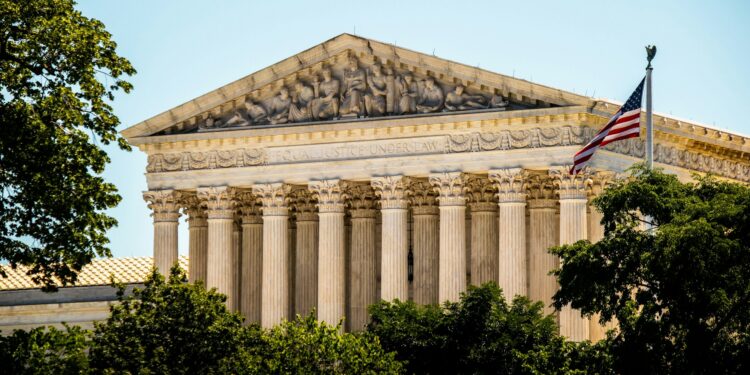
A leading progressive Democrat is openly confirming what many conservatives have warned about for years: some Democrats are still pushing to dramatically reshape the U.S. Supreme Court.
Rep. Pramila Jayapal (D-Wash.) said Friday that discussions inside the Democratic caucus about expanding the Supreme Court and imposing term limits on justices are “absolutely” taking place following another major legal victory for President Donald Trump.
The remarks came just one day after the Supreme Court issued a 6-3 ruling allowing the Trump administration to move forward with ending Temporary Protected Status (TPS) for certain migrants from Syria and Haiti while the legal battle continues in lower courts.
The decision marked another significant immigration win for the administration and immediately reignited debate over the future of the nation’s highest court.
Jayapal Confirms Court Expansion Talks
During an appearance on MSNBC, Jayapal criticized the Supreme Court’s latest decision, arguing that it supports the Trump administration’s immigration policies and will have lasting economic and humanitarian consequences.
She claimed Americans will soon experience the economic effects of the ruling in addition to what she described as its moral consequences.
The interview then turned to a topic that has divided Washington for years: whether Democrats are still considering adding more seats to the Supreme Court.
Jayapal left little room for doubt.
“Absolutely,” she said when asked whether Democrats continue discussing expanding the Court beyond its current nine justices.
The Washington Democrat argued that the current Court has repeatedly revisited long-standing legal precedents and said Congress should pursue sweeping judicial reforms.
Democrats’ Proposed Supreme Court Changes
According to Jayapal, Democrats should consider several major reforms to the federal judiciary, including:
- Expanding the Supreme Court from nine justices to thirteen.
- Creating term limits for Supreme Court justices.
- Establishing stronger ethics and transparency requirements.
- Applying ethics rules similar to those followed by other federal judges.
Jayapal also pointed to legislation she introduced with Sen. Elizabeth Warren (D-Mass.) that would establish new ethics standards for Supreme Court justices.
She argued that recent rulings have strengthened the case for making those changes.
A Long-Running Political Battle
The debate over Supreme Court reform has intensified in recent years as the Court has issued landmark decisions involving abortion, executive authority, immigration, religious liberty, and federal regulatory power.
Supporters of court expansion argue that reforms would improve accountability and restore public confidence in the judiciary.
Republicans strongly disagree.
Conservatives have long argued that expanding the Supreme Court would fundamentally alter the balance of the judicial branch and allow whichever party controls Congress and the White House to increase the number of justices whenever it disagrees with the Court’s rulings.
Critics also warn that such a move could trigger an ongoing cycle of future court expansions whenever political power changes hands.
Why the Supreme Court Matters
The Supreme Court remains the final authority on many of the nation’s most important constitutional questions.
Its rulings affect immigration policy, executive power, gun rights, religious freedom, elections, business regulations, and countless other issues that directly impact millions of Americans.
Because justices serve lifetime appointments under the Constitution unless they retire, resign, or are removed through impeachment, every vacancy has enormous political significance.
That reality has made the Court one of the biggest issues dividing Republicans and Democrats.
The Debate Is Far From Over
Jayapal’s comments make clear that proposals to expand the Supreme Court have not disappeared despite facing strong opposition in Congress.
Whether those proposals ever become law remains uncertain, but the conversation is expected to continue as lawmakers debate the future of the federal judiciary and the balance of power between Congress, the presidency, and the courts.
With the 2026 midterm elections approaching and judicial appointments remaining a top priority for both parties, the future of the Supreme Court is likely to remain one of Washington’s most closely watched political battles.