
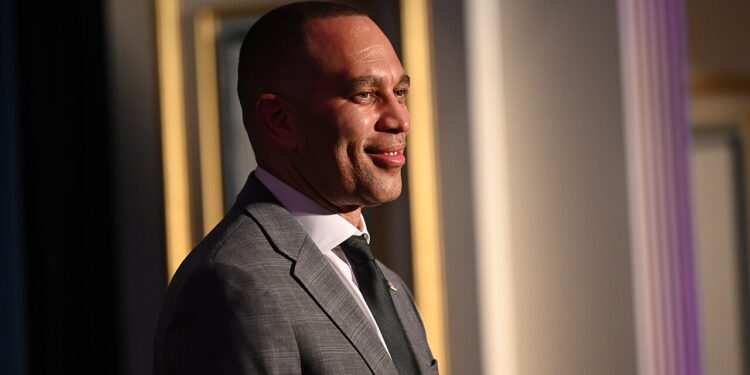
House Minority Leader Hakeem Jeffries is expressing growing confidence that Democrats will reclaim control of the House of Representatives in the 2026 midterm elections, arguing that the political environment increasingly resembles the 2018 election cycle during President Donald Trump’s first term.
Speaking with reporters during a conference call Sunday, Jeffries pointed to recent polling and election forecasts showing Democrats in a competitive position with Election Day approaching.
“House Democrats are poised to take back the majority,” Jeffries said, according to The Associated Press.
The remarks amount to one of Jeffries’ clearest declarations yet that Democrats believe they are positioned to take control of the lower chamber of Congress.
But with roughly a month remaining before voters cast their ballots, Republicans are mounting an aggressive effort to prevent that from happening.
Jeffries Points to a Possible Repeat of 2018
Jeffries compared the current political climate with the 2018 midterm elections, when Democrats captured the House during Trump’s first presidency.
That election produced major gains for Democrats and ended Republican control of the chamber.
Now, Democratic leaders believe another shift may be possible.
Recent election forecasts have given the party reason for optimism. Decision Desk HQ has projected that Democrats could win approximately 234 House seats in the upcoming election, which would be enough to secure the majority.
That forecast remains only a projection, however, and dozens of individual congressional races could shift before Election Day.
Control of the House will ultimately be decided district by district, with several competitive races expected to receive intense attention during the final weeks of the campaign.
Trump’s Approval Rating Becomes a Midterm Issue
Democrats are also watching President Trump’s national approval numbers closely.
According to the Decision Desk HQ polling average cited in recent reports, Trump’s approval rating stood at 38.6 percent, compared with a 59.3 percent disapproval rating.
Those numbers have become part of the Democratic argument that Republicans could face political headwinds in November.
The GOP is also confronting voter concerns surrounding household expenses, the economy and the ongoing conflict involving Iran.
Affordability has remained especially important as Americans continue evaluating the cost of groceries, housing, energy and other everyday necessities.
For congressional candidates in competitive districts, local economic concerns may prove just as important as national political controversies.
Poll Shows Democrats Ahead on House Control
Another recent poll also provided encouraging numbers for Democrats.
A Quinnipiac University survey found that 51 percent of registered voters said they would prefer Democrats to control the House if the election were being held immediately.
Thirty-nine percent said they preferred Republican control.
The gap has helped fuel Democratic confidence, although polling several weeks before an election does not necessarily predict the final outcome.
Campaign strategy, voter enthusiasm and turnout can all dramatically affect election results.
Midterm elections can be particularly unpredictable because participation is often lower than during presidential election years.
That means each party’s ability to motivate its supporters could become one of the biggest factors determining control of Congress.
Trump Sends Clear Message to GOP Voters
Trump, meanwhile, is urging Republicans not to become complacent.
During a rally in Ohio on Saturday, the president repeatedly called on his supporters to vote for Republican candidates.
“You got to get out and vote,” Trump told the crowd. “You got to vote for these guys.”
Trump said he believes Republicans can produce a major victory if supporters turn out in sufficient numbers.
His remarks reflect a broader Republican campaign strategy centered on mobilizing voters who strongly supported Trump in previous elections.
The president has been traveling through Republican-leaning states as part of an expanding campaign push ahead of the midterms.
Vice President JD Vance has also been campaigning for Republican candidates, including incumbents facing potentially competitive races.
Republicans Fight to Protect Their Majority
For Republicans, maintaining control of the House is critical to advancing Trump’s legislative priorities during the remainder of his term.
A Republican majority gives the administration a better opportunity to move legislation through Congress and maintain control of powerful House committees.
Losing the chamber would significantly change the political environment in Washington.
If Democrats capture the majority, they would gain control over House committees, investigations, hearings and much of the chamber’s legislative agenda.
Jeffries would also be in position to become speaker of the House if Democrats win enough seats.
That possibility raises the stakes considerably for both parties.
Democrats Hope History Repeats Itself
Jeffries’ decision to invoke 2018 was not accidental.
During that election cycle, Democrats gained more than 40 House seats and dealt Trump a major political setback halfway through his first term.
Democratic strategists hope voters could deliver another change in congressional control this November.
However, there are important differences between the two elections.
Trump has now spent years reshaping the Republican Party, and his political organization has developed substantial experience mobilizing supporters.
Republicans also believe polling does not always fully capture the enthusiasm of Trump-aligned voters.
That leaves both parties with reasons for optimism — and reasons for concern.
House Majority Could Come Down to a Handful of Seats
Although national polls often dominate political headlines, the battle for the House is ultimately a collection of individual congressional contests.
Only a relatively small number of competitive districts may determine which party controls the chamber.
Suburban voters, independents and Americans concerned about economic conditions could play an especially important role.
Candidate quality, campaign spending and voter turnout will also matter considerably.
A national polling advantage does not automatically translate into victories in the districts necessary to win a House majority.
That is why both parties are concentrating resources on a limited number of closely divided races.
What a Democratic House Would Mean for Trump
A Democratic takeover would create a new political obstacle for the Trump administration.
Democratic committee leaders would gain the ability to hold hearings, launch investigations and scrutinize administration policies.
They could also block or reshape portions of Trump’s legislative agenda.
Republicans therefore view the midterms as an opportunity to preserve the governing coalition voters gave them in the previous election.
Democrats view the contest differently.
For Jeffries and his party, winning the House would provide a major check on Republican power in Washington and give Democrats a stronger position heading toward the next presidential election cycle.
The Final Decision Belongs to Voters
Jeffries may be publicly confident, but the election remains unsettled.
Polling can shift rapidly during the closing weeks of a campaign, especially when voters begin paying greater attention to individual candidates and issues.
Unexpected events can also reshape the national political environment.
Trump’s response has been to emphasize turnout.
Democrats are pointing to favorable polling and forecasts. Republicans are betting that their voters will show up in sufficient numbers to keep control of Congress.
The result will determine far more than which party holds the speaker’s gavel.
It could shape Washington’s political agenda for the remainder of Trump’s term and influence the direction of both parties heading into the next presidential election.
For now, Jeffries is confidently predicting victory.
Whether Democrats actually deliver one will be decided by voters in November.