
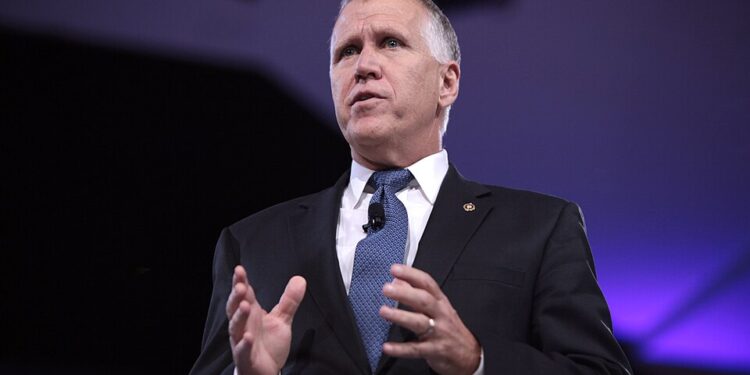
Republican Sen. Thom Tillis of North Carolina is escalating his criticism of President Donald Trump, warning that the president could create new political problems for the GOP if Republicans suffer major losses in the 2026 midterm elections.
Tillis, who is not seeking reelection, made the remarks during a wide-ranging interview on CBS News’ 60 Minutes. The retiring Republican discussed Trump, the future of the Republican Party, the constitutional balance of power in Washington and several prominent members of the Trump administration.
His comments are the latest sign of a widening political divide between Trump and a Republican senator who has become increasingly willing to challenge his own party’s president.
Tillis Raises Concerns About Trump and the Midterms
During the interview, correspondent Ross Douthat asked Tillis whether he was worried about how Trump might respond if Republicans have a disappointing election night in November.
“I think there’s a risk, I really do,” Tillis said.
He added that an inappropriate response could become another political “unforced error” for Republicans.
The comments immediately put Tillis at odds with Trump supporters who believe the president has every reason to aggressively defend Republican candidates and challenge what he views as unfair treatment from political opponents.
For conservatives watching the approaching midterms, the disagreement highlights a larger question facing the Republican Party: Should GOP lawmakers publicly challenge Trump, or should Republicans remain united behind the president as voters prepare to decide control of Congress?
January 6 Becomes Part of the Debate
Tillis said some of his concerns are rooted in the events of January 6, 2021, when demonstrators entered the U.S. Capitol while lawmakers were meeting to certify the presidential election results.
The North Carolina senator strongly condemned people who attacked law enforcement officers that day.
Tillis said those responsible for assaulting police should have faced lengthy prison sentences.
Douthat then pointed out that Tillis did not vote to convict Trump during the Senate impeachment trial that followed January 6.
That distinction is important.
Tillis has criticized aspects of Trump’s conduct while stopping short of supporting some of the most serious efforts Democrats made against the former president during his first administration.
Now, during Trump’s second term, Tillis appears increasingly comfortable airing his disagreements publicly.
Trump and Tillis Have Clashed Before
The tension between the two Republicans has been building for some time.
Tillis announced in 2025 that he would not seek another Senate term in 2026. His retirement decision came amid a highly publicized disagreement with Trump over the president’s major domestic policy legislation, commonly known as the One Big Beautiful Bill.
Trump responded forcefully to Tillis’ opposition.
The president publicly described the North Carolina senator as “weak and ineffective” and called him a “QUITTER.”
Since then, Tillis has continued criticizing both Trump and senior administration officials on several major issues.
Without another Republican primary ahead of him, Tillis has considerably more political freedom than GOP senators who still need Trump-supporting voters to remain in office.
Tillis Targets Pete Hegseth
Defense Secretary Pete Hegseth has become another major target of Tillis’ criticism.
Tillis has repeatedly questioned Hegseth’s leadership and has previously suggested Trump should replace him.
Those comments have placed Tillis in direct conflict with many conservatives who support Hegseth’s efforts to reshape the Pentagon and move the military away from policies associated with the Biden administration.
Trump selected Hegseth as part of his broader effort to change the leadership culture inside the federal government and military establishment.
Tillis, however, has argued that management and competence should remain central considerations regardless of political loyalty.
During the 60 Minutes interview, Tillis also criticized former Homeland Security Secretary Kristi Noem.
He described Hegseth and Noem as examples of officials he believes were given more authority than they should have received.
The remarks are likely to frustrate Republican voters who see Trump’s appointees as essential to carrying out the agenda voters supported at the ballot box.
Senator Issues Warning About Presidential Power
One of Tillis’ strongest statements involved the constitutional relationship between Congress and the White House.
The senator argued that the executive branch increasingly fails to treat the legislative branch as an equal part of the federal government.
The Constitution divides federal authority among three branches: Congress, the presidency and the courts.
That system was designed to prevent any single branch from accumulating unchecked power.
Tillis warned that Congress must continue defending its constitutional authority regardless of which political party controls the White House.
“We will have a sort of dictator king if we’re not careful,” Tillis told Douthat.
That provocative statement is likely to draw particularly strong reactions from Trump supporters.
Many conservatives argue that Trump’s use of executive authority is necessary because previous presidents, federal agencies and unelected bureaucrats dramatically expanded Washington’s power long before Trump returned to office.
They also contend that voters elected Trump specifically to disrupt the federal establishment and move quickly on immigration, government spending, national security and other priorities.
Tillis sees the issue differently, arguing that even Republican presidents must face meaningful congressional oversight.
A Larger Fight Over the Republican Party
The dispute comes at a critical moment for Republicans.
With the midterm elections approaching, Trump remains the dominant political figure inside the GOP, while Republican candidates across the country are attempting to maintain control of Congress.
Internal battles could therefore carry political consequences beyond Washington.
Republicans generally perform best when their voters are energized and united. Public feuds involving Trump and prominent GOP lawmakers risk distracting from issues Republicans would rather emphasize, including inflation, immigration, taxes, public safety and the economy.
At the same time, Tillis appears increasingly willing to speak publicly about his concerns because he will soon be leaving elected office.
His departure removes one of the biggest political pressures facing most senators: winning another election.
Tillis Preparing to Release New Book
Tillis’ comments also come as he prepares to release a new book examining leadership, political loyalty and what he views as excessive obedience within modern politics.
The senator has increasingly portrayed himself as a Republican willing to criticize both parties when he believes government officials are making serious mistakes.
Whether Republican voters see that approach as independence or disloyalty will likely depend heavily on their view of Trump.
For many members of the MAGA movement, Trump was elected with a clear mandate to challenge Washington’s political establishment.
From that perspective, Republican lawmakers who repeatedly undermine the president risk weakening the very agenda GOP voters sent them to Washington to implement.
Others within the party argue that congressional Republicans have an obligation to challenge any administration when constitutional authority or government management is at stake.
Who Ultimately Bears Responsibility?
Near the end of the interview, Douthat raised another important question: If Trump’s second administration succeeds or fails, should responsibility ultimately rest with the president rather than his advisers?
Tillis acknowledged the famous principle associated with former President Harry Truman: “The buck stops here.”
But Tillis added that Truman benefited from having strong advisers around him.
The comment reflected one of Tillis’ central arguments.
In his view, Trump’s legacy will depend not only on the president’s own decisions but also on the quality of the officials he chooses to carry out his agenda.
Trump supporters could reach a very different conclusion.
They may argue that the greater threat to Trump’s second-term agenda comes from politicians inside Washington who continue challenging the president despite Republican voters repeatedly making clear which direction they want the party to take.
What Happens Next?
The growing Tillis-Trump feud illustrates the continuing struggle over the Republican Party’s future.
Trump has transformed the GOP around an America First agenda focused heavily on border security, trade, energy independence, military strength and reducing the influence of Washington’s political establishment.
Tillis represents a more traditional wing of the Republican Party that remains willing to challenge presidential authority and criticize members of a Republican administration.
With Tillis preparing to leave the Senate and Trump attempting to protect Republican congressional majorities, their differences could become even sharper as the midterm elections approach.
The political question now is whether Tillis’ criticism gains support among other Republican lawmakers — or whether it leaves him increasingly isolated from a GOP base that remains firmly behind President Trump.
Either way, the dispute shows that some of the most consequential political battles ahead of the midterms may not simply be between Republicans and Democrats.
Some will be fought inside the Republican Party itself.