
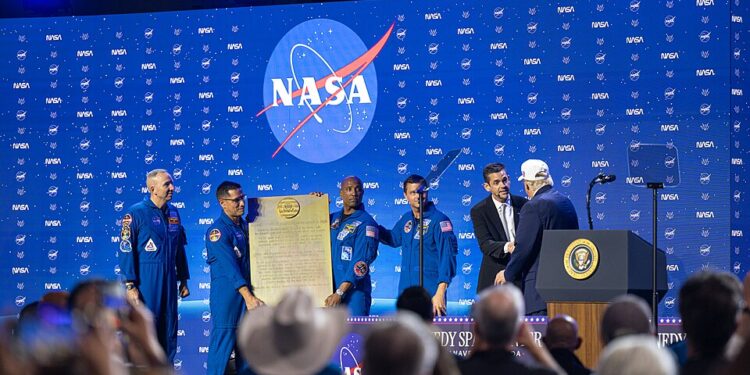
President Donald Trump’s appearance at NASA’s Kennedy Space Center in Florida has sparked another round of criticism from the media, but the controversy has less to do with America’s space program than with how the president delivered his remarks.
During the November 6 event, Trump discussed America’s future in space exploration, economic growth, manufacturing, and national security. He also outlined an ambitious goal of sending Americans to Mars.
However, rather than focusing primarily on those policy discussions, a Mediaite report emphasized Trump’s speaking style, suggesting that the president appeared tired and lacked his usual energy.
The report also highlighted that Trump spoke for approximately 25 minutes, considerably shorter than many of his recent political rallies.
The coverage illustrates how even a relatively brief presidential appearance can become a subject of political debate.
Trump Outlines Major Goals for NASA
Speaking at Kennedy Space Center, Trump emphasized the importance of restoring and maintaining America’s leadership in space exploration.
One of the most significant announcements involved the administration’s intention to eventually place an American flag on Mars.
Such an accomplishment would represent another historic milestone for the United States, building on the achievements of the Apollo program and decades of American technological innovation.
Trump also argued that NASA had previously received insufficient attention, portraying his administration as committed to strengthening the nation’s space capabilities.
The president’s comments reflected a broader vision of American leadership in science, technology, and aerospace development.
For generations, NASA has represented some of the country’s most remarkable achievements, including the first human landing on the moon in 1969.
The prospect of eventually reaching Mars continues that tradition, although significant technological, financial, and logistical challenges remain.
Media Report Questions Trump’s Energy Level
Despite the discussion of America’s space ambitions, Mediaite devoted considerable attention to the president’s demeanor.
In its November 6 report, the publication described Trump as delivering a subdued performance and suggested that his usual enthusiasm was noticeably absent.
The article also emphasized the difference between his approximately 25-minute NASA speech and the lengthy campaign appearances he delivered leading up to the midterm elections.
Trump participated in roughly 30 campaign events during that period, sometimes speaking for two hours or longer.
Those rallies were designed to energize Republican voters, while the Kennedy Space Center appearance was a formal government event.
The distinction matters because presidential speeches vary considerably depending on their purpose, audience, and setting.
A shorter speech does not automatically indicate that something is wrong with the speaker.
Mediaite’s report offered subjective observations about Trump’s delivery, but it did not establish that the president was experiencing a medical problem.
The article also did not demonstrate that the length of his remarks was unusual for the scheduled event.
Trump Responds to Republican Midterm Losses
The NASA appearance came just three days after Democrats achieved significant victories in the November 3 midterm elections.
The results delivered substantial setbacks for Republicans and raised new questions about the party’s direction heading into the next election cycle.
Trump addressed those losses during his remarks, reminding the audience that he had not personally appeared on the ballot.
The president argued that the results would have been different if he had been running.
His comments reflected his continued confidence in his personal political appeal, even as Republicans confronted a difficult election outcome.
The president had spent considerable time campaigning for GOP candidates across the country, attending rallies and encouraging voters to support Republican nominees.
Despite that effort, Democrats made major gains.
The election results have intensified discussions about Republican leadership, voter priorities, and the political challenges facing Trump’s administration.
For the GOP, the immediate question is how to respond to the losses while preparing for future elections.
President Highlights Jobs and American Manufacturing
Beyond the election results, Trump discussed several economic issues, including the October employment report and American manufacturing.
Strengthening domestic industry has remained a central theme of his economic agenda.
Trump has repeatedly emphasized the importance of producing more goods in the United States, supporting American workers, and maintaining the country’s industrial competitiveness.
Manufacturing is particularly important to communities that have experienced factory closures, job losses, and economic disruption over recent decades.
The president’s remarks connected those economic priorities with his broader message about American innovation.
While NASA’s mission is centered on science and exploration, the aerospace industry also supports businesses, engineering development, and specialized manufacturing throughout the country.
Continued investment in advanced technologies could carry implications far beyond the space program itself.
Trump Delivers Warning About Iran
National security also entered the discussion as Trump reiterated his opposition to Iran obtaining nuclear weapons.
The issue remains a major concern for American policymakers because of its potential consequences for international security and stability in the Middle East.
Trump’s position reflected his administration’s broader focus on confronting foreign threats and protecting American interests.
Although the NASA event was primarily associated with space exploration, the president used the opportunity to address issues extending beyond the immediate subject of the gathering.
The inclusion of economic and national security topics underscored the range of matters discussed during the relatively short appearance.
Trump Recalls the Concorde’s Remarkable Technology
Another memorable portion of the speech involved Trump’s reflections on the Concorde, the supersonic passenger aircraft that once allowed travelers to cross the Atlantic much faster than conventional commercial jets.
Trump recalled flying aboard the aircraft and expressed frustration that commercial aviation no longer offers comparable supersonic passenger service.
The Concorde could travel at more than twice the speed of sound before its retirement in 2003.
Its disappearance from commercial aviation provided Trump with an example of technological progress that has not continued in a straightforward direction.
The president questioned why modern passenger aircraft generally travel more slowly than the Concorde did decades earlier.
His comments fit the event’s larger theme of technological advancement and America’s capacity to pursue ambitious engineering projects.
For Americans who remember the Concorde’s years in service, the aircraft remains a striking example of innovation and the possibilities of high-speed transportation.
NASA Honors Trump’s Support for Kennedy Space Center
Toward the conclusion of the event, NASA’s Jared Isaacman presented Trump with a large commemorative plaque.
The presentation recognized the president’s support for a new runway at Kennedy Space Center.
The recognition highlighted the importance of infrastructure development at one of America’s most significant aerospace facilities.
Kennedy Space Center has played a central role in the nation’s space program for decades, serving as the launch site for historic missions and remaining a major part of ongoing exploration efforts.
The ceremony provided a formal conclusion to Trump’s appearance.
The Larger Debate Over Trump’s NASA Speech
The media reaction to Trump’s remarks demonstrates how political coverage can emphasize different aspects of the same event.
Mediaite focused heavily on the president’s energy level, speaking style, and shorter-than-usual address.
Those observations may interest readers who follow Trump’s public appearances, particularly following an exhausting campaign schedule and a difficult midterm election.
However, the speech also included discussions about NASA, Mars exploration, American manufacturing, Iran, and the future of technology.
Those subjects carry policy implications that extend well beyond the president’s presentation style.
The central distinction is between what happened and how commentators interpreted it.
Trump delivered a roughly 25-minute speech at Kennedy Space Center, addressed several national priorities, and received recognition from NASA officials.
Whether he sounded tired or unusually subdued remains a matter of interpretation rather than an independently established medical conclusion.
For Americans interested in the future of the country’s space program, the more consequential question may be whether Trump’s administration can turn its ambitious NASA goals into measurable achievements.
That will ultimately depend on policy decisions, funding, technological progress, and the ability of the United States to maintain its position as a leader in space exploration.