
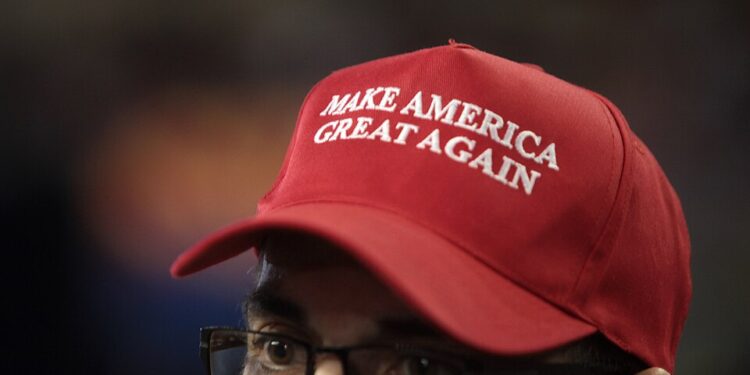
President Donald Trump still commands overwhelming support among Republican voters, but a new national poll is raising an uncomfortable question for the White House: Is some of the enthusiasm that powered the MAGA movement beginning to fade?
A new Reuters/Ipsos survey found that 82% of Republicans approve of Trump’s performance as president — a number that would ordinarily suggest a remarkably united GOP.
But buried beneath that headline number is a potentially more troubling result.
Only 35% of Republicans said they “strongly approve” of Trump’s job performance. Across all American adults surveyed, that number fell to just 13%.
For a president whose political strength has long been fueled not simply by support, but by exceptionally enthusiastic support, that distinction could matter as Republicans look toward the 2026 midterm elections.
Trump Still Has Republicans — But How Strongly?
The numbers do not show Republicans suddenly abandoning Trump.
Far from it.
An 82% approval rating within his own party demonstrates that Trump continues to hold a commanding position among Republican voters.
The concern is intensity.
There is a considerable political difference between a voter who merely approves of a president and one who enthusiastically supports him, talks about him with friends and family, donates money, attends rallies and makes certain to vote on Election Day.
Trump’s political movement has benefited from precisely that kind of loyalty for years.
The latest numbers therefore raise a bigger question: Are some Republican voters still standing with Trump while becoming less enthusiastic about his presidency?
New Poll Delivers A Warning Sign
The Reuters/Ipsos survey was conducted from Aug. 21 through Aug. 24 and included 1,215 U.S. adults.
Respondents were asked whether they approved or disapproved of Trump’s handling of his job as president.
CNN senior political reporter Aaron Blake called attention to the intensity numbers, noting the unusually low percentage of Republicans who selected “strongly approve.”
The result comes at a challenging moment for the Trump administration, with Americans continuing to focus heavily on pocketbook concerns.
And for millions of families, those concerns are difficult to ignore.
Economy And Inflation Could Be Trump’s Biggest Problem
The economy has increasingly emerged as one of the president’s most important political challenges.
Americans are watching what they pay at the grocery store, gas station and pharmacy. Retirees are watching household budgets. Homeowners are paying attention to insurance, utilities and taxes.
Those everyday expenses can matter more politically than almost anything happening in Washington.
Recent polling has shown Trump struggling on economic issues, particularly inflation and the cost of living.
That matters because Trump’s successful campaigns were built in part around working- and middle-class Americans who believed he would put their economic interests first.
If those voters begin questioning the direction of the economy, Republicans could have a much more difficult political environment heading into November.
Key Trump Voters Showing Economic Frustration
CNN data analyst Harry Enten recently pointed to Fox News polling showing a sharp deterioration in Trump’s economic standing among white voters without college degrees.
That voting bloc has been central to Trump’s political coalition.
Polling highlighted by CNN also showed significant dissatisfaction with Trump’s handling of inflation among those voters.
That does not necessarily mean they are preparing to vote Democratic.
Some could remain firmly Republican while becoming less motivated to vote. Others could support Trump personally while blaming congressional Republicans. Still others could simply stay home.
In a closely divided country, any of those possibilities could have consequences.
Cost Of Living Could Shape The 2026 Midterms
The political danger for Republicans is straightforward: Americans experience the economy personally.
Economic statistics released in Washington may say one thing, but voters frequently judge the economy by a much simpler standard — how much money remains after the bills are paid.
Gasoline, groceries, electricity, housing, healthcare and insurance can quickly consume a household budget.
That is particularly important for older Americans and retirees living on fixed or carefully planned incomes.
If voters believe their financial situation is deteriorating, the party controlling Washington can expect to hear about it at the ballot box.
For Republicans, that makes improving public confidence in the economy one of the biggest challenges between now and Election Day.
Trump Has Already Hit A Difficult Polling Milestone
The latest results also follow another difficult Reuters/Ipsos survey.
That earlier poll put Trump’s overall approval rating at 33%, the lowest recorded during his current presidency.
Trump has rejected the idea that he deserves most of the blame for Republicans’ political difficulties.
In an interview with Punchbowl News, the president argued that voters were frustrated with Republicans in Congress rather than with him personally.
That distinction could prove crucial.
Trump has repeatedly demonstrated an ability to maintain personal loyalty among Republican voters even when they are unhappy with other GOP politicians.
The question is whether that political firewall remains as strong as it once was.
CNN Goes After Trump Over Poll Numbers
Trump’s explanation quickly drew criticism from CNN.
CNN host Abby Phillip argued that the president was ignoring the significance of his declining poll numbers and Americans’ concerns about economic conditions.
But criticism from CNN is unlikely to persuade Trump’s most committed supporters, many of whom have spent years distrusting the mainstream media.
The more consequential issue for the White House may be what Republican voters themselves are experiencing at home.
If Americans feel financially secure and believe the country is moving in the right direction, Trump’s numbers could recover.
If household expenses remain a major concern, political frustration could continue.
Is MAGA Really Turning Against Trump?
Not necessarily — and that distinction is important.
The Reuters/Ipsos poll still shows more than eight in ten Republicans approving of Trump’s job performance.
Those are hardly the numbers of a Republican Party that has abandoned its president.
Instead, the survey suggests something subtler and potentially more important: Trump may still have the Republican base, but some voters may not feel as strongly about his performance as they once did.
That is a warning sign, not necessarily a political collapse.
Polling can also change quickly. Economic conditions, foreign policy developments and events in Washington could dramatically alter voter sentiment before the midterm elections.
What Happens Next Could Determine The GOP’s Future
The stakes extend beyond Trump’s personal approval rating.
Republicans are fighting to protect their power in Congress, and midterm elections frequently depend on which party can motivate its voters to actually show up.
Trump’s ability to energize conservatives, working-class voters and Americans who rarely participated in politics before his rise has transformed the Republican Party.
If those voters remain energized, Republicans could once again outperform expectations.
If they become frustrated enough to stay home, the GOP could face a far more difficult election.
For now, Trump’s Republican support remains formidable.
But the latest polling provides the White House with a message that may be difficult to dismiss: keeping Republican voters on your side is one thing. Keeping them enthusiastic is another.
And with the economy, inflation and the cost of living weighing heavily on American households, the battle to keep the MAGA base energized may become one of Trump’s most important political challenges heading into the 2026 midterms.