

Yes
It should.
No
It shouldn’t.
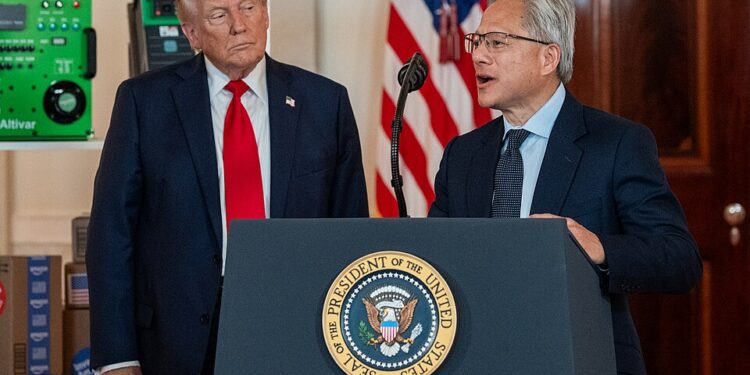
President Donald Trump is facing renewed scrutiny from lawmakers in Washington following his involvement in the reinstatement of Nvidia Chief Executive Officer Jensen Huang. The development has sparked a national conversation about presidential authority, American businesses, national security, and the relationship between the federal government and private corporations.
Nvidia has become one of the most influential technology companies in the world, playing a significant role in America’s artificial intelligence industry. Its products are essential to numerous industries, making the company’s leadership particularly important to investors, businesses, and the broader American economy.
President Trump acknowledged his involvement in encouraging Nvidia’s board of directors to bring Huang back into his leadership position. However, lawmakers from both political parties have raised concerns about the circumstances surrounding his return.
Some members of Congress believe additional oversight is necessary to address outstanding national security questions and determine whether the administration’s involvement was appropriate.
Supporters of presidential involvement in business matters may argue that maintaining stability at major American corporations is important, particularly when international competition threatens America’s technological leadership. They may also view communication between the White House and business executives as a reasonable part of promoting economic growth.
Others believe that decisions involving the leadership of publicly traded companies should remain primarily in the hands of their boards of directors. They worry that excessive government involvement could establish a precedent that raises questions about corporate independence and potential conflicts of interest.
The controversy comes as the United States continues to compete with China and other international economic powers for leadership in advanced technology and artificial intelligence.
Congress has an established responsibility to conduct federal oversight. However, Americans may disagree over whether this particular situation warrants a separate investigation into the president’s actions or whether existing inquiries into Nvidia are sufficient.
For many Americans, the larger question is whether President Trump’s intervention served legitimate economic interests or whether additional congressional oversight is necessary to protect public confidence and national security.
As the debate continues on Capitol Hill, Americans have an opportunity to share their opinions about the appropriate relationship between the presidency and private enterprise.