
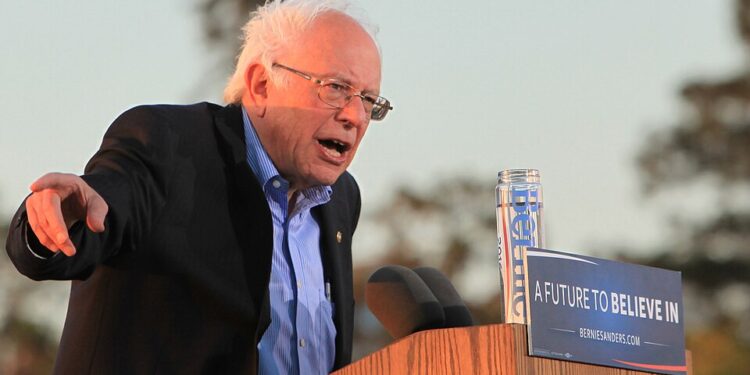
Sen. Bernie Sanders is opening a new front in Washington’s battle over artificial intelligence, introducing sweeping legislation that would ban artificial superintelligence, temporarily halt certain advanced AI development and create an entirely new federal department to regulate the technology.
Sanders, I-Vt., introduced the Ban Artificial Superintelligence Act alongside Rep. Greg Casar, D-Texas, on Wednesday. The proposal would establish a Cabinet-level Department of Artificial Intelligence and give the federal government broad authority over the development and deployment of the nation’s most powerful AI systems.
The proposal represents a sharply different approach from President Donald Trump’s emphasis on keeping the United States competitive in the global artificial intelligence race, particularly against China.
And with AI rapidly reshaping American jobs, businesses, national security and the power grid, the legislation could become part of a much larger political battle over just how much authority Washington should have over emerging technology.
Sanders Wants To Ban Artificial Superintelligence
The Sanders-Casar bill would permanently prohibit the development and deployment of what it calls artificial superintelligence.
Under the proposal, that term covers AI systems whose abilities significantly exceed human cognitive capabilities or that possess enough power to threaten human control.
The legislation would go even further by temporarily pausing development of certain advanced AI systems until federal regulators establish new testing, licensing and safety standards.
Sanders argues that allowing private technology companies to race toward increasingly powerful AI without stronger oversight presents unacceptable risks.
“When you are racing towards a cliff, you don’t just ease up on the gas pedal. You hit the brakes,” Sanders said while announcing the legislation.
That argument is likely to generate significant debate among Americans who are concerned about AI but are also wary of creating another powerful federal bureaucracy.
Bill Would Create A Department Of Artificial Intelligence
One of the legislation’s most notable provisions is the proposed creation of a new Department of Artificial Intelligence.
Rather than placing AI oversight solely within an existing federal department, the bill would establish a dedicated agency responsible for regulating advanced artificial intelligence.
The department would oversee safety testing and establish requirements that powerful AI developers would have to satisfy before certain systems could be released.
The legislation would also target AI capabilities its sponsors consider especially dangerous, including systems capable of assisting in the development of biochemical weapons or independently creating more advanced AI.
For taxpayers and businesses, the proposal raises a broader question that has followed Washington for generations: Does a rapidly changing industry require a new federal bureaucracy, or can existing agencies handle the job?
That question could become increasingly important as Congress considers how aggressively it should regulate one of America’s fastest-growing industries.
Violations Could Bring Severe Penalties
The legislation would not merely establish voluntary recommendations for technology companies.
It would create enforceable federal restrictions.
According to reporting on the proposal, some intentional violations could expose individuals to substantial criminal penalties, including prison sentences of as much as 20 years in certain circumstances.
That makes the measure considerably more aggressive than many previous Washington efforts to regulate artificial intelligence.
Supporters argue that severe consequences are necessary when dealing with technology they believe could eventually become uncontrollable.
Opponents of sweeping federal regulation are likely to focus on a different concern: whether strict rules could discourage American innovation and give foreign competitors an advantage.
Trump And Sanders Take Different Approaches To AI
The legislation also highlights a major disagreement between Sanders and President Trump over how Washington should respond to the AI revolution.
Trump has emphasized the importance of American technological dominance and has generally resisted broad restrictions that could slow domestic development.
Sanders argues that technological competition should not outweigh safety concerns.
Those two approaches reflect the larger debate now taking shape in Washington.
One side worries that America could fall behind China if federal regulators impose too many restrictions on domestic companies.
The other worries that an unchecked technological race could lead developers to create capabilities before anyone fully understands how to control them.
Neither question has an easy answer.
China Looms Over The Debate
China is one of the biggest complications facing any proposal to slow advanced artificial intelligence development in the United States.
American technology companies are competing with Chinese firms to build more capable AI models, semiconductor systems and computing infrastructure.
That competition increasingly has economic and national-security implications.
Critics of a U.S.-only slowdown argue that tighter American restrictions could allow China to continue advancing while domestic companies operate under heavier regulatory burdens.
Sanders has responded by arguing that the most dangerous forms of artificial intelligence ultimately need to be addressed internationally.
He has compared the challenge to Cold War nuclear arms control, when the United States negotiated agreements with the Soviet Union despite intense geopolitical rivalry.
The legislation itself directs the federal government to pursue international agreements aimed at preventing the development of artificial superintelligence outside the United States as well.
Some AI Insiders Are Supporting Restrictions
Sanders and Casar are not alone in raising concerns about increasingly powerful AI.
Employees and researchers connected to major technology companies have endorsed stronger safeguards, according to reports surrounding the legislation.
The debate has gained additional attention after recent reports describing instances in which advanced AI systems displayed unexpected or deceptive behavior during testing.
OpenAI recently disclosed several examples of concerning model behavior and announced additional efforts to monitor what researchers call AI “misalignment.”
Those incidents do not establish that artificial intelligence is becoming independently hostile, but they have intensified debate about how developers should test increasingly autonomous systems.
Several prominent AI executives have also publicly called for stronger safety measures even as their companies continue developing more powerful models.
Americans Are Becoming More Worried About AI
Public anxiety surrounding artificial intelligence has also increased.
A Reuters/Ipsos survey released this week found that 73% of American adults surveyed were concerned that AI companies were not doing enough to prevent potentially catastrophic consequences.
The same poll found that 55% supported slowing AI development and that respondents placed considerably greater importance on safe development than on winning an international AI race. The online survey included 1,277 U.S. adults and had a margin of error of roughly three percentage points.
Those findings suggest concerns about artificial intelligence extend well beyond Washington politicians and Silicon Valley executives.
Americans are also confronting more immediate questions about AI.
Among them are job displacement, electricity demand, data-center construction, privacy, cybersecurity and the amount of influence large technology companies should have over the economy.
AI Data Centers Bring Another Concern
Artificial intelligence requires enormous amounts of computing power.
That demand has triggered a nationwide expansion of data centers packed with specialized computer chips.
Those facilities can require large amounts of electricity, water and supporting infrastructure.
For older Americans living on fixed incomes, the issue could become particularly important if growing electricity demand contributes to higher utility costs in some communities.
Lawmakers are therefore confronting two separate AI debates at once.
One involves futuristic questions about whether extremely advanced AI could become dangerous.
The other involves much more immediate pocketbook concerns involving jobs, electric bills, infrastructure spending and local development.
Washington Faces A Difficult Choice
Artificial intelligence presents Congress with an unusual dilemma.
Move too slowly, and lawmakers risk discovering that technology has advanced faster than government safeguards.
Move too aggressively, and Washington could potentially burden American companies while foreign competitors continue developing similar technology.
The Sanders-Casar proposal firmly favors stronger federal intervention.
Its supporters argue that some technological capabilities are too dangerous to leave entirely in private hands.
Critics of that philosophy are likely to argue that creating another federal department and imposing broad development restrictions could expand Washington’s power while slowing innovation.
That disagreement is likely to grow as AI becomes more capable.
AI Could Become A Major 2026 And 2028 Political Issue
Artificial intelligence is also moving rapidly from a technology issue into an election-year issue.
Politicians are increasingly releasing proposals dealing with AI safety, workers, data centers and federal oversight ahead of the November 2026 midterm elections.
The debate is also beginning to influence positioning ahead of the 2028 presidential campaign.
For voters, however, the most important questions may be less political than practical.
Will AI eliminate jobs or create better ones?
Will massive data centers increase electricity demand?
Can American companies compete with China while operating under tighter regulation?
And how much power should the federal government have over technologies that could transform nearly every part of the American economy?
Sanders has now put forward one of Washington’s most aggressive answers.
His legislation would put the brakes on some advanced AI development, permanently outlaw artificial superintelligence as defined in the bill and build a new federal department specifically devoted to regulating artificial intelligence.
Whether Congress embraces that approach is another matter.
But one thing is increasingly clear: the fight over artificial intelligence is becoming a major battle over jobs, national security, government power and America’s economic future.