
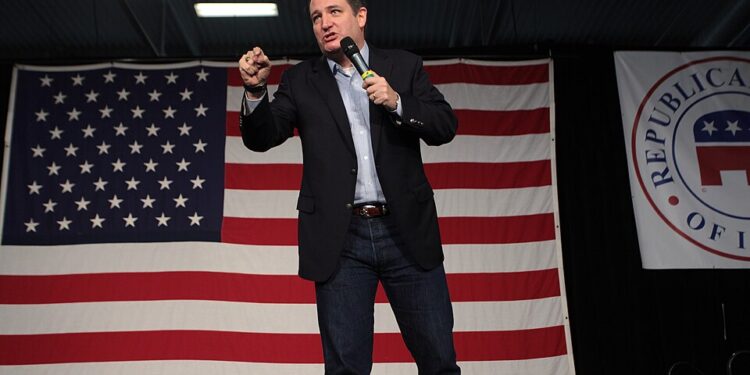
Sen. Ted Cruz is breaking with President Donald Trump over one of the president’s most attention-grabbing economic proposals, warning Republicans against embracing what he calls “right-wing socialism.”
The Texas Republican delivered the criticism while discussing the future of populism inside the GOP, arguing that conservatives should focus on jobs, small businesses and economic opportunity rather than expanding government-funded cash benefits.
Cruz made the remarks during an appearance on Fox News’ The Will Cain Show, where he described himself as a populist but rejected the idea that populism requires Republicans to support more federal spending.
Cruz described himself as a strong populist, noting that working-class voters have long been a key part of his support base.
But Cruz said his version of populism looks very different from the economic approach associated with Sen. Bernie Sanders and other democratic socialists.
Cruz said populism should focus on protecting working Americans’ jobs and supporting small businesses.
Fox News separately described Cruz’s appearance as an argument for what he considers “true populism.”
Cruz Pushes Back as Trump Promotes $5,000 Payments
The disagreement comes after Trump unveiled a proposal to provide a $5,000 dividend to every adult American citizen if Republicans retain control of both the House and Senate in the 2026 midterm elections.
Trump announced the proposal during the Republican midterm convention in Dallas on September 9.
“Here is my promise: If the Republicans win the House of Representatives and the United States Senate, I will issue a dividend to every adult citizen in the United States of America for $5,000,” Trump said.
The White House has promoted the proposal as a way to return some of the benefits of the administration’s economic policies directly to Americans.
Trump has also said the payments would be connected to revenue generated by his economic and tariff policies.
But the enormous potential cost has triggered resistance from some Republicans.
With hundreds of millions of American adults potentially eligible, the proposal could carry a price tag exceeding $1 trillion.
Fox News estimated the cost at roughly $1.2 trillion, while reporting that the national debt had already surpassed $40 trillion when Trump announced the plan.
Cruz Warns Republicans About “Right-Wing Socialism”
Cruz has used unusually strong language to describe economic proposals that he believes abandon traditional conservative principles.
“There are two answers to ‘right-wing socialism’: no, and hell no,” Cruz wrote on X.
During his Fox News appearance, Cruz also warned about what he described as “misguided voices in MAGA” that want Republicans to embrace what he called “socialism lite.”
His concern is that Republicans could undermine their own economic message if they begin competing with Democrats over who can offer voters more government assistance.
For Cruz, the better approach is centered on creating private-sector jobs, helping businesses expand and increasing opportunities for workers.
The dispute exposes an increasingly important question inside the Republican Party: What should conservative economic populism actually look like?
Some Republicans Support Trump’s Dividend
Cruz is far from the only Republican weighing in on Trump’s proposal.
Sen. Bernie Moreno of Ohio has taken a different approach and said he intends to pursue legislation that would help turn Trump’s $5,000 dividend proposal into law.
Moreno has said his version would require the money to be spent inside the United States.
Other Republicans remain skeptical.
The Associated Press reported that many Republican candidates have been reluctant to embrace the proposal publicly, even as the Republican National Committee supports it as part of Trump’s broader economic message.
House Speaker Mike Johnson has also made clear that Trump cannot simply distribute the money on his own.
Congress would have to authorize the payments.
That could make passage difficult even if Republicans maintain their majorities.
Republicans Debate Spending and the National Debt
The disagreement is especially significant because federal spending and the national debt have traditionally been major Republican issues.
For decades, fiscal conservatives have warned that large deficits eventually force Washington to choose between higher taxes, spending reductions or additional borrowing.
Trump’s dividend proposal presents Republicans with a difficult policy question.
Supporters can argue that Americans should directly benefit from increased government revenue and economic growth.
Critics can argue that Washington should use additional revenue to reduce deficits and debt rather than finance another massive federal payment program.
That debate is now playing out openly among prominent Republicans.
Cruz Says GOP Should Not Copy Democrats
Cruz’s warning goes beyond Trump’s $5,000 proposal.
He has also criticized the growing popularity of democratic socialist candidates on the political left and urged Republicans not to respond by adopting similar economic policies under a conservative label.
Cruz argued that Republicans could put themselves in political trouble if voters begin seeing little difference between the two parties when it comes to government spending.
Cruz warned that Republicans could hurt their chances at the polls if they simply copy Democratic spending policies while offering voters fewer benefits.
His comments highlight a broader philosophical divide that has developed as the Republican Party has become increasingly populist.
One faction continues to emphasize traditional conservative priorities such as lower spending, smaller government, tax reductions and private-sector economic growth.
Another is increasingly open to using federal power and government programs to provide direct economic benefits to working- and middle-class Americans.
Trump’s proposed dividend has brought that disagreement directly into the spotlight.
A Major Economic Fight Inside the Republican Party
The clash between Cruz and Trump’s proposal illustrates how dramatically Republican economic politics have changed.
Both men describe themselves as defenders of working Americans, but they are emphasizing different ways of achieving that goal.
Trump is proposing a direct $5,000 payment to adult citizens if Republicans retain Congress.
Cruz is warning that Republicans should be extremely cautious about adopting expensive government programs simply because they may be politically popular.
The ultimate decision would not rest with either man alone.
Any dividend plan would require congressional approval, meaning Republican lawmakers would have to decide whether they are willing to support a program potentially costing more than $1 trillion.
For conservative voters concerned about inflation, federal spending, taxes and the national debt, the disagreement offers a revealing look at the economic debate taking place inside today’s Republican Party.
And with the November midterm elections approaching, that debate is unlikely to disappear anytime soon.