
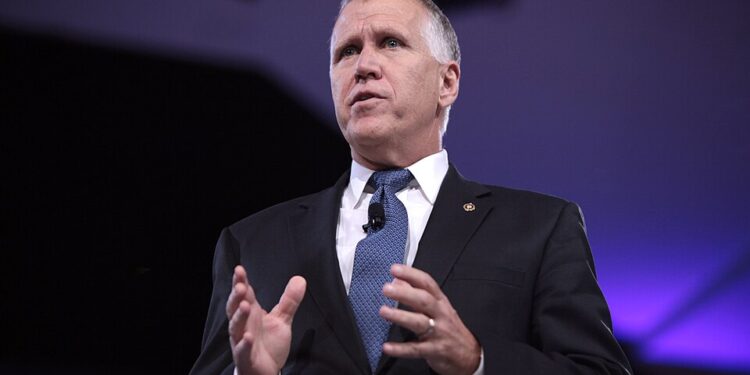
A prominent Senate Republican is threatening to block legislation containing a major part of President Donald Trump’s election-security agenda.
Sen. Thom Tillis of North Carolina warned Thursday that he would use every procedural tool available to delay Senate business if the House sends lawmakers another reconciliation bill containing disputed voter ID provisions.
The retiring Republican supports voter identification in principle. However, he argues that the latest proposal cannot be implemented nationwide before the November elections and could jeopardize other important legislation.
“If I see a reconciliation bill come from the House with another failed attempt to confuse this election, I will use every device I have available to slow down the wheels of government until people cop a clue and do the math,” Tillis declared on the Senate floor.
Tillis Challenges Trump’s Election-Security Push
Tillis issued the warning as House Republicans debated a party-line legislative package containing provisions related to the Safeguard American Voter Eligibility Act, better known as the SAVE Act.
Trump has made voter eligibility and election integrity central parts of his legislative agenda. Supporters say requiring proof of citizenship and stronger identification safeguards would help prevent illegal voting and restore confidence in American elections.
Critics, however, question whether the federal government could impose major new election requirements so close to November. Multiple versions of the legislation have already encountered resistance in the Senate.
Tillis has emerged as one of the most outspoken Republican skeptics of the current proposal.
Republican Senator Says the Plan Is Unworkable
During his Senate floor speech, Tillis used a whiteboard to explain the practical challenges of implementing nationwide voter ID requirements.
Election administration in the United States is spread across thousands of state and local offices. Under a new federal mandate, those agencies could be required to change procedures, update computer systems, retrain employees and educate voters in only a matter of months.
Tillis drew on his experience helping North Carolina establish its voter ID system. He argued that even after Congress approves a final bill, state officials would need substantial time to put the rules into effect.
The senator said he has spent nearly a year warning lawmakers about the legislation’s shortcomings.
Tillis mocked the numerous versions under consideration, referring to them as “SAVE goes to Hollywood” and “SAVE goes to Hawaii.” Regardless of the title, he said, each proposal faces the same fundamental problem: insufficient time for implementation before the election.
Tillis Still Supports Voter ID Protections
Tillis emphasized that he is not opposed to voter ID laws.
Instead of imposing an immediate national mandate, he suggested establishing a federal grant program that would encourage individual states to adopt identification requirements. States that declined to participate could potentially face additional election audits.
Such an approach, he argued, would give state officials the time and resources required to make the changes properly.
That distinction could be important as Republicans debate how best to advance Trump’s election-security priorities. The disagreement is not necessarily over whether election safeguards are needed, but over how quickly they can be imposed and which legislative process Congress should use.
Why Tillis Opposes Using Reconciliation
Tillis also objected to placing the voter ID provisions inside a budget reconciliation package.
Reconciliation allows certain tax and spending legislation to pass the Senate with a simple majority, avoiding the usual 60-vote threshold needed to overcome a filibuster. However, provisions included in the package must satisfy strict budgetary rules.
Adding a complicated election policy could create procedural problems and threaten the broader legislation, Tillis warned.
Congress also has a limited number of legislative days remaining before the election. Tillis said lawmakers should concentrate on funding the federal government and completing other urgent business instead of pursuing a proposal unlikely to take effect in time.
Concerns About Public Confidence in the Election
Tillis further warned that passing an election law that states cannot implement could produce unintended consequences.
Rather than strengthening confidence in the voting process, he said, a last-minute mandate could create confusion among voters and election officials. Inconsistent implementation across different states could then raise new questions about the results.
“Let’s stop the charade. Let’s stop the distraction,” Tillis said.
He urged lawmakers to keep the reconciliation package focused and avoid adding policies that could undermine its chances of passage.
A Growing Republican Disagreement
The dispute highlights a significant division within the Republican Party.
Trump and his allies want Congress to act quickly on voter eligibility, proof-of-citizenship requirements and election integrity. They maintain that stronger protections are necessary to ensure that only eligible American citizens participate in federal elections.
Tillis agrees with the broader goal of voter identification but believes the current strategy is unrealistic. His willingness to delay Senate business could become a serious obstacle if Republicans attempt to move the legislation through reconciliation.
Because the GOP’s Senate margin is limited, opposition from even a small number of Republican lawmakers could determine whether the larger package succeeds or fails.
What Happens Next?
House Republicans must decide whether to keep the SAVE Act-related provisions in their reconciliation package, revise them or remove them entirely.
If the election measures remain and the bill reaches the Senate, Tillis has pledged to resist. That could delay other Republican priorities and force party leaders to negotiate a compromise.
The senator’s warning does not necessarily mean Trump’s broader voter ID agenda is finished. Congress could return to the issue through separate legislation, or lawmakers could develop a grant-based approach giving states more time to comply.
For now, however, Tillis has drawn a firm line: He will not support using reconciliation to rush nationwide election changes before November.