
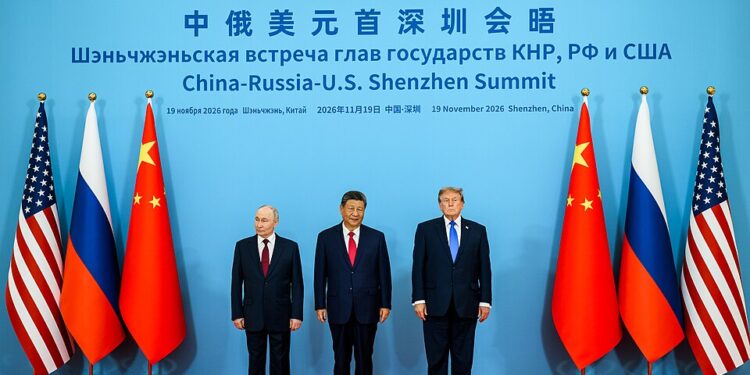
President Donald Trump has announced a significant international agreement following a historic meeting with Russian President Vladimir Putin and Chinese President Xi Jinping, bringing together three of the world’s most powerful leaders for discussions about global security, energy production, and international cooperation.
The unprecedented gathering took place Thursday, November 19, in Shenzhen, China, during the Asia-Pacific Economic Cooperation summit.
Following the meeting, the three leaders released a four-point declaration outlining commitments intended to strengthen international stability, address energy concerns, and reduce the threat of nuclear conflict.
The announcement marks a notable diplomatic development for the Trump administration as the president seeks to advance American interests while negotiating directly with two of Washington’s most influential international competitors.
Trump Unveils Four-Point Agreement With Russia and China
The joint declaration, titled the “U.S.-Russia-China Heads of State Declaration toward Peace,” identifies four major areas of cooperation between the United States, Russia, and China.
The agreement focuses on reforming the United Nations, expanding energy supplies, addressing international legal authority, and reducing nuclear risks.
Each commitment carries potentially significant implications for American foreign policy and the global economy.
The first provision calls for changes to the United Nations to help the organization respond more effectively to international challenges.
As permanent members of the United Nations Security Council, the United States, Russia, and China have considerable influence over international security decisions.
The leaders agreed that reforms should help the organization fulfill its responsibility to promote peace and security.
Energy Agreement Could Impact American Households
One of the most economically significant portions of the announcement involves global petroleum production.
Under the second provision, the United States, Russia, and China announced plans to increase the production and availability of refined petroleum products.
The leaders also emphasized the importance of maintaining stable energy supplies.
For American households, energy costs remain an important financial concern, particularly for retirees, working families, and individuals living on fixed incomes.
Gasoline prices affect transportation expenses, while energy costs can influence the price of groceries, household necessities, and other everyday purchases.
Trump has consistently emphasized domestic energy production and energy independence as important priorities for his administration.
The agreement’s focus on petroleum supplies could complement those objectives by encouraging greater stability in international energy markets.
However, the declaration does not establish specific production targets or guarantee immediate reductions in gasoline prices.
Whether American consumers experience any financial benefits will depend on future production decisions, energy demand, and broader economic conditions.
Trump, Putin, and Xi Address Nuclear Weapons
Another major component of the agreement involves nuclear security.
The three leaders acknowledged the potentially catastrophic consequences of nuclear conflict and committed to continuing discussions about reducing nuclear dangers.
The United States, Russia, and China possess some of the world’s most significant military capabilities, making communication between their governments especially important.
Their declaration emphasizes that nuclear conflict must be avoided and that additional dialogue is necessary to prevent the spread of nuclear weapons.
For Americans concerned about international instability, the commitment represents an important area of potential cooperation.
Maintaining strong national defense capabilities while reducing the possibility of military confrontation has long been a central challenge for American presidents.
Trump has expressed interest in negotiating nuclear security arrangements with other major powers, and Thursday’s declaration creates an opportunity for additional discussions.
Still, the agreement does not establish a binding nuclear arms reduction treaty.
Further negotiations would be necessary before the countries could implement measurable reductions or new verification requirements.
Leaders Challenge International Court Authority
The agreement also addresses the relationship between national governments and international legal institutions.
Trump, Putin, and Xi emphasized the importance of national sovereignty, state consent, and legal protections for government officials.
The declaration specifically raises concerns about the International Criminal Court and similar institutions exercising authority beyond their established jurisdiction.
The issue reflects an ongoing international debate over the balance between national independence and international accountability.
Supporters of stronger national sovereignty argue that international institutions should respect the legal authority of individual countries.
Others maintain that international courts play an important role in addressing serious violations of international law.
The declaration signals that the three governments intend to emphasize limits on international judicial authority, although it does not announce specific changes to existing international legal arrangements.
Historic Summit Comes During International Uncertainty
Thursday’s meeting was particularly significant because it brought together the leaders of three nations with substantial economic, diplomatic, and military influence.
Despite their differences, the United States, Russia, and China share an interest in preventing direct military confrontation and maintaining stability in critical international markets.
However, serious disagreements remain.
Russia’s war in Ukraine, international trade disputes, and competing security interests continue to complicate relations between Washington, Moscow, and Beijing.
The joint declaration did not announce an end to the war in Ukraine or resolve the broader conflicts involving the three countries.
Instead, the summit produced a framework for continued diplomatic engagement in areas where cooperation may be possible.
For the Trump administration, maintaining open communication with rival governments could provide opportunities to address international challenges without abandoning American national security priorities.
What Does Trump’s Announcement Mean for America?
The agreement could eventually influence several issues affecting Americans, including energy security, international stability, and the country’s relationships with major foreign powers.
For households concerned about rising expenses, the emphasis on petroleum supplies could become important if participating governments follow through with measurable production increases.
For Americans worried about global conflict, continued nuclear security discussions could offer opportunities to reduce tensions.
And for those concerned about national sovereignty, the declaration’s provisions regarding international institutions will likely attract additional attention.
Nevertheless, the announcement represents an initial diplomatic commitment rather than a completed transformation of international relations.
The effectiveness of the agreement will ultimately depend on whether the United States, Russia, and China translate their commitments into concrete policies.
A Major Diplomatic Moment for Trump
The historic summit gives President Trump an opportunity to pursue cooperation with two powerful geopolitical rivals on issues that affect global security and economic stability.
While disagreements between the countries remain substantial, the four-point declaration establishes a shared commitment to continued engagement.
The meeting also highlights the complicated balance between protecting American interests and working with competing nations to address common international challenges.
For now, the agreement stands as one of the notable diplomatic announcements emerging from Trump’s participation in the 2026 APEC summit.
Whether the declaration leads to lower energy costs, reduced nuclear risks, or meaningful institutional reforms remains uncertain. But the agreement has established a new framework for discussions between three of the world’s most influential governments.