
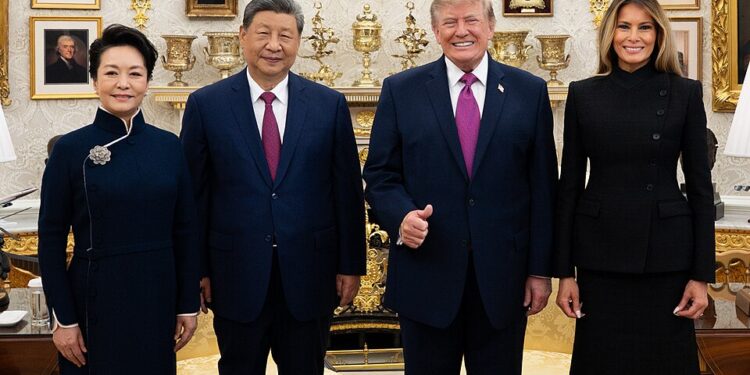
President Donald Trump reportedly made an extraordinary proposal during Chinese President Xi Jinping’s recent visit to the United States, asking whether China would be interested in buying American weapons.
The revelation came from U.S. Ambassador to China David Perdue, who discussed the Trump-Xi meetings during a Sunday television interview.
According to Perdue, Trump pointed out that the United States sells military equipment to countries around the world and asked Xi at one point whether China wanted to purchase American weapons.
The exchange stands out because China is one of America’s most powerful strategic competitors, with Washington and Beijing frequently clashing over Taiwan, military expansion, trade, technology and national security.
Trump’s Question to Xi Draws Attention
Perdue presented the remark as an example of Trump’s deal-making approach to foreign policy.
The president has frequently emphasized American manufacturing and weapons exports as part of his broader economic and national security agenda.
But selling major U.S. defense equipment to China would be far more complicated than selling weapons to traditional American allies and security partners.
The United States maintains extensive restrictions on defense exports involving China, making any actual weapons transaction subject to major legal and national security barriers.
There is also no indication that a weapons agreement with Beijing was reached.
Perdue’s account concerned a question Trump reportedly posed during his conversation with Xi—not an announced U.S. policy change or approved military sale.
Taiwan Remains a Major Issue Between the U.S. and China
The reported conversation came as Perdue defended the Trump administration’s position on Taiwan.
Taiwan has long been one of the most sensitive issues in the relationship between Washington and Beijing.
China claims Taiwan as part of its territory and strongly opposes American military support for the island.
The United States, meanwhile, continues to provide Taiwan with weapons intended to strengthen its ability to defend itself.
Ahead of Xi’s Washington visit, Reuters reported that the Chinese leader was expected to press Trump on U.S. arms sales to Taiwan. The Trump administration has continued approving significant arms packages for Taipei.
Perdue rejected suggestions that Washington had abandoned its support for Taiwan and pointed to the Trump administration’s record of weapons sales to the island.
Could Trump Actually Sell American Weapons to China?
Even if Beijing expressed interest, a major American weapons sale to China would face formidable restrictions.
U.S. export rules tightly control transfers of defense equipment and sensitive military technology to China.
Those restrictions have deep historical roots, including measures adopted following the Chinese government’s 1989 crackdown in Tiananmen Square.
That means Trump’s reported question should not be confused with an approved arms deal.
No such agreement was announced following Xi’s visit.
Instead, the comment appears to illustrate the unconventional negotiating style Trump often brings to meetings with foreign leaders.
China’s Relationship With Iran Also Came Up
China’s relationship with Iran was another significant topic surrounding the Trump-Xi meetings.
American officials have raised concerns about possible Chinese assistance to Tehran during the ongoing conflict involving Iran.
Perdue said Trump made clear to Xi that Chinese assistance to Iran—including intelligence, military equipment or components—would be unacceptable to Washington.
The issue has become increasingly important as the United States tries to prevent other major powers from strengthening Iran’s military capabilities.
China has significant economic ties to Iran and is also one of the world’s biggest energy consumers, giving Beijing a major interest in stability across the Middle East.
Strait of Hormuz Becomes Key Issue
Perdue also discussed China’s position on several major issues connected to Iran.
According to the ambassador, the talks included preventing Iran from obtaining a nuclear weapon and keeping the Strait of Hormuz open.
The Strait of Hormuz is one of the world’s most important energy corridors.
Large quantities of global oil and natural gas move through the narrow waterway, meaning disruptions can quickly affect international energy markets.
For American consumers, prolonged instability in the region can potentially influence gasoline prices, transportation costs and the price of everyday goods.
That makes the issue important far beyond the Middle East.
Trump and Xi Continue High-Stakes Relationship
Despite deep disagreements between their governments, Trump and Xi have continued direct talks on several major issues.
Their latest meetings covered subjects including trade, artificial intelligence, Taiwan and the Iran conflict.
Xi’s three-day visit ended without major publicly announced breakthroughs on several of those disputes, although Trump characterized the meetings positively.
The two nations remain major economic partners while simultaneously competing for influence in technology, military power and global trade.
That complicated relationship makes even an informal conversation about American weapons noteworthy.
What Happens Next?
For now, there is no announced plan for the United States to begin selling weapons to China.
Instead, Perdue’s disclosure provides another example of Trump’s unconventional approach to negotiations with foreign leaders.
The larger questions remain much more consequential.
Washington and Beijing must still navigate disputes involving Taiwan, Iran, trade, artificial intelligence and military competition in the Pacific.
And for Americans watching relations between the world’s two largest economic powers, those issues could have direct consequences for national security, energy costs, manufacturing and the broader U.S. economy.
Trump’s reported weapons question may have captured the headlines, but the outcome of those larger negotiations could ultimately matter far more.